The arrival of affordable, high-performance client SSDs gave us two (closely related) things: 1) a high-speed primary storage option that could work in both a notebook or a desktop, and 2) independence from traditional hard drive form factors.
Unlike traditional hard drives, solid state storage didn't have the same correlation between performance and physical size. The 2.5" form factor was chosen initially because of the rising popularity of notebooks and the fact that desktops could use a 2.5" drive with the aid of a cheap adapter. Since then, many desktop cases now ship with 2.5" drive bays.
It turns out that even the 2.5 wide, 9.5mm tall form factor was a bit overkill for many SSDs. We saw the first examples of this with the arrival of drives from Corsair and Kingston, where the majority of the 2.5" enclosure went unused. Intel and others also launched 1.8" versions of their SSDs with performance levels comparable to their 2.5" counterparts.
Moore's Law ensures that large SSDs can be delivered in small packages. Take the original Intel X25-M for example. The first 80GB and 160GB drives used a 50nm 4GB MLC NAND die (1 or 2 die per package), across twenty packages. Intel's SSD 320, on the other hand, uses 25nm NAND to deliver 300GB or 600GB of storage in the same package configuration. As with all things Moore's Law enables, you can scale in both directions - either increase capacity in a 2.5" form factor, or enable smaller form factors with the same capacity.
The Ultrabook movement has encouraged development of the latter. While Apple and ASUS (among others) have picked custom form factors for their smallest form factor SSDs, there's always a need for standardization. One option is the mSATA form factor:
Take a mini PCIe card, use the same connector, but make it electrically compatible with SATA and you've got mSATA. It's even possible to build an mSATA/mini PCIe connector that can switch between the two interfaces.
We met our first mSATA SSD with Intel's SSD 310, however today Micron is announcing an mSATA version of its popular C400 drive.
Read on for our full review!
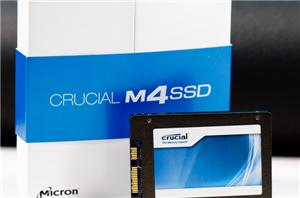
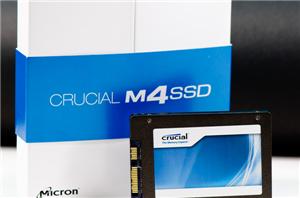
When we first reviewed Crucial's m4 SSD we came away with mixed feelings on the drive. In some cases it was the first or second fastest drive we'd reviewed, while in others it struggled to outperform last year's C300. While Crucial has been diligent in updating the m4 to fix compatibility issues, we haven't seen any of the performance increases Crucial promised at the drive's introduction.
That all changed last week as Crucial posted the latest 0009 firmware for the m4 and Micron C400. Read on for our analysis of the performance update and a quick recap of the m4's role in the marketplace.

Last week I was in Orlando attending CTIA. While enjoying the Florida weather, two SSDs arrived at my office back in NC: Intel's SSD 320, which we just reviewed three days ago and Crucial's m4. Many of you noticed that I had snuck in m4 results in our 320 review but I saved any analysis/conclusions about the drive for its own review.
There are more drives that I've been testing that are missing their own full reviews. Corsair's Performance Series 3 has been in the lab for weeks now, as has Samsung's SSD 470. I'll be talking about both of those in greater detail in an upcoming article as well.
And for those of you asking about my thoughts on the recent OCZ related stuff that has been making the rounds, expect to see all of that addressed in our review of the final Vertex 3. OCZ missed its original March release timeframe for the Vertex 3 in order to fix some last minute bugs with a new firmware revision, so we should be seeing drives hit the market shortly.
Read on for our full review of Crucial's m4!