



The SSD Anthology: Understanding SSDs and New Drives from OCZ
by Anand Lal Shimpi on March 18, 2009 12:00 AM EST- Posted in
- Storage
The Anatomy of an SSD
Let’s meet Mr. N-channel MOSFET again:
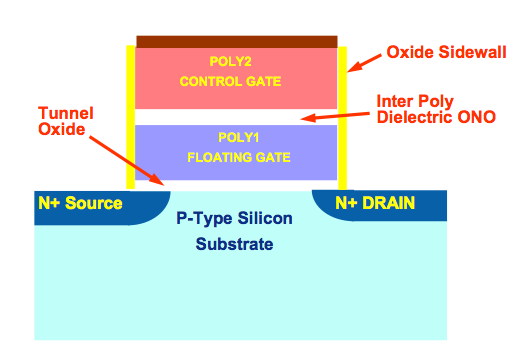
Say Hello
This is the building block of NAND-flash; one transistor is required per cell. A single NAND-flash cell can either store one or two bits of data. If it stores one, then it’s called a Single Level Cell (SLC) flash and if it stores two then it’s a Multi Level Cell (MLC) flash. Both are physically made the same way; in fact there’s nothing that separates MLC from SLC flash, it’s just a matter of how the data is stored in and read from the cell.
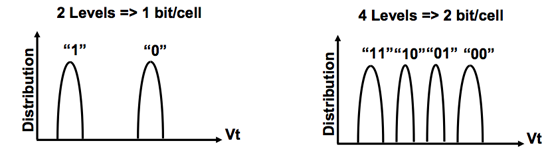
SLC flash (left) vs. MLC flash (right)
Flash is read from and written to in a guess-and-test fashion. You apply a voltage to the cell and check to see how it responds. You keep increasing the voltage until you get a result.
| SLC NAND flash | MLC NAND flash | |
| Random Read | 25 µs | 50 µs |
| Erase | 2ms per block | 2ms per block |
| Programming | 250 µs | 900 µs |
With four voltage levels to check, MLC flash takes around 3x longer to write to as SLC. On the flip side you get twice the capacity at the same cost. Because of this distinction, and the fact that even MLC flash is more than fast enough for a SSD, you’ll only see MLC used for desktop SSDs while SLC is used for enterprise level server SSDs.
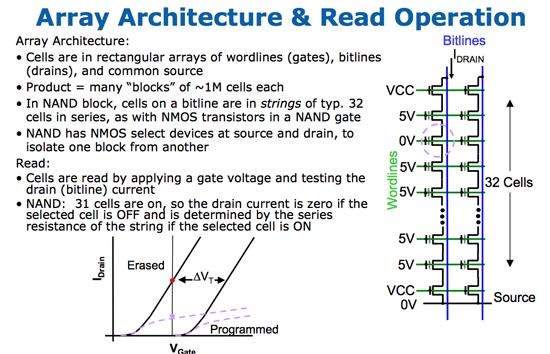
Cells are strung together in arrays as depicted in the image to the right
So a single cell stores either one or two bits of data, but where do we go from there? Groups of cells are organized into pages, the smallest structure that’s readable/writable in a SSD. Today 4KB pages are standard on SSDs.
Pages are grouped together into blocks; today it’s common to have 128 pages in a block (512KB in a block). A block is the smallest structure that can be erased in a NAND-flash device. So while you can read from and write to a page, you can only erase a block (128 pages at a time). This is where many of the SSD’s problems stem from, I’ll repeat this again later because it’s one of the most important parts of understanding SSDs.
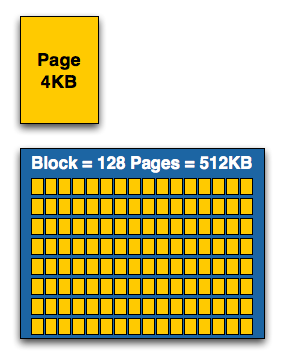
Arrays of cells are grouped into a page, arrays of pages are grouped into blocks
Blocks are then grouped into planes, and you’ll find multiple planes on a single NAND-flash die.
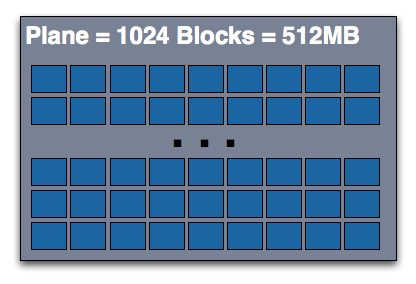
The combining doesn’t stop there; you can usually find either one, two or four die per package. While you’ll see a single NAND-flash IC, there may actually be two or four die in that package. You can also stack multiple ICs on top of each other to minimize board real estate usage.


 Facebook
 Twitter
 RSS
RSS


250 Comments
View All Comments
KadensDad - Tuesday, October 27, 2009 - link
How do these drives fail? I have heard that they will just suddenly die, no more writes or reads possible. What I would like to know is what happens when it dies? Do you lose all data? Just can't write anymore? How does the OS respond? Any early warnings? What about e.g. CRC? How does possibility of data corruption compare to traditional SSD? What about RAID? Since the drives are electrical, not mechanical, this reduces the number of failure vectors and environmental concerns (e.g., ambient temperature over lifetime of the drive). Won't SSDs therefore fail closer together in time in a RAID configuration? This reduces the window of opportunity for fixing an array and also decreases the applicability of RAID, however marginal.adsmith82 - Monday, September 14, 2009 - link
I need to run HDDErase on an X25-M. No matter what bootable CD or flash drive I create, HDDErase does not see either of my SATA hard drives. I already disabled AHCI in BIOS. Also, I am using version 3.3. I know that 4.0 does not work with the X25-M.Can someone help me troubleshoot this please? Thanks.
gallde - Thursday, June 11, 2009 - link
You point out that TRIM will only work on deletions, not on overwrites. But, couldn't a smart controller look at blocks that have a majority of invalid pages and "trim" them as well, recovering clean pages as a background process?forsunny - Thursday, August 13, 2009 - link
Why not just make the SSDs capable of individual page erases instead of blocks? Problem solved.Ron White - Sunday, August 31, 2014 - link
Erasing the NAND transistor in an SSD requires such a large jolt of voltage that it would affect surrounding transistors.lyeoh - Friday, May 29, 2009 - link
Good and informative article.Regarding the shill tshen83 who claims that Anandtech cost the drive manufacturers millions of dollars in sales.
If that is true, Anandtech has saved customers millions of dollars.
Anandtech should care more about their readers losses than drive manufacturer losses. If Anandtech was a site for drive manufacturers and their shills we wouldn't be reading it.
To me, if the SSD drive manufacturers lose money, it's their own fault for building crap that has higher write latencies than old fashioned drives with metal discs spinning at 7200RPM or slower. Not anandtech's.
I can get higher sequential reads and writes by using RAID on old fashioned drives. It is much harder to get lower latency. So Anandtech did the right thing for OCZ.
Lastly, there might be a way of making your windows machine stutter less even with a crap SSD. Note: I haven't tested the actual effect on an SSD because I don't have an SSD.
Basically by default when Windows accesses a file on NTFS, it will WRITE to the directory the time of the access. Yep, it writes when it opens files and directories (which are just special files). That might explain the stuttering people see. For a lot of things, Windows has to open files.
Warning! There are reasons why some people or programs would want to know the last access time of files. Me and my programs don't (and I doubt most people would).
If you are sure that's true for you (or are willing to take the risk) set NtfsDisableLastAccessUpdate=1 as per:
http://technet.microsoft.com/en-us/library/cc75856...">http://technet.microsoft.com/en-us/library/cc75856...
poohbear - Sunday, April 26, 2009 - link
Brilliant article and very informative on these emerging technology. I wont be buying one anytime soon @ their prices, but good to know we'll FINALLY be replacing convential HDD which are the one component that have been pretty much the same since as far back as i can remember"SSDs have +5 armor immunity to random access latency"
rofl that's the best analogy i've seen on a hardware review site. is every comp geek a RPG geek @ heart?
Gootch - Sunday, April 19, 2009 - link
Great article. Realy made me understand what I need to look at before making the plunge. Mistakes and all, my compliments. As for value between the now seemingly drastically improved Vertex vs the X25-M, I compared prices between the two and per Gb, the Intell product for say an 80 Gb drive is Can $5.86/Gb, while the OCZ 60 Gb SSD is Can $6.81/Gb. Now that we are no longer comparing apples and oranges, I think we need to point out that the Intel product is not only faster and maintains it's performance edge better, but it is cheaper per Gb. At least in Canada. I have many OCZ products and I love the company and it's customer support. I can only hope that they will make their SSDs more competitive in the near future, because most consumers will pay the extra 70 bucks and go with the X25 when they pay attention to the numbers, both performance and price.Baffo - Saturday, April 11, 2009 - link
I could forsee a whole host of issues with encrypting SSD drives, not the least of which is essentially making the drive completely "used" outside of the drive slack space - which would be a temporary reprieve for the reasons discussed in this article. However, I could also see potential performance and lifetime issues since modern encryption uses streaming ciphers (e.g. an entire encrypted block - which may or may not conform to the physical block size will be changed for even one bit change within the block itself). Has anyone looked at the resultant effect on performance due to using encryption - it would be good to compare say Bitlocker, PGP, Checkpoint, and an open source encryption solution (Crypt or something like that?). This could actually become a real driver for moving to on-drive encryption where it would have the opportunity to optimize the encrpytion for the pro/cons of the SSD architecture.brandensilva - Friday, April 10, 2009 - link
Great article! I respect that OCZ made the necessary changes to make this drive work. I'd rather take a slightly slower drive if it meant consistent performance.If my hard drive started to stutter I'd flip out! I'm glad that they took the feedback and instead of selling faulty drives, that would ultimately hurt their brand, they decided to go back to the drawing board and iron out the kinks. I'm not expecting them to compare to Intel's 25-M per price or performance. They don't have nearly the cash or manufacturing capacity to compete with Intel but they do have that small business feel with receiving feedback and making improvements, which is important to customers.
Lets hope they continue to utilize that aspect of their business and further improve on their products and bring us some reliable SSD's in the future.