



The SSD Diaries: Crucial's RealSSD C300
by Anand Lal Shimpi on July 13, 2010 12:39 AM ESTFinal Words
In terms of new, out of box performance, the Crucial RealSSD C300 does very well. It performs like a next generation drive and is significantly faster than Intel's X25-M G2 or anything based on an Indilinx controller. The 128GB C300 tends to be slower than the 100GB SandForce drives while the 256GB C300 is about on par and sometimes faster. The 256GB C300 also pulls ahead if you move to a 6Gbps SATA controller.
For Crucial the achilles heel is our old friend: the read-modify-write, a used C300 can potentially lose a good amount of its initial performance. The major disadvantage for SandForce is if you’re writing perfectly random or highly compressed data. Again I’m talking about data that’s random in nature, not random in terms of access pattern. Our heavy downloading workload shows this best where the 256GB C300 remains on top while the 100GB SandForce drive drops to Indilinx-like performance.
The C300 is clearly a drive made for Windows 7. With no TRIM utility, poor 512-byte aligned performance and clear degradation over time with heavy random writes, the C300 is best used with Windows 7 and its native TRIM support. Luckily for Crucial, there are a lot of Windows 7 users out there. Update: Version 2.6.33 of the Linux kernel supports TRIM as well. Presumably the C300 would do just as well under Linux so long as there's TRIM support.
I often get questions from Mac users asking what the best SSD is for OS X. Since Apple still won’t support TRIM you need a very resilient drive under OS X. That path leads you to SandForce. Pick up a Corsair Force, OCZ Vertex 2, G.Skill Phoenix or whatever SF drive tickles your fancy if you want the best of the best in your Mac.
At last year’s IDF a very smart man put this slide up on a projector:
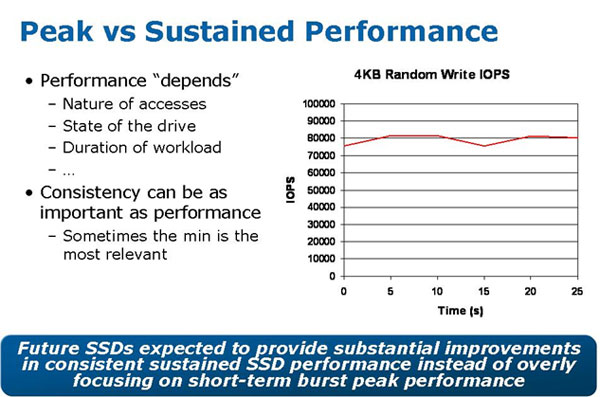
At the time, the best SSDs offered great peak performance but lost a significant percentage of that over time. The aforementioned smart man then went on to say that Intel is currently playing with technologies that would trade peak performance for better overall performance, not to mention more consistent performance.
Ultimately that’s what bothers me about the C300. In terms of pure performance, in many areas, it’s the drive to beat. The 256GB version performs admirably regardless of workload, and even the 128GB drive is pretty fast. But its performance drop over time just isn’t indicative of a next generation controller. I want to see less of a drop from peak to worst case scenario performance. The larger that hit is, the more write amplification is going on. TRIM fixes much of this but it really depends on the workload. I'd say most desktop users should be fine.
It boils down to this. Crucial is a big company. Micron, its parent, is just plain huge. Despite the early hiccups with the drive I do trust their validation and testing. Even the best fall victim to mistakes. Micron works with enough OEMs to know the importance of shipping stable product. I don’t like that Crucial continued to sell C300s while the drives could potentially brick themselves, but the company gets points for being a name you can trust. Particularly if paired with a good 6Gbps controller, the 256GB C300 is fast. As a result, the C300 is a good balance of high performance and reputable brand.
SandForce on the other hand is much smaller. Most of its validation falls on the shoulders of its partners. And there’s also this nasty habit of selling drives with RC instead of MP (mass production) firmware. Things that wouldn’t fly at Crucial/Micron. But the performance ranges from decent to absolutely amazing depending on the workload. And in terms of degradation over time? I’m almost willing to say that SandForce is simply immune to it. Almost.
So who do you pick? The big company with a controller that behaves more traditionally, yet still tops the charts. Or the smaller company, with a controller that acts more like a rockstar.
If you’re running Windows 7, have a 6Gbps controller and want a 256GB drive, go Crucial. If you’re running any other OS, are using RAID or can only afford a 128GB drive, go SandForce.


 Facebook
 Twitter
 RSS
RSS


51 Comments
View All Comments
fgmg2 - Tuesday, July 13, 2010 - link
I know that I could flip back and forth between the various charts to calculate the performance per a watt, but it be great to get a consolidated chart that graphed the drives based upon write (read?) performance per a watt.Additionally analyzing drives purely based upon their write/read performance and/or purely based upon their power consumption seems a bit meaningless. It should be very easy to make a drive consumes almost no power but writes slower than a 3 1/2" floppy. Especially as you see some drives perform more than twice as fast as others.
Just a suggestion.
P.S. It might not be a bad idea to do the same for your other reviews, such as video cards and CPUs.
7Enigma - Tuesday, July 13, 2010 - link
Agreed. In most reviews (video cards for example) performance per watt is somewhat less important as normally you'll be modeling or gaming and the power draw is going to be pretty stable.But for a hard drive, especially when many of these will be notebook replacements, it is very important. I have an Intel G2 80GB and love it, and when I look at the power consumption numbers it looks better than the C300. But I'm not naive to the fact that (when TRIM'd) the C300 crushes the G2 in pretty much every benchmark. What that tells me is that in a real-world result the C300 would use more power but get the job done in a shorter time and since we aren't spinning up a traditional platter, the HD behaves very much like a modern Intel CPU and would go idle.
That hurry up and get idle I think would skew those power consumption charts heavily.
What I would design would be a benchmark that has a set instruction set (write 2GB of random, 2 GB of sequential, read 10GB of data), and then measure the TOTAL power of the drive consumed during that time. Then report that total power number and use it for future reviews (a static number to rank similar to a PCMark or Vantage score)
Ernestds - Tuesday, July 13, 2010 - link
I think the best way to calculate efficiency is measuring the total energy used by the drive doing the "Typical Workload" test. Of course, if Anand could do the same with the "Heavy Downloading Workload" it would be great. IMO there is no need for the "Gaming Workload" though, usually who looks for the power graphs is aiming the improvness(does this word exist?) of a notebook's battery life, and frequently who cares about that, do not game on battery.Just a question to Anand, do you feel difference between two SSDs, say the Nova one and the Crucial?
Keep on the great work!
MrSpadge - Tuesday, July 13, 2010 - link
It's kind of funny to see someone asking for power efficiency for something which is probably the most power efficient thing in the entire PC, especially if you compare it to HDDs. I understand it's interesting and maybe even important for laptops, though.I'd rather be interested in more detailed power draw and/or efficiency analysis in case where the power draw really hurts: GPUs and to a lesser extent CPU. For example: how does the power draw of a GF100 improve under load if you watercool it? Sure, not very relevant for most users.. but the difference should be surprisingly large.
shin0bi272 - Tuesday, July 13, 2010 - link
If you want best overall performance go sandforce. The only real large advantage the crucial drive had was in read performance. sysmark et al were within a few hundred points of one another. So the overall feel of the system will be identical till you either do some heavy read ops or conversely you fill the drive and dont trim it. With the prices being about the same for the 100 vs 128 the better performer is the sandforce drives.Techdad - Tuesday, July 13, 2010 - link
Really? You'd take the performance tricks and the risk of real data that doesn't fit SandFarce's fancy algorithms over the straight honest performance of the Crucial drive? That's odd.I've had my Crucial drive since it came out and it's been great. In spite of Anand's corner-case bashing the first version firmware has been rock solid. Debating even if I want to bother with the firmware upgrade, but I'll probably do it.
bji - Tuesday, July 13, 2010 - link
Relying on TRIM and optimizing for the least stressful case is also a "performance trick", so your implication that Sandforce uses such tricks and Micron does not is wrong. Also your childish pun on the Sandforce name shows alot about where you are coming from.The Sandforce and the Micron drives look to have very similar performance in the vast majority of cases, so shin0bi272 is spot-on. And the increased cost of the Crucial drive would seem to be the deciding factor for me.
But you can't go wrong with either offering it would seem, so pick whichever you like best. As for myself, I would pick Sandforce, only because of my extreme aversion to any chance of degraded drive performance, having been bitten by stuttering of early drives. Not saying that the Crucial drive is anything like a JMicron, but I personally value the resiliency of the Sandforce controller very highly, and would pay some peak performance cost happily for the guarantee of better worst-case performance.
Not everyone will, or should, have the same opinion on this; those less averse to the risks of worst-case performance degredation would be well served by the Crucial drive.
hotlips69 - Tuesday, July 13, 2010 - link
Having read this review, I'm considering buying one of the 100GB "OCZ Vertex 2" drives used in this article, but I'm not sure exactly which is the correct drive model as there seem to be numerous "Vertex 2" drives on the OCZ website!!Is it the Pro Series or EX Series or just the standard Vertex 2 series???
hotlips69 - Tuesday, July 13, 2010 - link
....also, why is it listed as 120GB in the chart on page 1 of the article?Anand Lal Shimpi - Tuesday, July 13, 2010 - link
A standard Vertex 2 120GB drive is all you need. The 100GB capacities will probably be phased out by most SandForce partners over time as there's no tangible performance benefit for desktop workloads.I just used the 100GB data we had in the engine which is why it appears as such in the charts.
Take care,
Anand