



Fermi Goes Mobile: AVADirect's Clevo W880CU with GTX 480M
by Dustin Sklavos on July 7, 2010 11:45 PM ESTMobile Gaming Showdown
So we know that as far as 3DMark is concerned, NVIDIA's GeForce GTX 480M is the fastest mobile GPU available. But how does it fare in actual gaming situations?
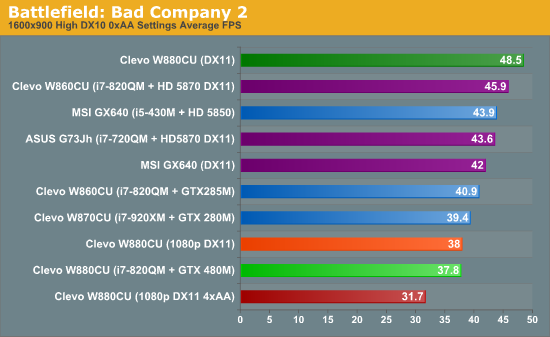
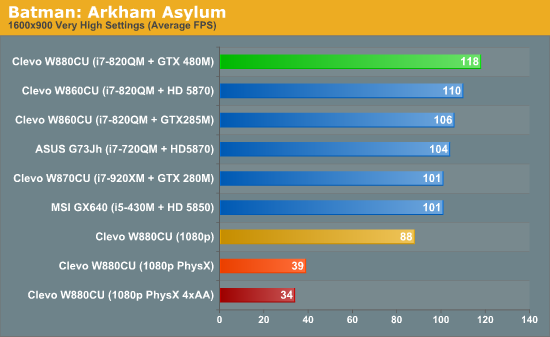
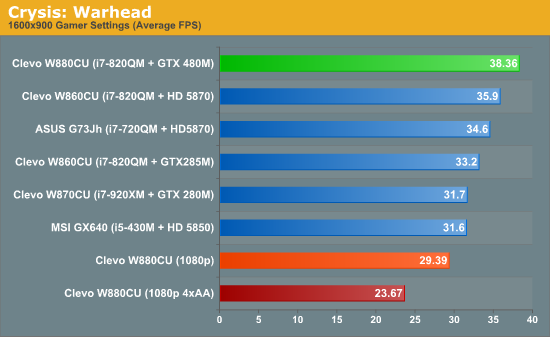
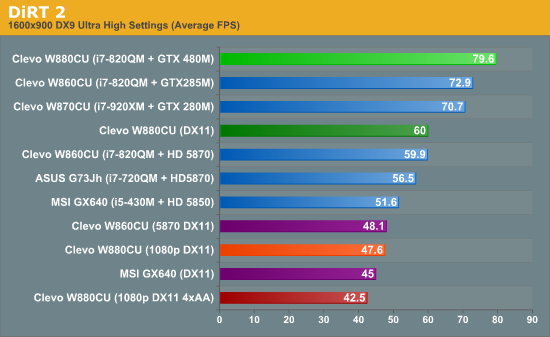
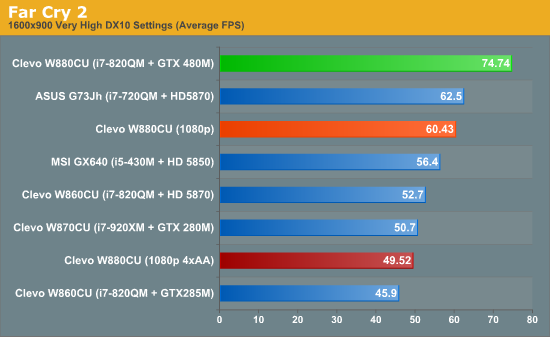
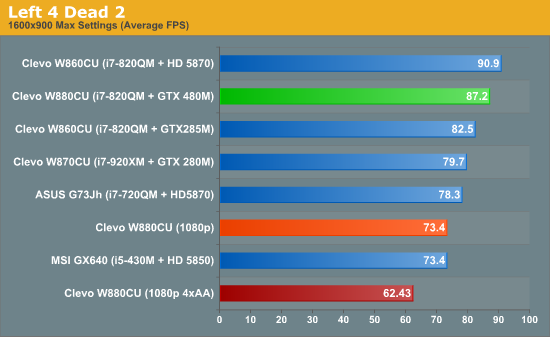
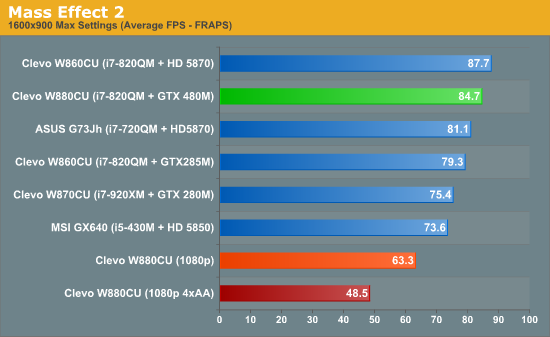
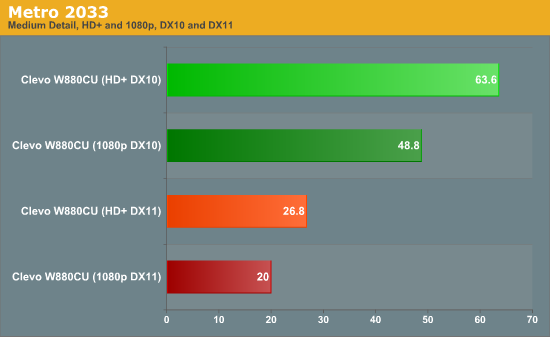
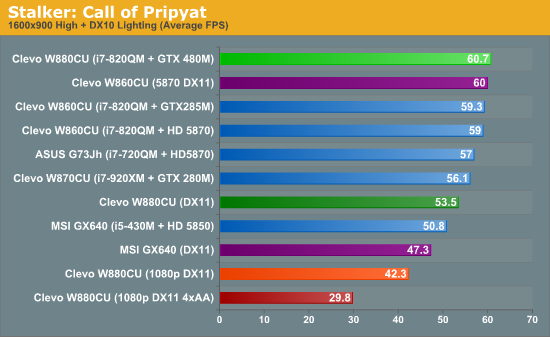
Well, we keep saying it's the fastest mobile GPU available, and that's probably because it's the fastest mobile GPU available. How much faster? That's kind of a problem.
While the 480M takes the lead in most of the games we tested—it downright tears past the competition in Far Cry 2 and DiRT 2—in Mass Effect 2 and Left 4 Dead 2 it was actually unable to best the Mobility Radeon HD 5870. It's only when 4xAA is applied at 1080p that the 480M is able to eke out a win against the 5870 in those titles (we only showed the 4xAA results for the 480M, but you can see the other results in our W860CU review), but the margin of victory is a small one. Of course, Mass Effect 2 doesn't need ultra high frame rates and Left 4 Dead 2 (like all Source engine games) has favored ATI hardware.
Ultimately, that seems to be the pattern here. The wins the 480M produces are oftentimes with the 5870 nipping at its heels; even compared to the 14-in-dog-years GTX 285M it only offers a moderate improvement in gaming performance. What we essentially have are baby steps between top-end GPUs, particularly when we're running DX10 games running at reasonable settings. DX11 titles may be more favorable; DiRT 2 gives the 480M a 25% lead while STALKER is a dead heat; early indication are that Metro 2033 also favors NVIDIA, though we lack 5870 hardware to run those tests. You can see that DX11 mode is punishing in Metro, regardless. Our look at the desktop GTX 480 suggests that NVIDIA has more potent tesselation hardware. Will it ultimately matter, or will game developers target a lower class of hardware to appeal to a wider installation base? We'll have to wait for more DX11 titles to come out before we can say for certain.
NVIDIA provided additional results in their reviewers' guide, which show the 480M leading the 5870 by closer to 30% on average. However, some of those are synthetic tests and often the scores aren't high enough to qualify as playable (i.e. Unigine at High with Normal tesselation scored 23.1 FPS compared to 17.3 on the 5870). Obviously, the benefit of the GTX 480M varies by game and by settings within that game. At a minimum, we feel games need to run at 30FPS to qualify as handling a resolution/setting combination effectively, and in many such situations the 480M only represents a moderate improvement over the previous 285M and the competing 5870. Is it faster? Yes. Is it a revolution? Unless the future DX11 games change things, we'd say no.


 Facebook
 Twitter
 RSS
RSS


46 Comments
View All Comments
my_body_is_ready - Thursday, July 8, 2010 - link
Any news on what ASUS will be doing with this chip? I hear they are refreshing their G series and adding 3D VisionJarredWalton - Thursday, July 8, 2010 - link
If ASUS doesn't someone else will. I suspect we'll see that sort of notebook come fall.drfelip - Thursday, July 8, 2010 - link
IIRC the Asus G73JW is going to sport a GTX 480M, but probably a downclocked one...LtGoonRush - Thursday, July 8, 2010 - link
Given the very tiny lead of the GTX 480M, I'm very much looking forward to the next enthusiast mobile graphics products from AMD. Given that the Mobility 5870 has a 50TDP and is essentially a desktop R5770, they may be able to cram an underclocked desktop R5870 into a 100W TDP like the GTX 480M, maybe call it the Mobility 5970? Ah well, it will be exciting to see what the Mobility 6870 brings to the table, I'm assuming we'll see a Southern Islands-derived mobile GPU lineup.blyndy - Thursday, July 8, 2010 - link
Isn't ATI supposed to release some new mobile parts about now?james.jwb - Thursday, July 8, 2010 - link
Sorry to bring this up here, but the front page carousel is killing the front page performance. I've heard lot's mention this over time, and it's now started happening to me. I think some random update, possibly to Flash or Firefox has caused this for me.Is this problem being acknowledge or ignored? I kinda expect more form a site like this, with this much traffic.
Using Firefox.
JarredWalton - Thursday, July 8, 2010 - link
If you're not at native size (i.e. no magnification), performance is okay. I'm on a quad-core 3.2GHz Kentsfield system, and the main page is fine normally but if I magnify suddenly it's super slow. Like, peg a core of my CPU at 100% for a couple seconds slow. If you were on a slower system, I imagine it would be terrible.FWIW, I believe we're talking about killing the carousel. I thought it sounded like a good idea in the design phase, but in practice I don't like it that much.
tommy2q - Thursday, July 8, 2010 - link
the carousel is a cpu hog and makes the front page harder/slower to browse for information because it takes up way too much space...B3an - Thursday, July 8, 2010 - link
It would be better to keep it, but make it Flash. For any sort of animations Flash runs much better with less CPU usage - if done right.I make stuff like this all the time, you're looking at around 2 - 4% CPU usage with Flash on a average quadcore. Even an Atom CPU would easily cope.
But Anand seems to be a big crApple supporter, so i cant see that happening.
strikeback03 - Thursday, July 8, 2010 - link
I just tried on my work computer (3GHz Q6600) and I get processor usage spiking to about 28% spread across 2-3 cores when the carousel shifts. Using the keyboard buttons to magnify doesn't change the processor usage any.I never look at it though, without any defined beginning and end I find myself having to watch the whole thing to see what might be new, it is far easier to just look at the static listing.