



OCZ's Agility 2 Reviewed: The First SF-1200 with MP Firmware
by Anand Lal Shimpi on April 21, 2010 7:22 PM ESTOCZ's Agility 2 and the SF-1200
Relegating Indilinx to the bottom of the pyramid for now is a bold move for OCZ. Considering how much business OCZ has given Indilinx over the past year I don’t expect that they are very happy over this move.
SandForce’s architecture is on a different level from what we’ve seen from Indilinx. While the Vertex could be viewed as an Intel alternative, OCZ’s Vertex 2 and Agility 2 are designed to offer better-than-Intel performance and as such they actually command a higher dollar-per-GB rate.
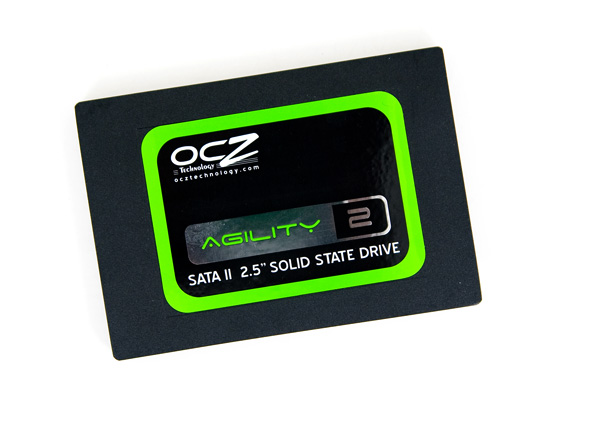
Both the Vertex 2 and Agility 2 are based on SandForce’s SF-1200 controller. I’ve described the differences between this and the SF-1500 in detail here. It boils down to a bunch of enterprise class features missing and lower sustained small file random write speed on the SF-1200 vs. the 1500.
The Vertex 2 retains the small file random write performance of the SF-1500, while the Agility 2 is a standard SF-1200 implementation. According to SandForce, the Agility 2 is representative of how all other SF-1200 based SSDs will perform using the 1200’s current mass production firmware (more on this later).
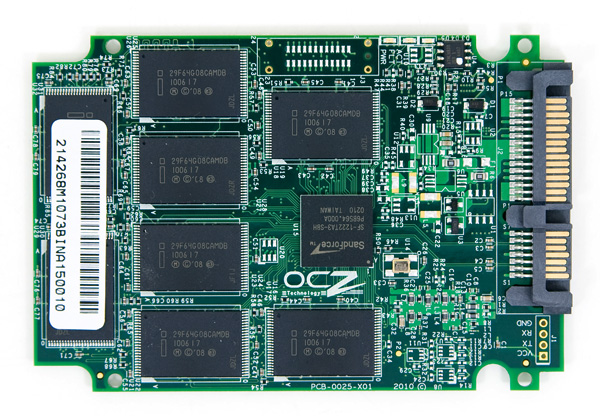
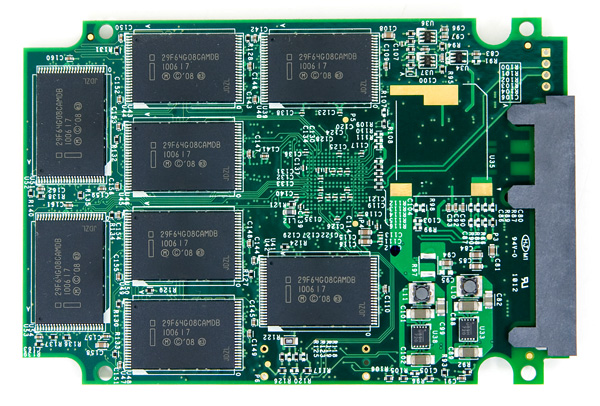
Note the missing super cap, that's a feature of enterprise SF-1500 designs
OCZ sent in their Agility 2 for review, arguably the more interesting of the two since we already have an idea of how the Vertex 2 will perform. Similar to previous Agility drives, the new A2 shaves a small amount off the retail price of the Vertex 2 in exchange for lower performance:
| OCZ SandForce Drive Pricing (MSRP) | |||||
| 50GB | 100GB | 200GB | |||
| OCZ Agility 2 | $204.99 | $379.99 | $719.99 | ||
| OCZ Vertex 2 | $219.99 | $399.99 | $769.99 | ||
The Agility 2 ships with a 2.5" to 3.5" drive sled for use in desktops. If you use this sled the SATA ports won't line up with drive trays in systems like the Mac Pro.
Inside the drive itself we find SandForce’s SF-1200 controller and no external DRAM. SandForce’s architecture attempts to solve the issue of NAND write amplification by simply writing less to the drive through compression/deduplication techniques. With less data to keep track of, a large external DRAM isn’t necessary - assuming the data being written is easily reduced by SandForce’s algorithms.
SandForce also claims that its reduced write amplification could enable the use of cheaper NAND on these drives. It’s an option that some manufacturers may take however OCZ has committed to using the same quality of NAND as it has in the past. The Agility 2 uses 34nm IMFT NAND, presumably similar to what’s used in Intel’s X25-M G2.
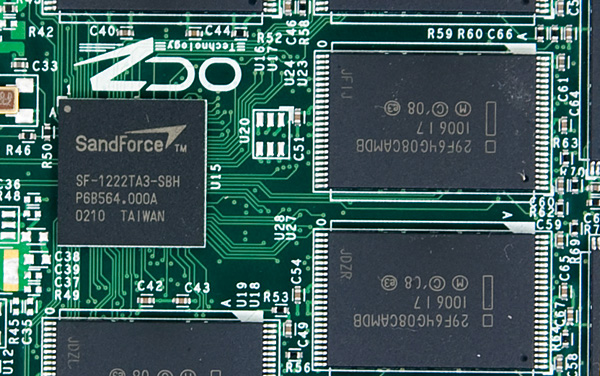
The Agility 2 sample OCZ sent had the first SF-1200 mass production firmware (v3.0.5) from SandForce on it with full TRIM support. The Agility 2 should begin shipping to etailers later this month.


 Facebook
 Twitter
 RSS
RSS


60 Comments
View All Comments
johnlewis - Wednesday, April 21, 2010 - link
Thanks for another great article. I'm patiently waiting for a (decent) 512 GB SSD in my budget so I can just throw everything besides media files on it; 256 GB might work, if I wasn't so damn lazy. Plus, I'd rather have a half full 512 GB drive than a 90+% full 256 GB drive.retnuh - Wednesday, April 21, 2010 - link
90%+ full 256gb, I hear ya. I've been digging over as many SSD reviews as I can in the last couple days. I WANT to replace my 256gb 5400rpm in my notebook, but just can't quite squeeze everything into 200gb.gadgetguy10 - Wednesday, April 21, 2010 - link
I am waiting until the price is at least down to $1 per gigabyte for a decent ssd. I figure I can get by with about 128gb of space.retnuh - Thursday, April 22, 2010 - link
my problem is the ~120gb of development VMs, I can't get rid of them, but since I'm in vmware all day a SSD would be heaven sent for general performance. I'm keeping things pretty slim at ~190gb out of 256gb, but that 200gb mark is just too tight. I'd buy a 300gb agility 2 today if it existed.529th - Wednesday, April 21, 2010 - link
I thought the OWC controllers were discovered to have the SF 1200 controllers?Also, can we get a review on the 50g Vertex LE that are selling at New Egg, Thanks
Anand Lal Shimpi - Wednesday, April 21, 2010 - link
Those numbers are from the older OWC Mercury which used a limited run of SF-1500. The newer drives going forward are SF-1200 based. I'll be phasing them out of our graphs as a result.Take care,
Anand
dmayes - Thursday, April 22, 2010 - link
When are we going to see benchmarks on the new intel driver that's faster than microsoft's driver and it supports trim with raid and we shouldn't go off of just prices MSRP but actual newegg prices and maybe even have a low to high # for example Intel X25-M Mainstream SSDSA2MH160G2R5 ($400 - $489). Also include the 80gb version specially since its around $215 - $225Impulses - Thursday, April 22, 2010 - link
I agree on the prices... Street prices of OCZ's Indillix drives are much lower than that Corsair Nova for instance, since OCZ ALWAYS has $20-30 rebates going on their drives (and they're just cheaper to begin with)... OCZ's Nova equivalent, the Solid 2, is like $300 flat after MIR.Intel's newer SATA drivers don't enable TRIM in RAID, just w/RAID... You can have a SSD w/TRIM support and two HDD in RAID on the same controller with said drivers (something you couldn't do before), but you still can't RAID two SSD and retain TRIM support. AFAIK they didn't dramatically alter performance either but if you've got a link to tests that say otherwise I'd love to see it... I haven't bothered to install them yet.
eaw999 - Thursday, April 22, 2010 - link
but you do have to admit it is strange that imsm 8.9 was used for the testbed instead of irst 9.6. 8.9 doesn't support trim at all! one has to wonder how this might affect (or not) the benchmark scores.dmayes - Thursday, April 22, 2010 - link
"The SandForce SF-1200 controller used in the A-DATA S599 with Intel’s latest RST 9.6 drivers is the fastest 2.5 inch solid state drive for Windows users at this time. This combination is able to outperform every other drive we have tested to date in all around performance." Source tweaktown but they compared it to another 1200 drive instead of using the same ssd with both drivers. This is what intel says "Is there TRIM support for RAID configurations?Intel® Rapid Storage Technology 9.6 supports TRIM in AHCI mode and in RAID mode for drives that are not part of a RAID volume.
A defect was filed to correct the information in the Help file that states that TRIM is supported on RAID volumes."