



Intel's X25-V & Kingston's 30GB SSDNow V Series: Battle of the $125 SSDs
by Anand Lal Shimpi on March 19, 2010 12:00 AM EST- Posted in
- Storage
The story goes like this: Intel let Kingston build a value version of its X25-M G2 drives. This became the 40GB Kingston V Series Boot Drive. When Intel added TRIM support to the G2 drives, Kingston was told to wait. Kingston would get TRIM support when Intel launched its own 40GB version of the G2. Here’s where things get hairy. Intel and Kingston couldn’t work out terms for the TRIM enabled firmware on the V Series Boot Drives. Intel wanted too much money and Kingston wanted to keep the drive price below $100. The outcome? Kingston V Series Boot Drive owners never got official TRIM support and the product was dropped altogether.
This all took place a few months ago. Two things have happened since then. Intel has, as expected, launched its value SSD: the X25-V. This is basically the Kingston drive we reviewed last year, but with official TRIM support. In other words, it’s a X25-M G2 but with only half the channels populated with IMFT NAND. The X25-V is available only in a 40GB capacity (we’ll see an 80GB version based on 25nm NAND in Q4 2010). The drive is priced at $125 and available today. On a side note, Intel’s pricing shows that there wasn’t any room for Kingston to deliver a sub-$100 version of the X25-V.
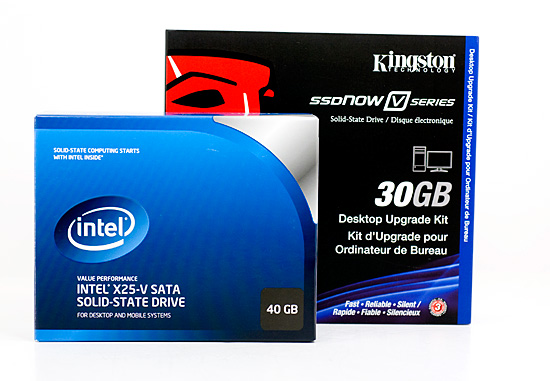
The second thing to happen was that Kingston built another V Series Boot Drive, this time based on a Toshiba controller with 32GB of MLC NAND on board. The price? $124.99 for an upgrade kit. Kingston appears to be going head to head with Intel in the value SSD space. Ballsy. Update: Kingston has pointed out that despite the $124.99 MSRP, Newegg is currently selling the drive for $114.99 with an additional $30 mail in rebate that will drop the total price to $84.99 after rebate.
Meanwhile, OCZ recently announced its Onyx SSD based on a newer low cost Indilinx controller. The target price? Sub-$100. Unfortunately we’ll have to wait a little longer on it as the final firmware is still being ironed out. Instead, today’s comparison takes place exclusively at $125 and is between Intel and Kingston. Former bedmates, the two now have equally compelling entry-level SSD offerings.


 Facebook
 Twitter
 RSS
RSS


78 Comments
View All Comments
jed22281 - Saturday, March 27, 2010 - link
Given it's in a similar size category...Shouldn't the 50GB OWC Mercury Extreme be included in this?
Or is it only allowed to sit in X25-M territory?
Is that the only other competitor for the Mercury Extreme?
If true...
In which scenario/s might one pick the Extreme over the X25-M?
Thank-you!
thllxb - Saturday, March 27, 2010 - link
I actually bought one intel-v 40g and i got the shipment today. The sequential read is very good, 190mb/s with nvidia SATA controller driver and 170mb/s with win7 driver. However, the random read speed is only 22mb/s with both drivers, much lower than the test result 60mb/s. I still need to find out why.jed22281 - Friday, March 26, 2010 - link
Given it's in a similar size category...Shouldn't the 50GB OWC Mercury Extreme be included in this?
Or is it only allowed to sit in X25-M territory?
Is that the only other competitor for the Mercury Extreme?
If true...
In which scenario/s might one pick the Extreme over the X25-M?
Thank-you!
jed22281 - Thursday, March 25, 2010 - link
^^^ anyone? thank-you!jed22281 - Thursday, March 25, 2010 - link
^^^ anyone? thank-you!jed22281 - Wednesday, March 24, 2010 - link
Given it's in a similar size category...Shouldn't the 50GB OWC Mercury Extreme be included in this?
Or is it only allowed to sit in X25-M territory?
Is that the only other competitor for the Mercury Extreme?
If true...
In which scenario/s might one pick the Extreme over the X25-M?
Thank-you!
NandFlashGuy - Sunday, March 21, 2010 - link
Hi Anand,I think it's misleading that you continue using the phrase "IMFT Nand". This gives the impression that all IMFT Nand is equivalent.
IMFT does not sell Nand -- they are the just legal way that Micron and Intel can share the cost of manufacturing Nand together. Each parent company has the ability to define their own litho process or their own test strategies.
This means that the Nand on the X-25 series is "Intel Nand", not IMFT or Micron Nand. Moreover, the Nand on the X-25 series receives much more extensive testing than what is sold to the removable memory market.
chuckbam - Saturday, March 20, 2010 - link
Because of the growth size of the winsxs folder, I think 40GBs are to small for a boot drive.sdsdv10 - Sunday, March 21, 2010 - link
That might be the case for you, but not for everyone. I just upgraded my father-in-law's PC with one of the Intel 40GB SSD and a 250GB regular HD for data storage. Installation of Windows 7 Home Premium left just under 23GB of usable space. Besides IE, the only other thing he needed was Office 2003 (this took less than 350MB total). Still had 22GB of space left. It boots up very quick and opening programs in very fast (nearly instantaneous). A nice improvement over the previous incarnation with XP on a regular 7200rpm HD.JimmiG - Saturday, March 20, 2010 - link
28 or 37GB is definitely too small for me. If you're going to buy a SSD to speed things up, there must be enough space on it to actually install some stuff on it to speed up. If you can only speed up a few percent of your disk operations, it's pretty pointless.60GB would be the minimum for me, preferably 80+ GB. 30GB is barely enough for Win7 itself *or* a couple of games. I'm using 410GB on my "Applications" drive, the one that contains the OS and games and programs I use (almost no user data like movies or pictures).