



The Intel Xeon 5670: Six Improved Cores
by Johan De Gelas on March 16, 2010 3:39 PM EST- Posted in
- IT Computing
Decision Support benchmark: Nieuws.be
| Decision Support benchmark Nieuws.be | |
| Operating System | Windows 2008 Enterprise RTM (64 bit) |
| Software | SQL Server 2008 Enterprise x64 (64 bit) |
| Benchmark software | vApus + real-world "Nieuws.be" Database |
| Database Size | > 100GB |
| Typical error margin | 1-2% |
The Flemish/Dutch Nieuws.be site is one of the newest web 2.0 websites, launched in 2008. It gathers news from many different sources and allows the reader to completely personalize his view on all this news. Needles to say, the Nieuws.be site is sitting of top of a pretty large database, more than 100 GB and growing. This database consists of a few hundred separate tables, which have been carefully optimized by our lab (the Sizing Server Lab).
Nieuws.be was so kind to let us test the MS SQL 2008 database for CPU benchmarking. We used a log taken between 10 and 11 AM, when traffic is at its peak. VAPUS, the stress testing software developed by the Sizing Server Lab, analyzes this log and simulates real users by performing the actions they performed on the website. In this case we used the resulting load on the database for our test. 99% of the load on the database are selects, about 5% of them are stored procedures. Network traffic is 6.5 MB/s average and 14 MB/s at the most. So our 1 gigabit connection has still a lot of headroom. Disk Queue Length (DQL) is at 2 in the first round of tests, but we only report the results of the subsequent rounds where the database is in a steady state. We measured a DQL close to 0 during these tests, so there is no tangible intervention of the harddisks. This test is as real world as it gets! All servers were tested in a dual CPU configuration.
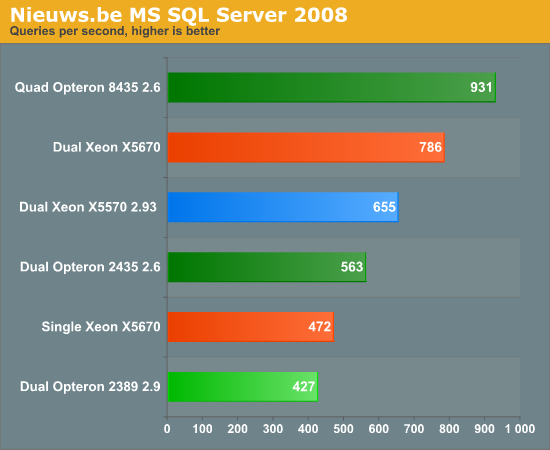
The Dual Xeon X5670 is not scaling so well here, as 50% more cores only result in 20% higher performance. Still, until the newest AMD Opterons arrive, there is not any competition for the six-core Xeon. It outperforms the nearest competitor by 40%.


 Facebook
 Twitter
 RSS
RSS


40 Comments
View All Comments
Wireloop - Saturday, March 27, 2010 - link
After watching vApus' result for both Intel and AMD gear, the natural conclusion drawn is that Hyper-V is more optimized for the Opteron architecture than ESX since the latter achieves a lower Geometric Mean VM rate (on that platform).I guess it has something to do with maneuver of data into the L3 cache which is a critical condition for high multithreaded performance on the AMD platform. If so, my kudos to Microsoft.
mgbell - Friday, March 19, 2010 - link
Hey Anand,I think you should do set up a test pitting the Xeon line against their perspective i7 counterparts and run some workstation type tests. I would be very interested in any testing that had to do with video encoding/rendering. I am a video editor and would love to see a side by side comparison with a xeon sytem of the same speed against a core i7 system. Also just for fun turn off the second processor or turn it on so we can see what kinds of rendering benefits a second processor with 4/6 cores (8/12 threads) would gain.
Thanks
MB
lemonadesoda - Sunday, March 21, 2010 - link
I very much agree. It would be interesting to run a typical "enthusiast" or "workstation" application/benchmark just to see how it compares.I would like to see a Cinebench R10 comparison, a Everest PhotoWorxx, and a Fritz Chess Benchmark. Possibly a video encoding benchmark too.
A lot of enthusiasts run dual Xeons as workstations... you cant predict what software they will be running, but the above 3 tests are good general comparatives.
There are also servers providing other services like OCR or PDF generation. These Oracle database benchmarks are useful, but represent only one type of server/workstation use.
damianrobertjones - Thursday, March 18, 2010 - link
I'm sitting here at the end of and ADSL line with a fresh WIndows XP machine, all updates, new Kaspersky install.While waiting for an app to install I've visited this page....
Bang. Kaspersky popped up with a warning
Trojan downloader.java.agent.aw from www.googleadsenstats.ru/useralexey/files/gsb50.jar/Appletx.class
Do you have something against ie8 as this doesn't happen with Opera?
PLEASE MAKE YOUR SITE SAFE!
itsmeagain - Wednesday, March 17, 2010 - link
Any chance you could throw a couple of these in a mac pro and give us a preview?Shadowmaster625 - Wednesday, March 17, 2010 - link
The E5503 looks like the most reasonable and appealing server processor for those of us that live in the real world. Yet there are no benchmarks...Lukas - Thursday, March 18, 2010 - link
The 550x CPUs are crap. They don't have HyperThreading or TurboBoost. The only reason they exist is for a cheap entry price tag. If you don't need a lot of CPU (e.G. unvirtualized LOB software), better go with a 34xx series Xeon. A lot cheaper than the 55xx series.majortom1981 - Tuesday, March 23, 2010 - link
they also exist for government and public service contracts . We got a z600 with 4 gig ram ,1 5504 xeon, and an 80 gig 10k rpm enterprise sata drive (also nvida gpu) for $700. For just $239 i can add another 5504 .pvdw - Wednesday, March 17, 2010 - link
How come only Windows servers are being used. What about RHEL with a Tomcat or JBOSS bench (surely such exists).Lukas - Thursday, March 18, 2010 - link
Probably because the benchmarkers are not familiar with those platforms? Doing benchmarks on a platform about which you don't know enough will not give you any usable results.