



AMD's 2010 - 2011 Roadmaps: ~1B Transistor Llano APU, Bobcat and Bulldozer
by Anand Lal Shimpi on November 11, 2009 12:50 PM EST- Posted in
- CPUs
Server Roadmap
AMD’s previous CMO, Henri Richard, was a huge Ferrari fan. In turn, AMD became a sponsor of Ferrari’s Formula 1 team and some of AMD’s roadmap developed Italian-inspired codenames.
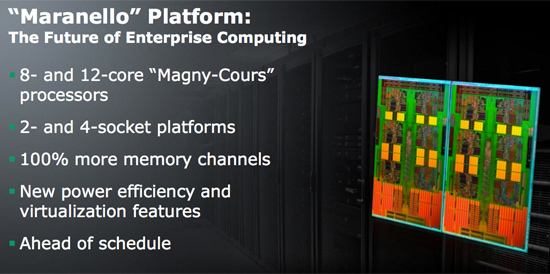
The Maranello platform is AMD’s high end server platform, due out in 2010. It supports the 8 and 12 core Magny Cours processors. These are multi-chip-modules with two quad or hexa core die on a single package.
With twice the die, you get twice the memory controllers. Magny Cours has four DDR3 memory channels. With more memory channels, Magny Cours needs a new, higher pincount socket which AMD is calling Socket G34. The chips will be branded as Opteron 6000 series.
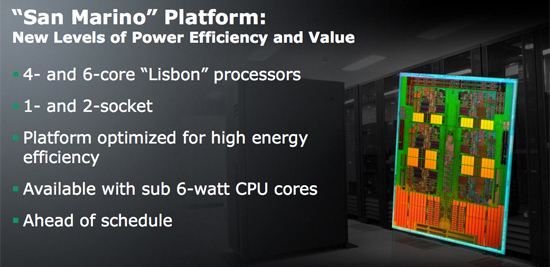
San Marino is the second major server platform of 2010 and it’s for more normal servers. Four and six core Lisbon processors find their homes in San Marino. There’s also a low power Adelaide platform that’ll be available.
These Lisbon processors will be branded as Opteron 4000 series chips and will work in Socket C32.
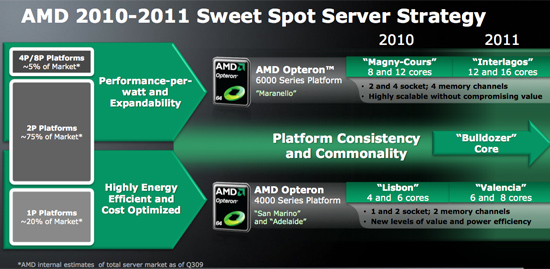
In 2011 we get Interlagos and Valencia platforms, both based on AMD’s next-generation Bulldozer cores. Interlagos is a Socket-G34 platform supporting 12 and 16 core processors, while Valencia is Socket-C32 and can accommodate 6/8 core chips.
Final Words
Unfortunately for AMD, 2010 isn’t really interesting. The company will have to rely on aggressive pricing and the continued success of its graphics teams to carry it for the next 12 - 18 months.
Bulldozer, from what I know, appears to be a bold enough architecture to really challenge Intel if AMD can get it done properly. Bulldozer should arrive between Sandy Bridge and Intel's first 22nm CPUs. It's too early to tell how well Bulldozer's execution is going; AMD absolutely must sample in 2010.
It's disappointing that Llano won't use Bulldozer. With 32nm Phenom II cores, Llano will be roughly one to two architecture generations behind Sandy Bridge. The GPU side should be strong though, it is ATI after all.
AMD’s graphics strategy is much stronger. Bringing an already industry leading GPU architecture on die and then revving it every year is going to completely change the way we look at annual CPU releases. The big question here is what apps are we going to be running on these integrated GPU cores? The market has roughly two years to start finding out.


 Facebook
 Twitter
 RSS
RSS


59 Comments
View All Comments
pullmyfoot - Saturday, November 14, 2009 - link
Finally. Im tired of Intel dominance. I havent seen seomthing really exciting from AMD like this in a long time. All the AMD stuff for the last three years have looked skimpy at best. But they really have a lot of stuff coming out. Not only that but it really looks like its going to be competitive this time. Late or not its better than nothing. Better than what theyve been coming out with for the past few years anyways (like that original Phenom bs). Happy to see that they are catching up pretty fast.Im an AMD fan, but I do admit, its true that AMD is really late. I wouldnt go as far as labling this Intel propaganda....
I wonder what will change now that AMD has an extra $1.25 billion in their pockets. All this would have been in development for a long time and so that cash would have had no effect on it. However perhaps they might take a few more risks now that they have a billion of buffer with possibly more rewarding results.
Zool - Saturday, November 14, 2009 - link
The GPU will be limited by the memory bandwith anyway until they dont come with a on die framebuffer and higher bandwith cpu memory. I think the main advantage will be the + paralel fp compute power if they can take advantage of the openCL or directcompute.Zool - Saturday, November 14, 2009 - link
I also want to note that a combined CPU/GPU code that heawyly depend on each other (for example a complex game engine where AI,physics and colision detection would depend on each other and interact) would run several times faster with merged GPU/CPU (with shared higher level caches and same ram pool) than with a stand alone GPU and a CPU(it would crawl on a stand alone gpu and cpu actualy). With GPU comunicating trough pcie buss and with its own memmory the latencies would kill this kind of tasks. Its actualy one of the reasons why nvidias physX just act as a added layer with minimum game code interaction.The amd-s fusion is actualy a giant leap in this direction (to a real monolithic cpu/gpu). Nvidia doesnt have cpu-s and intel doesnt have a gpu (i doesnt count the GMA series).
There is still one thing thats need to be solved and thats the memory bandwith. With shared memory and the need for the gpu to acts as a real gpu the next generation fusion chips will need ram bandwith
over 100 GB/s (actualy that wouldnt be bad for the cpu part either :)).
duploxxx - Thursday, November 12, 2009 - link
Final WordsUnfortunately for AMD, 2010 isn’t really interesting. The company will have to rely on aggressive pricing and the continued success of its graphics teams to carry it for the next 12 - 18 months.
those are your final words? Indeed there are no new architectures popping-up in 2010 but for the rest I think AMD is really focusing on execution which is very important against mighty INTEL. The laptop refresh is really needed for good competition and what about c32/g34 not important enough, it will close the gab quite a bit on the server platform. Perhaps ask Johan if he doesn´t see this as a big thing happening in the server world, it paves the path to next generation of AMD.
Carleh - Thursday, November 12, 2009 - link
Victoria falls are on the Zambezi river, wondering what a waterfall has to do with microarchitecture, if anything.strikeback03 - Thursday, November 12, 2009 - link
How about Nile, Geneva, Huron, Ontario, Conesus...All other bodies of water of varying levels of importance.
TETRONG - Thursday, November 12, 2009 - link
Funny, I worked at a semicon company here in Calif. There was this crazy engineer who wouldn't shut up about Zambezi. Every spare moment he would be working on it, swearing that AMD was going to want the specs right away. Everyone would scream "Stop working on Zambezi!" Do something useful.This was three years ago. Talk about execution.
grimpr - Thursday, November 12, 2009 - link
Yes, he also forgot to mention that the GPU Core of Llano 1st gen Fusion APU will be leveraged by DirectX11 DirectCompute and OpenCL in constrast to Intels crap IGP GMA successor in Sandy Bridge.A perfect candidate for Laptops and low priced mainstream desktops. Beefy desktops will reside with Bulldozer 8 cores / 16 threads and ATI's next gen 32nm discreet GPU at probably 8 Teraflops on the X2 Parts considering that Hemlock X2 has 5 Teraflops of Floating Point Power.
Take care.
gost80 - Thursday, November 12, 2009 - link
Wait, wait, wait, wait,... 1 billion?Lets do the math...
GPU transistors = 1B - ~750M (Phenom II X4) = ~<300M
That is only a bit more than a 4550 (~250M). So what I am hearing is, the next-gen, not-yet-released, coming-in-2-years, the-bees-knees, 32nm APU chip has a GPU is about as fast as the lowest end 55nm card you can find?
Wow, I am so impressed... NOT!
I guess this one is just IGP replacement for fusion platform. And if my guess is right, should take about 150 mm^2. Making the price around 80-150, depending on competing intel stuff.
Context: I own AMD stock.
qcmadness - Thursday, November 12, 2009 - link
Propus (AthlonII x4): 300M transistor (with 2 x 64-bit DDR-2 / DDR-3 MC)RV730 (320SP HD46x0): 514M transistor (with 128-bit DDR-2 / (G)DDR-3 MC)
But I do agree with your 150mm^2 assumption.
(300M x 0.25 + 700M x 0.125) = ~ 160mm^2