



The Lynnfield Preview: Rumblings of Revenge
by Anand Lal Shimpi on May 29, 2009 1:00 PM EST- Posted in
- CPUs
Making Nehalem Affordable: LGA-1156
Take the Core i7, shave off one memory controller and replace the high bandwidth QPI link with Intel’s slower DMI and you’ve got the makings of a (more) mainstream Nehalem.
Many have been calling this processor the Core i5 although I’m not quite ready to jump on that bandwagon, so I’ll keep referring to it by its socket (LGA-1156) or codename (Lynnfield).
Intel’s QPI is a very fast bus delivering up to 25.6GB/s of bandwidth. The image below shows you how Intel sees it being useful:
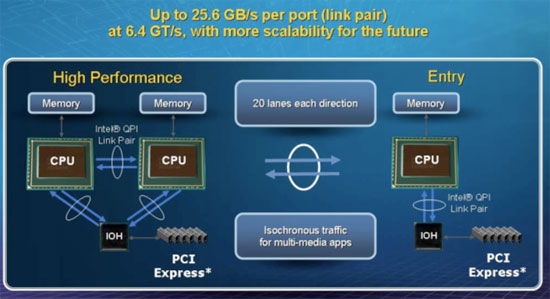
If you’ve got a multi-socket system (e.g. dual processor Xeon workstation, or Skulltrail successor) or if you’ve got a lot of high bandwidth PCIe devices (e.g. multi-GPU or lots of Larrabees) then QPI makes a whole lot of sense. However, if you’ve got a single socket system and aren’t running a lot of high bandwidth PCIe devices then QPI is overkill.
Intel’s DMI is the link used between the X58 chipset and the ICH10 I/O controller, it’s a much more conservative bus capable of delivering 2 - 4GB/s of bandwidth. That’s enough bandwidth for things like SATA and USB but a single PCIe x16 slot can deliver 16GB/s of bandwidth, far too much for Intel’s DMI.
Instead of crippling graphics on its mainstream platform, Intel did the next best thing and integrated 16 PCIe 2.0 lanes onto the die of its mainstream Nehalem part.
What you get looks like this:
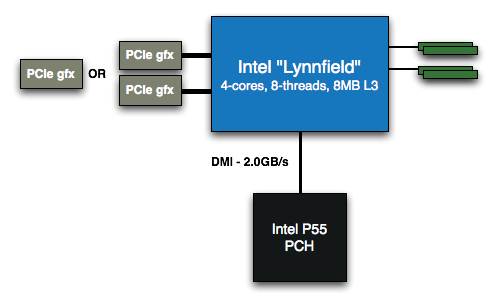
A Lynnfield system only need two chips (CPU + PCH) while a Bloomfield system needs three (CPU + IOH + ICH)
The 16 PCIe 2.0 lanes can be configured as one x16 or two x8, allowing you enough bandwidth and very low latency to do things like CrossFire or SLI. Any additional PCIe lanes will branch off of what Intel is now calling the Platform Controller Hub (PCH). The first PCH is Intel’s P55 chipset; all you need is a Lynnfield CPU and the P55 PCH, no additional ICH is necessary as all of that functionality is embedded in the PCH.
The price of Intel’s P55 PCH is also much lower than the X58 chipset, in fact P55 is expected to be price competitive with P45 + ICH10. In other words, we should eventually see P55 boards priced at $100 or less.
Getting rid of QPI and one of the three DDR3 channels knocked down the pin-count of LGA-1366, but adding in 16 PCIe 2.0 lanes brought it back up to 1156 which you can count in the socket below:
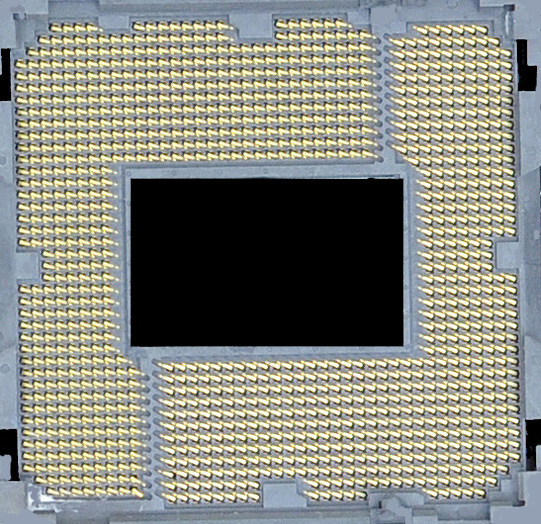
I’ve blacked out the motherboard around it and the caps in the middle to protect the innocent.


 Facebook
 Twitter
 RSS
RSS


95 Comments
View All Comments
fpaat - Tuesday, August 4, 2009 - link
Cheap as*es who keep buying these lower spec broken underclocked BS parts contribute to the decline of PC gaming.There is exactly zero reasons to release so many different chips, except for crap manufacturing.
Buy an i7, be done. i5 = celeron = piss off Intel. ATI and NVIDIA can piss off as well for release 10 different versions of video cards per generation.
fpaat - Tuesday, August 4, 2009 - link
I LoL at people who still buy the "celeron" equivalent of computer parts.It's fine if your a teenager on a budget, but if you're an adult still buying gimp'd parts because you can't afford proper components, well, fail.
grimpr - Thursday, July 16, 2009 - link
Smart users would simply buy a fast SSD disk and a Windows 7 Home premium 64bit pack. Anand may glorify to heavens Lynnfield i5 but there is not a single excuse for dumping perfectly good hardware from 2006 upward for Intels new mainstream platform. Best upgrade would be in 2011 with a brand new platform from AMD, new CPU's from both companys that carry the AVX instruction sets, cheap low latency and fast DDR3-1600 ram as a standard, mature,cheap and fast DX11 cards, PCI-EX 3.0 and many more things.Hrel - Saturday, June 6, 2009 - link
I HATE their stupid price fixing screw the consumer crap. CPU's over 200 dollars are useless, that's simply too much for a CPU. They won't give us dual cores based on nahaylem cause they'd have to charge 190 and less; OH NO! Greedy bastards. I REALLY want AMD to get back on top so prices get driven down again.It's INFINETELY infuriating that the ONLY way that intel charges fair prices is if someone else MAKES them.
Hrel - Saturday, June 6, 2009 - link
Seriously??? E8400 anyone? I REALLY don't care about having 8 threads, like even you said in this article, doesn't really help consumers. I'm far more interested in highly clocked dual cores, and wish Intel would release dual core CPU's based on the new architexture, throw HT onto a solid dual core and I can't see any games in the near future even fully utilize it.I'd MUCH rather see a 4GHz dual core cpu with HT than some more stupid quad cores at sub 3GHZ clock speeds. This is 2009, we need to leave the sub-3GHz range in the history books.HexiumVII - Tuesday, June 2, 2009 - link
Lynnfield looks mighty good. Unfortunetly USB3 and SATA3 are looming. Since they won't be integrated into mobos for a while, high bandwidth on the PCIe slots for add-in cards will be crucial for the transition. I don't know about you buys, but USB3.0 will be the most exciting upgrade we had in a while.MasterShogo - Monday, June 1, 2009 - link
I'm not really sure if this has been talked about at all, but it seems to me that the option for an Nvidia-supplied chipset providing integrated graphics, and it still be good, isn't completely lost.I think you have to ask, why does a person want Nvidia integrated graphics in the first place? I see two reasons. For one, to provide a "business-like" or super-simple PC that has adequate graphics performance for normal stuff and simple games, but with a powerful processor. For this use, Nvidia could just make a chip that uses 8 of the PCIe lanes coming out of the CPU socket and leave the other 8 for the user/vendor to optionally provide a faster video card. Sure, that slot wouldn't have the awesomeness of a 16x PCIe slot, but it would be perfectly fine for this machine. Plus, the added video card could still use hybrid SLI or something similar for power-saving purposes...
Which leads me to the other reason people (like me) might want it. Power savings via hybrid-SLI. I would personally want all 16 lanes coming out of the CPU socket for my SLI setup or just one monster card. But in this case, I think it would be perfectly fine to have a 3rd party P55-like chip provide hybrid-SLI video for power savings. I wouldn't care about the starved DMI link, because I would never expect that video chip to do anything difficult, that's what I have the other video cards for! This is assuming the drivers work well enough to switch over very seamlessly when it needs to happen.
In other words, I think there is still enough input/output throughput for Nvidia to sell chips that use integrated graphics, but it is just going to be more spread over the board now, making their electrical design more difficult. Possibly requiring two different chips to provide for the two different scenarios. I don't see why they couldn't do it, though.
Or even better, make a 3rd party chip that can accept, as an interface, both the DMI and the PCI links coming out of the socket, but only using what is available in the particular board you are manufacturing at the moment. Maybe that would be too expensive, though. Any thoughts on how feasible that may be?
In any case, I don't need the three memory channels. It's not that I don't WANT them, it's that they don't help me at all. It's not like I'm running a major database server in my bedroom or anything. But having a direct PCI connection to the CPU would be cool, and I think this processor is just super-duper for a variety of reasons.
Kreed - Monday, June 1, 2009 - link
In terms of Photoshop CS4 performance, would a 2.8GHz i5 outperform 2.66GHz i7 920?Beno - Sunday, May 31, 2009 - link
if you test the i7 920 with HT off, lynfield will lose number 1 in those gaming benchmarkswhy didnt you bench it without HT?
genkk - Sunday, May 31, 2009 - link
is there any new mobos like the dragon platform to bench, anad is even using an old catalyst driver......... your 65% chipzilla and 35% chimpzilla