



Anand Reviews the Apple iPhone 3G
by Anand Lal Shimpi on July 16, 2008 8:00 PM EST- Posted in
- Smartphones
- Mobile
The iPhone Recap
From a software standpoint, the iPhone 3G is actually no different from last year’s iPhone - they run virtually identical OSes and both ship with the same applications. Once updated to the 2.0 firmware, you can’t tell the difference between using the OS on the iPhone 3G vs. on the original iPhone.
There are some physical changes between the devices, which I’ll get to shortly but I thought I’d go down a quick list of the things that made the original iPhone the phone I stuck with for the past year. If you already know this stuff, feel free to skip ahead:
The Interface
The iPhone interface remains the best combination of simplicity, functionality and speed I have seen in any smartphone. Animations are smooth and fast, and the interface is just plain responsive. Since the physical interface is done mostly via the touchscreen, Apple needed something that responded very naturally, and honestly it’s nearly perfect.
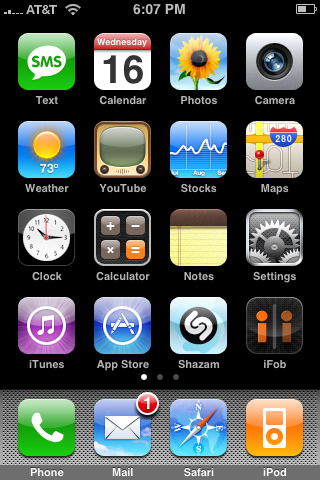
Much like Microsoft did with the advent of its Media Center interface, Apple took a step back and created a new UI that was suited for the task at hand with the iPhone, rather than attempting to adopt a foreign UI to a smartphone. As we’ve seen numerous times in the tech industry, there are limits to how far down you can scale something before it’s better to start from scratch.
The Buttons
The iPhone has four physical buttons on it: home, power, volume and a ringer switch. And that’s all you honestly need. The home button takes you home, the power button will turn your phone on/off, put it to sleep or silence an incoming call depending on how you use it, the volume rocker does what you think it would and the ringer switch lets you turn the ringer on/off.
Of all of the complaints I’ve had about the iPhone over the past year, I’ve never felt the need for more buttons. Apple got it perfect from the start.
The Screen
The iPhone’s screen is a high dpi 480 x 320 screen with a large surface area, measuring 3.5” on the diagonal. It’s a multi-touch display that allows you to use gestures to navigate around. Zooming is done by placing your two fingers together on the screen and pulling them apart or the opposite by pinching them together. Flipping through photos is done by swiping your finger across the screen. You type and dial by tapping virtual keys, and the entire device responds as you would expect it to. This isn’t the sluggish touchscreen you may be used to, it’s the touchscreen from the starship Enterprise, it just works.
An Incredible Web Browser
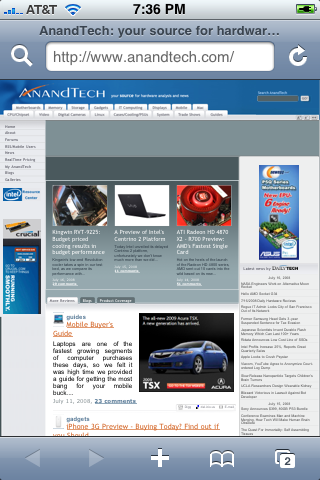
Minus support for Flash (which the iPhone still lacks), Safari for the iPhone is honestly the best web browsing experience you can get on a smartphone. If you’ve seen the videos of it in action, it works just like that. You can actually browse real, non-mobile websites just fine using Safari on the iPhone. Although the arrival of iPhone-optimized websites doesn’t hurt either.
Visual Voicemail
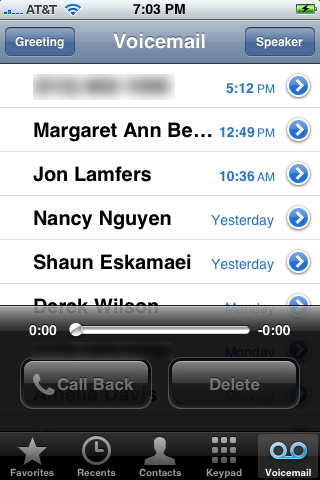
This just plain makes sense. You don’t dial in to hear your voicemail, it gets listed like emails in your Visual Voicemail tab. Listen to them out of order, delete them out of order, it’s one of the simplest but most useful features of the iPhone. It’s voicemail done right.
An Awesome SMS Interface
I was never a big texter until the iPhone. While typing on QWERTY smartphones wasn’t bad, the SMS interface was generally terrible. SMSes should have worked like conversations and in most phone OSes they were sent as individual messages, with no common log of history.
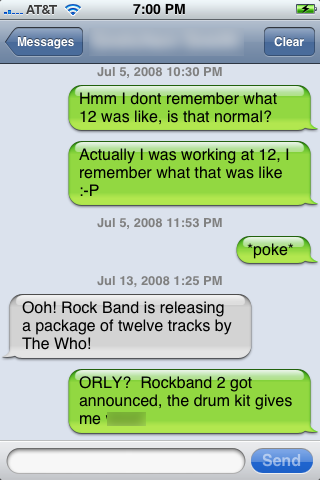
The iPhone changed that for me, the SMS interface was, and you may be noticing a trend here, just done right. Have a look:
It does Email and Plays Music Too
Like the rest of the features, the iPhone’s mail client is very fast and makes checking/responding to emails ridiculously easy - even easier than on my old Blackberry. The interface’s simplicity and quickness are key here. There were limitations for corporate email users with Exchange servers, but many of those issues have since been addressed as you’ll soon see.
Oh and it’s an iPod. Two devices in your pocket just became one.
There’s more to the iPhone but those were the key features from the first round with what many called the JesusPhone. So how is it even remotely possible that there hasn’t been a real iPhone competitor in the year since the original’s release? It would appear that Apple truly caught the incumbent mobile phone manufacturers by surprise with the iPhone.


 Facebook
 Twitter
 RSS
RSS


55 Comments
View All Comments
buckdutter - Friday, August 22, 2008 - link
AT&T's coverage could indeed be better, but then again they are still rebuilding from when they decided to switch from TDMA to GSM, instead of following the natural path to CDMA, which Verizon, Sprint, and Alltel (soon to be Verizon) use, as well as many more localized carriers. The problem with CDMA is that it is going nowhere. The majority of the world is GSM, and CDMA is becoming more and more marginalized, in fact in the next 4 or 5 years CDMA will be practically phased out in the US. Verizon (and Alltel) will be switching to LTE, a GSM based technology which will be a rough transition - either resulting in sacrificed coverage, or more expensive devices (like Verizons expensive "world edition phones") that will run on both their networks. Either way, they will be doing what AT&T (Cingular, whatever) did 4 or 5 years ago, and much later in the game.Meanwhile AT&T will make a natural transition from their 3G, which is in all fairness not nearly as widespread as EVDO at the moment, to LTE. Sprint will be going WiMax. Not one major carrier in the US or abroad has made a commitment to the future of CDMA. Verizon has held on to EVDO as long as it could, and has prolonged having to switch, but they are beginning to hit the limitations of EVDO, meanwhile 3G is just getting started, with AT&T planning to follow suit of carriers abroad and boost the speeds to around 20mbps in mid-2009. EVDO will be topping out around 3.2 at most, if even that.
While having used all the services I strongly disagree with saying that Sprint or T-Mobile even come close to AT&T for coverage, it is largely regional subjective, and is really not fair to work in experiences in one localized area into the review for the phone. Like them or hate them, AT&T recognized early that GSM was the roadmap to go. Like it or hate it, blame Verizon for delaying the inevitable for so long...it makes no sense for Apple to make a CDMA phone when it is so limited in implementation globally. Because of that decision they are the most widespread GSM provider in the US (the US was a little late in getting into the GSM game).
In the end, AT&T may have a lot of ground to cover, but we should be excited what at least one U.S. carrier took the leap and is building out a GSM network in the states, even though it meant making the sacrifice of less coverage in rural areas as they build the new network out. It will be interesting to see how Verizon copes with having to change over.
Hrel - Tuesday, August 12, 2008 - link
Over 2 years the new iphone plane costs an extra 60 bucks, but the upfront cost is 300 dollars less. The iphone 3G is less expensive in every way; even with the incremental increase in contract cost. I'm confused that I need to point this out considering you say it in your article then contradict yourself by saying the old plan and phone was less expensive. Total cost over two years the new one is 240 dollars less.maxnix - Thursday, July 31, 2008 - link
With no user replaceable battery, it is a toy, not a reliable business device.It seems to me that 90% of the users I see are fiddling about on it with their fingers and not even 10% use Bluetooth. Are there still no voice driven commands? That's how I use my phone.
Seems like a great device for someone who wants to make calls on their iPod when they are not listening to a lossy audio source.
Jobs is the new PT Barnum in that he fully exploits the "A sucker's born every minute..." credo. The world is full of lemmings.
maxnix - Thursday, July 31, 2008 - link
Welcome fanboys to AT&T's limited 3G. The rest of the world has been there for 5 years.Lezmaka - Monday, July 21, 2008 - link
I think there's a fairly obvious (to me anyway) reason why the talk time measured is almost half the time the specs state, beyond the best case scenario stuff.In most conversations, there's a significant amount of dead air. Even if it's only 1/10 - 1/4 of a second at a time, over the course of several hours, that will add up. But with most music, there's almost no dead air. Even when the person isn't saying something, there's at least some sound being generated. Detecting that dead air and not transmitting would probably be the best for battery life, but even if it continually transmits, the compression would reduce the amount of data transmitted to almost nothing.
I would guess that choosing an audio source that more closely matches an actual conversation would provide a somewhat more accurate test result. But I'm not expert, so what the hell do I know?
Giacomo - Monday, July 21, 2008 - link
Ehm... No man, there's no way this could influence battery life. No matter how intense is the information in the call, most of the energy drain is due to the "line" itself... Keeping the full-duplex conversation online.Everything else left to the battery is the loudspkeaker consumption... But it's a ridicolous amount, you won't be able to measure its impact.
Giacomo
donhoffman - Tuesday, July 29, 2008 - link
Actually the original commenter on this was correct. This is a time-honored technique for getting more battery life out of cell phones. Channel allocation for voice calls is done at call setup. A continuous data stream is not needed to keep up the "line". If either end of the call has nothing to send, it does not need to transmit, saving significant power. The technique used in this article probably does underestimate the battery life. Not by 100%, but maybe 20-30%. Transmit power is much larger than audio power. That is why you get 24 hours listening to music on the iPod side, but only 5 or so hours doing cellular phone calls.nichomach - Sunday, July 20, 2008 - link
Not wishing to get into whether the new iPhone is all that, I'd note that the enforced PIN code when using Exchange is usually a policy setting defined in Exchange, and there's a choice about enabling it. That choice'll be made by your Exchange admin(s). If they enable it - personally, I do - then I'd expect it to be enforced on any device that claims to support Activesync. One of my arguments with Nokia's Mail for Exchange client, for instance, is that it doesn't (or didn't) properly support policies like that; that the iPhone does makes it a viable choice if I end up with a director demanding one. If you're using your phone in a corporate environment, then you may be sending and receiving confidential stuff. Enforcing a PIN and supporting remote wipe properly is the sine qua non as far as I'm concerned.Schugy - Sunday, July 20, 2008 - link
Openmoko will have the best 3rd party support while Nokia and Google (Maemo / Android) have their own ressources. But regarding their openness they are evil. The FIC Freerunner is a nice phone but the Openmoko project still has to develop a lot.On the other hand I think that a Open Pandora handheld with a USB HSDPA modem (maybe builtin in future revisions) is a lot more usable and even has game controls. Telephony and navigation could be done via a bt headset+voip and gps receiver.
All the platforms will feature ports of killer apps like pidgin IM, scummvm, evolution e-mail and lots more. Ports of gnash, the GNU flash player, are possible too but I would suggest to get rid of these stupid and annoying banner ad players. A nice stream or download link for mp4-files will make your full featured (fullscreen / post processing filters) mplayer happy.
cleviticus - Saturday, July 19, 2008 - link
A basic one-line plan with Cingular (I know they go by AT&T now)without ANY extra features runs you $45/month and that is with just enough minutes to tell people that you'll call them back after nine. Unlimited internet and data runs $45, last I checked, and that somehow doesn't cover much texting, something I do a lot of. Texting is another $10. So to get service and data BEFORE tax you spend $90. My provider offers unlimited voice/data/text/GPS/e-mail for $100 with coverage that exceeds AT&T's.That fact alone is enough to keep me away from the iphone for good. I admit that the interface is unbeatable but the functionality of the phone is not. That being said I don't think it deserves as much attention as it receives. Also coverage varies drastically from city to city. In NY my phone works great but in Vegas it blows. In Chicago I'm golden but anywhere between Arkansas and Virginia- forget about it. I used cingular for two years and their coverage was only good in large metropolitan areas. As soon as I got out of the inner city my reception was weak and I couldn't even text. I think they are a horrible company but since they bought up most of the old bell empire- they're here to stay.