



NVIDIA's 1.4 Billion Transistor GPU: GT200 Arrives as the GeForce GTX 280 & 260
by Anand Lal Shimpi & Derek Wilson on June 16, 2008 9:00 AM EST- Posted in
- GPUs
Overclocked and 4GB of GDDR3 per Card: Tesla 10P
Now let's say that you want to get some real work done with NVIDIA's GT200 GPU but that 1.4 billion transistor chip just isn't enough. NVIDIA does have an answer for you, in the form of an overclocked GT200 with the 240 SPs running at 1.5GHz (up from 1.3GHz in the GTX 280) and with a full 4GB of GDDR3 memory on-board.
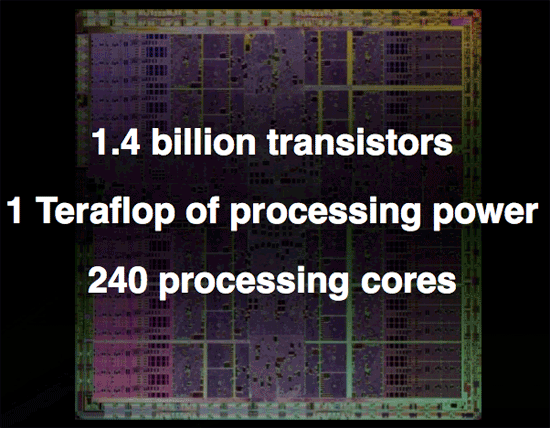
Today NVIDIA is also announcing their next generation Tesla product based on GT200 (called a T10P when used on Tesla for some reason). The workstation graphics guys will have to wait a while for a GT200 Quadro unfortunately. This new Tesla is similar to the older model in that it has much more RAM and no IO ports. The server version is also clocked higher than the desktop part because fan noise isn't an issue and data centers have lower ambient temperatures than some corner of an office under a desk.
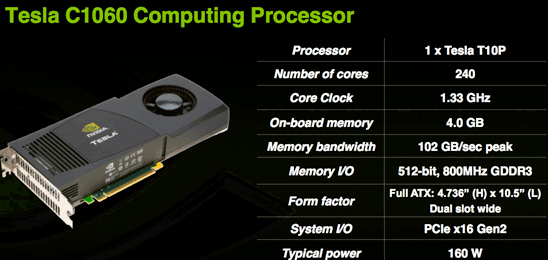
The Tesla C1060 has an entire 4GB of RAM on board. This is obviously very large and will do well to accomodate the large scale scientific computing apps it is targeted at. This card is designed for use in workstations and is the little brother to the new monster server that is also being announced today.
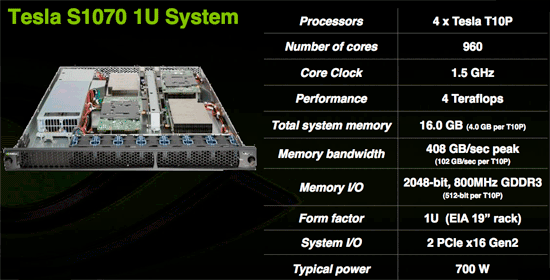
The Tesla S1070 is a 1U server containing essentially 4 C1060 cards for a total of 16GBs of RAM on 960 SPs. This server, like the older version, connects to a server via a PCIe cable and is designed to run code written for CUDA at incredible speeds. With 120 double precision IEEE 754r floating point units in combination with the 960 single precision IEEE 754 units, this server is a viable option for many more projects than the previous Tesla hardware which was only capable of single precision floating point.
Though we don't have an application to benchmark the double precision floating point hardware on GT200 yet, NVIDIA states that a GT200 can roughly match an 8 core Xeon system in DP performance. This would put the S1070 on par with a 32 way Xeon setup at less than 700W. Needless to say, single precision code runs much much faster and can outpace hundreds of traditional CPUs in parallel.
While these servers are expensive (though we don't have pricing), they are cheap compared to the alternatives currently out there. The fact that CUDA code can be implemented and tested on any of the 70 million NVIDIA G80+ GPUs currently in people's hands means that developer already have a platform to test and debug code on before committing to the Tesla solution. On top of that, schools are beginning to adopt CUDA as a teaching tool for parallel computing. As CUDA gains acceptance and the benefits of GPU computing are realized, more and more major markets will take interest.
The graphics card is no longer a toy. The combination of CUDA's academic acceptance as a teaching tool and the availability of 64-bit floating point in GT200 make GPUs a mission critical computing tool that will act as a truly disruptive technology. Not only will many major markets that depend on high performance floating-point processing realize this, but every consumer with an NVIDIA graphics card will be able to take advantage of hundreds of gigaflops of performance from CUDA based consumer applications.
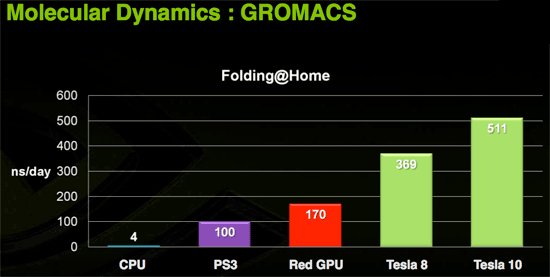
Today we have folding@home and soon we'll have Elemental's transcoder. Imagine the audio and video processing capabilities of a PC if the GPU were actively used in software like ProTools and Premier. Open source programs could easily best the processing capabilities of many solutions with dedicated hardware for these types of applications.
Of course, the major limiter to the adoption of this technology is that it is vendor specific. If NVIDIA put the time in (or enlisted help) to make CUDA an ANSI or ISO standard extention to a programming language, we would could really start to get excited. Beyond that, the holy grail would be a unification of virtualized instruction sets creating a standard low level "assembly" interface for GPU computing allowing CUDA to compile to one target and run on any graphics card. Sort of an x86 for massively parallel work.
Right now CUDA compiles to PTX, NVIDIA's virtual instruction set, and there is no reason someone couldn't write a CUDA compiler to target AMD's equivalent CAL (or even to develop a PTX to CAL wrapper that allowed AMD GPUs to run compiled CUDA code). Unfortunately, NVIDIA doesn't want to invest money and resources in extending functionality to AMD and AMD doesn't want to invest money and resources into bolstering an NVIDIA owned technology (that could theoretically radically change to cripple AMD's hardware support in future versions). While standards and cooperation are a great idea, the competition in this market is such that neither NVIDIA nor AMD are looking to take a chance on benefiting the consumer if there is any risk of strenthening the competition (even in spite of weakening the industry).


 Facebook
 Twitter
 RSS
RSS


108 Comments
View All Comments
elchanan - Monday, June 30, 2008 - link
VERY eye-opening discussion on TMT. Thank you for it.I've been trying to understand how GPUs can be competitive for scientific applications which require lots of inter-process communication, and "local" memory, and this appears to be an elegant solution for both.
I can identify the weak points of it being hard to program for, as well as requiring many parallel threads to make it practical.
But are there other weak points?
Is there some memory-usage profile, or inter-process data bandwidth, where the trick doesn't work?
Perhaps some other algorithm characteristic which GPUs can't address well?
Think - Friday, June 20, 2008 - link
This card is a junk bond when taking into consideration cost/perfomance/power consumption.Reminds me of a 1976 Cadillac with a 7.7litre v8 with only 210 horsepower/3600 rpm.
It's a PIG.
Margalus - Tuesday, June 24, 2008 - link
this shows how many people don't run a dual monitor setup. I would snatch up one of these 260/280's over the gx2's anyday, gladly!!The performance may not be quite as good as an sli setup, but it will be much better than a single card which is what a lot of us are stuck with since you CANNOT run a dual monitor setup with sli!!!!!!!!!!!!!!!!!!!!!!!!!!!!!!!!!!!!!!!!!!!!!!!!!!!!!!!!
iamgud - Wednesday, June 18, 2008 - link
"I can has vertex data"LOL
These look fine, but need to be moved to 55nm. By the time I save up for one they will .
calyth - Tuesday, June 17, 2008 - link
Well what the heck are they doing with 1.4B transistors, which is becoming the largest die that TMSC has been producing so far?The larger the core, the more likely that an blemish would take out the core. As far as I know, didn't Phenom (4 cores on die) suffered low-yield problems?
gochichi - Tuesday, June 17, 2008 - link
You know, when you consider the price and you look at the benchmarks, you start looking for features and NVIDIA just doesn't have the features going on at all.COD4 -- Ran perfect at 1920x1200 with last gen stuff (the HD3870 and 8800GT(S))so now the benchmarks have to be for outrageous resolutions that a handful of monitors can handle (and those customers already bought SLI or XFIRE, or GTX2 etc.)
Crysis is a pig of a game, but it's not that great (it is a good technical preview though, I admit), and I don't think even these new cards really satisfy this system hog... so maybe this is a win, but I doubt too many people care... if you had an 8800GT or whatever, you're already played this game "well enough" on medium settings and are plenty tired of it. Though we'll surely fire it up in the future once our video cards "happen to be able to run it on high" very few people are going to go out of their way $500+ for this silly title.
In any case, then you look at ATI, and they have the HDMI audio, the DX 10.1 support and all they have to do at this point is A) Get a good price out the door, B) Make a good profit (make them cheap, which these NVIDIA are expensive to make, no doubt) and C) handily beat the 8800GTS and many of us are going to be sold.
These cards are what I would call a next gen preview. Some overheated prototypes of things to come. I doubt AMD will be as fast, and in fact I hope they aren't just as long as they keep the power consumption in check, the price, and the value (HDMI, DX10.1, etc).
Today's release reminded me that NVIDIA is the underdog, they are the company that released the FX series (desperate technology, like these are). ATI has been around well before 3DFX made 3d-accelerators. They were down for a bit, and we all said it was over for ATI but this desperate release from NVIDIA makes me think that ATI is going to be quite tought to beat.
Brazofuerte - Tuesday, June 17, 2008 - link
Can I go somewhere to find the exact settings used for these benchmarks? I appreciate the tech side of the write up but when it comes to determining whether I want one of these for my gaming machine (I ordered mine at midnight), I find HardOCP's numbers much more useful.woofermazing - Tuesday, June 17, 2008 - link
AMD/ATI isn't going to abandon the high end like your article implies. Their plan is to make a really good mid range chip, and ductape to cores together ala the X2's. Nvidia goes from the high-end down, ATI from the mid-end up. From the look of it, ATI might have the right idea, atleast this time around. I seriously doubt we'll see a two core version of this monster anytime soon.DerekWilson - Tuesday, June 17, 2008 - link
they are abandoning the high end single GPU ...we did state that they are planning on competing in the high end space with multiGPU cards, but that there are drawbacks to that.
we'll certainly have another article coming out sometime soon that looks a little more closely at AMD's strategy.
KeypoX - Tuesday, June 17, 2008 - link
i dont like it, not impressed either :(. Hopefully my 8800gt last for a while, far past this crap atleast