



Intel Core 2 Duo E6750 Preview: The Desktop Gets a 1333MHz FSB
by Anand Lal Shimpi on June 25, 2007 2:57 AM EST- Posted in
- CPUs
Tell it To Me Straight Anand: Is it Any faster?
The beauty of these FSB launches at equivalent clock speeds is that we show you a single chart that summarizes the performance impact of the faster FSB across our entire bench suite. At one single glance you can figure out whether or not there's anything worth getting excited about:
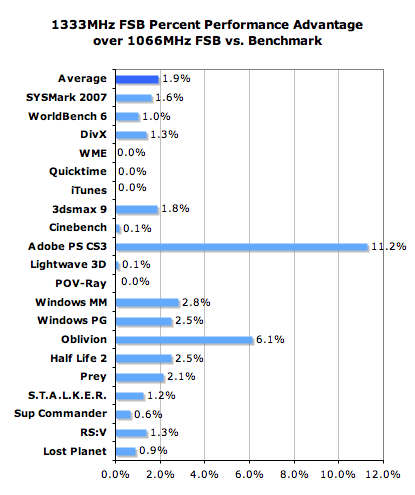
Overall, the 1333MHz FSB doesn't do much for dual core processors. Over the 20 benchmarks we sampled for this chart, the 1333MHz FSB gave us an average improvement of 1.9% over the 1066MHz FSB. There are two unique outliers in the chart: Oblivion with a 6.1% improvement and Photoshop CS3 with an 11.2% increase in performance. Both of these benchmarks are hand timed so the variance between runs is greater than normal, and we suspect that may be the reason for some of the larger than normal impact of the faster FSB but after multiple subsequent runs we were left with the same results.
Keep in mind the fundamental rules of FSB performance: clock speed, number of cores, memory bandwidth and microprocessor architecture all play important roles in the impact of a faster FSB. The clock speeds Intel is launching its 1333MHz FSB processors are basically the same ones that Intel first introduced the Core 2 at; we weren't FSB bottlenecked back then, thus there's no reason to expect a huge increase in performance by bumping the FSB today. Quad-core CPUs may see a performance boost, but we'll have to wait until later to find out exactly what that improvement would be; we have a feeling that the overall performance impact will be similarly unimpressive given the relatively limited number of desktop applications that can take full advantage of four cores.
As Intel ramps up clock speed and continues its transition to quad-core the 1333MHz FSB will be more important, but today it's by no means a necessary feature. There's a bigger performance impact from having more L2 cache (e.g. 4MB vs. 2MB) than from the 1333MHz FSB, which is great news for present day Core 2 owners.
Under load, the faster FSB also doesn't increase power consumption much at all:
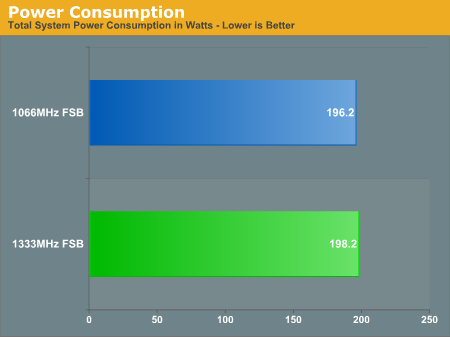
An increase of 2W isn't much for a desktop platform, although Intel could arguably implement a variable speed FSB from its latest Centrino platform if power consumption ever becomes an issue.


 Facebook
 Twitter
 RSS
RSS


42 Comments
View All Comments
mbf - Monday, July 23, 2007 - link
I've been wondering how older motherboards will work with the new FSB1333 processors. Specifically I'm interested how an ASUS P5W DH Deluxe without the latest BIOS would react to having e.g. an E6750 dropped in. ASUS claims support for FSB1333 processors for the P5W DH Deluxe as of 2205 beta.Would the system boot and run using a pre-2205 BIOS (although not at peak performance), so a BIOS upgrade can be performed? Or would the system fail to boot at all, like when the first Core 2 Duo processors surfaced and needed a BIOS upgrade to run at all on certain boards.
The reason I ask this is that I've my eyes set specifically on that board (I have several reasons, ECC memory support being one of them). I had originally planned on getting an E6600 after the July 22 price cuts, but right now there's nearly no FSB1066 processor to be had locally. Also, I'd of course love to have a access to the latest processors in any case.
myrubbish - Tuesday, July 17, 2007 - link
which one is original ?http://www.hardspell.com/english/doc/showcont.asp?...">http://www.hardspell.com/english/doc/showcont.asp?...
kobymu - Tuesday, June 26, 2007 - link
If at all possible, I would like to see the impact ofA) 1333MHz FSB with DDR2
B) DDR3 bandwidth
C) both 1333MHz FSB with DDR3
on quadcore in multiprocessing scenarios, preferably the non synthetic ones.
myrubbish - Tuesday, July 17, 2007 - link
which one is original ?http://www.hardspell.com/english/doc/showcont.asp?...">http://www.hardspell.com/english/doc/showcont.asp?...
AnnonymousCoward - Monday, June 25, 2007 - link
I noticed that last picture shows 1.088V, and my E6600 is rated at 1.325V (and measures 1.328-1.344V). Did Intel lower the voltage for this new series? This wasn't addressed.457R4LDR34DKN07 - Monday, June 25, 2007 - link
Y should I pick 1 of these up when a 2.66 GHz quad core will be avalable at $266 dollars. much better perfomance even at 1066 FSB and thats before overclock.Chunga29 - Monday, June 25, 2007 - link
I see both listed, with the same price and same features. What exactly then is the purposed between having two model numbers? Does one of them not have virtualization? Even if that's the case, why bother? I mean, are there times when virtualization (even if disabled) would be a bad thing? Or maybe it's just a mistake in the table and I'm reading too much into it?Anand Lal Shimpi - Monday, June 25, 2007 - link
The E6550 has Intel Trusted eXecution Technology (TXT), while the E6540 does not. The model numbers would be far too easy to understand without curveballs like that :)Take care,
Anand
SunAngel - Monday, June 25, 2007 - link
I like the artice and understand it is just based on dual cores. However, I believe that everyone, including myself, really would like to know which will be faster for encoding jobs the 2.4 quad-core 1066FSB or the 3.0 dual-core 1333FSB? Since encoding is big business now, it is no secret that raw power is everyones wish. So, the sooner you can get me this benchmark, the sooner I can get back to clicking on advertisements.Anand Lal Shimpi - Monday, June 25, 2007 - link
It's a very valid and important request, but I do believe it's one we've already answered :) If you look back to our article on the Core 2 Extreme QX6800, I tested a Core 2 Quad Q6600 (2.4GHz/1066/quadcore) and a Core 2 Extreme X6800 (2.93GHz/1066/dualcore). While the X6800 not quite the E6850 (3.0GHz/1333), it's close in performance so you should be able to get an idea of the performance comparison:http://www.anandtech.com/cpuchipsets/intel/showdoc...">
To save you the trouble of looking, the Core 2 Quad Q6600 is a better buy strictly for encoding if you're doing DivX/WME encoding. Our Windows Movie Maker and Quicktime tests show the Q6600 falling behind the X6800, but for DivX encoding and heavy WME work (and potentially H.264 encoding on other software platforms) you'll be better off with the Q6600.
I hope this helps :)
Take care,
Anand