



The Era of Tera: Intel Reveals more about 80-core CPU
by Anand Lal Shimpi on February 11, 2007 5:44 PM EST- Posted in
- CPUs
Final Words
As Cell-like as Intel's Teraflop Research Chip may be, it's never going to be a product. In fact, there's no rhyme or reason to choosing 80 cores as the magic number, it was simply the number of cores Intel was able to cram into the design given the target die size. At the same time, the teraflop chip isn't here to set any performance records either, its sole purpose is as a test vehicle for its tiled network approach, power management with many cores, 3D stacked memory, and as a whole for the future of multi-core processors.
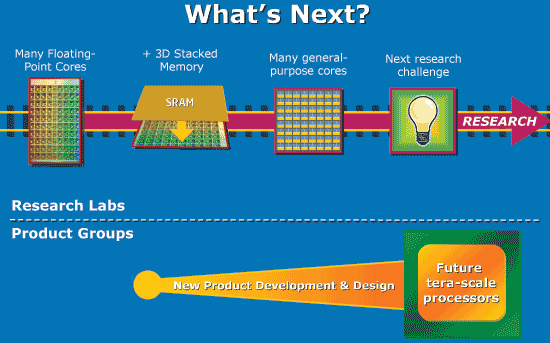
Intel stated that the two next steps for this research chip are to introduce a 3D stacked die, which we're suspecting Intel has already made significant progress on, and to introduce some more capable cores.
Intel's goal with this chip isn't to build a FP monster, but rather a fast general purpose chip. Chances are that what this chip evolves into won't be an array of 80 general purpose processors, but maybe an 8 or 16 core chip complete with x86 cores, specialized hardware, and 3D stacked memory.
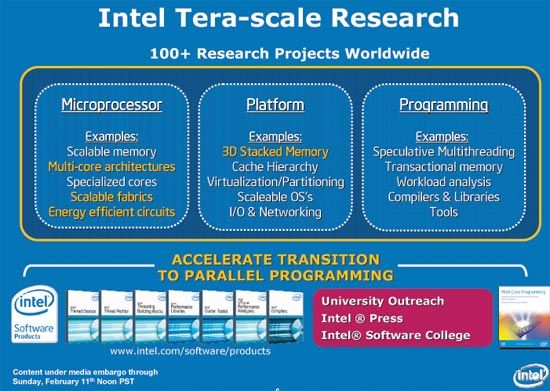
What's the time to fruition for these technologies? Intel estimates 5 - 10 years before we see the tangible benefits of this research in products. By the end of the decade we can expect quad-core to be mainstream on the desktop, so by 2015 you can expect that many of these many-core problems we recapped here today will be a reality. Intel's Tera-scale research that we've seen today will hopefully mitigate those problems, leading to a much smoother transition to the era of tera.


 Facebook
 Twitter
 RSS
RSS


25 Comments
View All Comments
F1N3ST - Monday, February 19, 2007 - link
800 cores for 10 TFlops I say.jiulemoigt - Wednesday, February 14, 2007 - link
maybe 80 un-synced in-order chips is pointless but that stack as a mem controller80 socketed un-synced in-order chips is pointless, since most of the functionally comes from branch logic and out-of-order operations, and not syncing them together means that you could not pass data through them only to them, and even then, issues with passing data would be a mess.
Yet that stack sitting underneath a modern cpu, especially if it could be used as a modern memory stack, with cache speed data access to four cores, that would speed many corp customers could use. Though the memory controller on the chip in the center to control the data flow treat the system memory as virtual extension of it, just like modern hard drives are virtual extensions of system memory, now we are a talking about access data as fast as we can use it. Though the branch logic is going to have to get even better.
najames - Monday, February 12, 2007 - link
Remember the Itanimum and the BILLIONS of dollars Intel spent on the thing? Remember how they thought every company would buy them by the truckload? Remember how expensive they were?Intel did deliver on the Core 2, but I am still leary of anything they hype up.
Brian23 - Monday, February 12, 2007 - link
I know that this chip won't run x86 code, but how does a Core 2 Duo 6600 compare to this as far as teraflops go?AnnihilatorX - Monday, February 12, 2007 - link
I believe that due to physical structures of the silicon lattice silicon is just not a good material candidate for a silicon-on-chip design. Exact same reason why blue laser diodes are made of Gallium arsenide rather than silicon.It's time to move on the much faster and better material than silicon.
fitten - Monday, February 12, 2007 - link
Yes, but silicon has the advantage of beinga) very cheap, comparatively
b) plentiful
benx - Monday, February 12, 2007 - link
I think it is time to stop building computers around the van neumann cycle idea. There wil always be the FSB preformance hit. To counter the problem cpu builders just add more L1/L2/L3 and now maybe L4?time to make the intel cycle with out fsb =)
fikimiki - Monday, February 12, 2007 - link
80 cores sounds great for webserver, java or paralell-processing but how does it stand against to the price and performance of 4 x QuadCore stacked on a single board?Intel is trying to achieve the same thing as Transmeta or just show the marketing muscle once again. I'm sure that Teraflop is going to loose with specialized variety of chips like nVidia, ATI, Cell or Opteron together. You put 3-4 of those and that's it.
We hear that R580 (ATI) can run some calculations 20x faster than ordinary x86, the same with Cell so what the hell is teraflop chip? Especially with integer only calculations?
JarredWalton - Monday, February 12, 2007 - link
I think you're missing the point of this article and the processor. Intel has no intention of ever releasing this particular Teraflop chip into the mainstream market. This is an R&D project, nothing more nothing less. All you have to do is look at the transistor counts to realize that performance isn't going to be competitive right now. Intel chose 80 cores simply because that was what fit within their die size constraints. If they could've fit 100 cores, they would have done that instead.In the future, Intel is going to take some of what they've learned with this research project and apply it to other processors that they actually intend to mass produce and sell. That probably won't happen for several more years at least, and when they get around to releasing those chips you can be sure that they won't have 80 cores and that the course of that they do have won't be anything like the simple processing units on this proof of concept.
How long before anything like this ever becomes practical on desktop computers? How long before it becomes necessary? Those are both interesting questions, and software are obviously has a long way to go first. I have no doubt that someday people are going to have computers with dozens of processor cores sitting on their desktops and in their laptops. Whether that's going to be in 10 years or 100 years... time will tell. I just hope I'm around long enough to see it! :-)
Andrwken - Monday, February 12, 2007 - link
Basically they are just using it as a proving ground to show what can be done when more bandwidth is needed than traditional fsb and hypertransport can deliver. It would definitely be worthwhile in a configuration with say 20 cores and using 8 for cpu, 8 for video, and 2 for physix (one example). But my question is, doesn't this kind of go along with the supposed programmable generic cores that intel wants to use in their new discreet graphics cards? If so, it could be supposed that the code for this kind of monster is already being worked out and one multicore chip can be programmed to use each core as necessary, finally eliminating all the discreet cards and levying the power of one large multicore chip as needed? (sony came close with POS3 but still needed a discreet graphics chip at this point) They get the programming down with the discreet graphics cards and then use that for single chip integration down the road. That's just how I am reading into it and I may be way off base, but this tech maybe much closer to viable than we are giving it credit for. Especially in a cheap laptop or small formfactor application.