



Intel Core Duo (Yonah) Performance Preview - Part II
by Anand Lal Shimpi on December 19, 2005 12:55 PM EST- Posted in
- CPUs
Overall System Performance using WorldBench 5
Our final set of overall system performance tests come from WorldBench 5, which is a pretty good tool for looking at older application performance as well as single-threaded performance.
The breakdown of the WorldBench 5 score is reported below. Note that the values below are task completion times in seconds with lower numbers translating into better performance.
Our final set of overall system performance tests come from WorldBench 5, which is a pretty good tool for looking at older application performance as well as single-threaded performance.
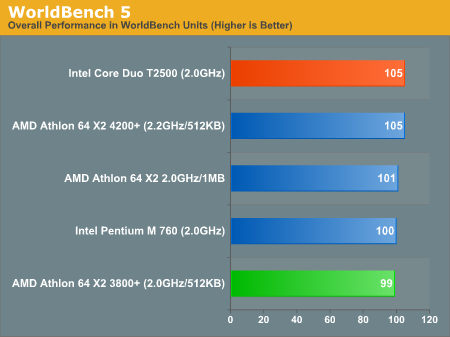
The breakdown of the WorldBench 5 score is reported below. Note that the values below are task completion times in seconds with lower numbers translating into better performance.
| AMD Athlon 64 X2 4200+ | AMD Athlon 64 X2 3800+ | AMD Athlon 64 X2 2.0GHz/1MB | Intel Core Duo T2500 | Intel Pentium M 760 | |
| ACD Systems ACDSee PowerPack 5.0 | 537 | 574 | 572 | 544 | 545 |
| Adobe Photoshop 7.0.1 | 339 | 364 | 362 | 319 | 325 |
| Adobe Premiere 6.5 | 388 | 402 | 400 | 405 | 404 |
| Ahead Software Nero Express 6.0.0.3 | 507 | 509 | 506 | 512 | 510 |
| Discreet 3ds max 5.1 (DirectX) | 254 | 268 | 266 | 256 | 256 |
| Discreet 3ds max 5.1 (OpenGL) | 317 | 337 | 333 | 320 | 322 |
| Microsoft Office XP with SP-2 | 524 | 531 | 536 | 531 | 505 |
| Microsoft Windows Media Encoder 9.0 | 283 | 304 | 301 | 295 | 415 |
| Mozilla 1.4 | 360 | 440 | 411 | 338 | 310 |
| Multitasking: Mozilla and Windows Media Encoder | 445 | 484 | 445 | 439 | 634 |
| MusicMatch Jukebox 7.10 | 483 | 527 | 531 | 511 | 529 |
| Roxio VideoWave Movie Creator 1.5 | 262 | 278 | 277 | 267 | 400 |
| WinZip Computing WinZip 8.1 | 401 | 420 | 419 | 396 | 399 |
Overall System Performance using SYSMark 2004
Professional Application Performance with 3dsmax, Adobe Premier and Photoshop


 Facebook
 Twitter
 RSS
RSS


103 Comments
View All Comments
mitcoes - Saturday, April 22, 2006 - link
The msot important question about corel duo, is if dual processors Apple Machines with ATI X1900XT woul be a better machine than AMD and Pentium with one processor at same clocks. Better when core duo would arrive to 3 Mhz or nearby. Becouse hard gamers, and renderers would buy this (expending a few more bucks) and have the choice of use MAC OS, Win XP, an Linux on the same machine with opengl games probably going better in Leopard than in XP becouse of the better networking of UNIX and Linux over TCP/IP. The test of packets losed with Quake3 XP vs Leopard would be a great test, becouse probably AMD, and Pentium with same clocks and ATI would have similar preformance in games that are not prepared for two processors, but Photoshop CS2, blender And other CAD/CAM apps would run better. Perhaps The future new market of Apple machines are hard gamers, and hard users like architects, renderers, animators and so one. But it must be tested. And I want to know if MAC mainboards are better than ASUS and Gigabyte ones (or other better if them exists).Cygni - Wednesday, December 21, 2005 - link
Congrat AT commenters! I have to say, this is the new HIGH SCORE for useless, incorrect, biased, self important posts in the history of AT!Really, i was going to respond to each one in turn, but I think its far easier just to make this one post where i point out that many, many, many of you should likely try lurking a bit instead of instantly hitting the reply button and spouting off about latencys, bus widths, and other thing your Toms Hardware Education degree has certified you an expert at. We will all be more intelligent if you didnt post.
IntelUser2000 - Tuesday, December 20, 2005 - link
They should have used low latency DDR2-533 rather than the normal JEDEC specified 4-4-4-12 latency for their reviews. It might be faster then :)).Also, testing Sonoma notebooks have shown that it likes single channel DDR2-533 better than DDR2-400, like how it doesn't benefit from dual channel. I would also like to see DDR2-667 results(over dual channel DDR2-533), as few % here and there will really show Yonah's potential.
coldpower27 - Tuesday, December 20, 2005 - link
Yes that would be interesting, as Anantech does have Corsair DDR2-667 3-2-2-8 available in their repitoire.StuckMojo - Tuesday, December 20, 2005 - link
I'd like to see compilation benchmarks. Lots of us use our laptops for software development.
Betwon - Tuesday, December 20, 2005 - link
Compilation?At the recent Spec CPU Cint2000 test--The most fast x86 CPU about compiler is P4 670.
176.gcc 2195/2195 ponits
PM@2.26GHz(1995/1994) is fast than FX-55@2.6GHz(1931/1933).
IntelUser2000 - Tuesday, December 20, 2005 - link
If any of you actually care to search for transistor performance of Intel's and AMD/IBM, you can see that AMD/IBM's the newest 65nm process is only 2-3% faster but Intel is providing the numbers at HALF the leakage.There WILL be X2 clock speed like versions of Yonah with higher TDP and being graded as EE.
-Equal platform comparisons are never possible.
-DDR2's power advantage isn't as great as you think.
-We don't know if Turion would benefit at all from DDR2 in performance, the claimed 15% or so is at best case, aka single benchmark. It always happens, companies say some wonder number and in reality its even worse than the previous one.
Betwon - Tuesday, December 20, 2005 - link
The very low latency of L2 cache is the main real reason? AT may be foreget that L2 can be shared, which is different with AMD.Schmide - Tuesday, December 20, 2005 - link
Correct me if I'm wrong. Doesn't the AMD architecture have a 3 cycle L1 latency due to an exclusive L1 L2 cache relationship. While Intel uses a 2 cycle L1 inclusive L1 L2 cache relationship. With the larger cache sizes now, the more costly exclusive set seems to be holding AMD back. However, this higher latency could be the reason AMD is able to reach higher speeds using a lower process.As for the power consumption, I wonder if the board design had anything to do with the X2 being 30% higher. Chime in here
On die memory controller advantage AMD.
DDR2 lower power consumption advantage Intel
65nm process advantage Intel
Mature SOI advantage AMD.
Betwon - Tuesday, December 20, 2005 - link
You are wrong about the cache of Yonah. The mobile CPU is different with the Netburst.Yonah's L1 latency is 3 cycles, and it is a kind of write-back cache, which needs not always copy the data to L2. L2 latency is 14 cycles(AT said), which is the same with AthonX2. And Yonah's number of pipeline stages is 11,12, or 13. The AthonX2 is 12-stage. So, (Include AT)we believe that Yonah can reach the high frequency. The real reason of Yonah only max 2.16GHz -- for the moblie applications ... to control the power sum.