



IDF Spring 2005 - Day 2: The Yonah Scoop
by Anand Lal Shimpi on March 3, 2005 1:01 AM EST- Posted in
- Trade Shows
Other Facts about Yonah
Mooly offered a few more tidbits of information about Yonah and the Napa platform:
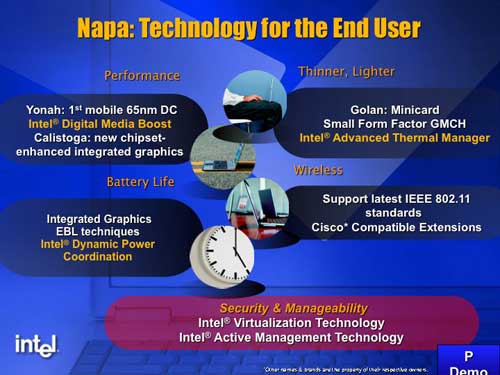
1) The Golan WiFi solution will be a minicard, less than half the size of the Colexico wireless solution used in current generation Pentium Ms. The WiFi in Napa will be 802.11a/b/g initially.
2) Yonah will have full support for Intel AMT and VT, both technologies we talked about yesterday.
3) The heat sink on the development Yonah platforms is purposefully large because the chip is far from mass production, the shipping chip will have no problems running just as cool, if not cooler than current generation Dothan notebooks.
4) No comment on EM64T support, although we doubt that Yonah will have 64-bit support out of the box. Remember that Yonah's execution units are borrowed from the Pentium 3, moving to 64-bit execution units would make the chip significantly larger, similar to what we saw in the Northwood -> Prescott transition (although not nearly as extreme, since the pipeline would remain the same). For a mobile platform, that decision just doesn't make sense yet.
5) The chipset is also listed as being a "Small Form Factor", most likely meaning that the package is smaller, allowing for even tinier board layouts.
Final Words
In meetings since Mooly's presentation we've been piecing together even more about the future of Yonah and Intel's strategy beyond Netburst, it looks like the focus on SIMD FP/FP performance was a calculated one...


 Facebook
 Twitter
 RSS
RSS


23 Comments
View All Comments
PentiumIV - Wednesday, March 16, 2005 - link
Banias - there is a rever in Golan Heights called Banias (or waterfall, don't remember ...)Dothan - there is a Dothan Valley in Israel.
P.S. We've go a great honor- to use Israeli names for code names !
PentiumIV - Wednesday, March 16, 2005 - link
Yonah als means "pidgeon" in Hebrew ....PeteRoy - Friday, March 4, 2005 - link
I think your right Determinant about that, Yonah can be a person name they call the core after.Dothan has no meaning in Hebrew but some people in Israel are called Dothan, I don't know about Banias.
IntelUser2000 - Thursday, March 3, 2005 - link
LOL, its so funny to see people going religiously over some computer hardware. Not that I am not an enthusiast, but not so into like most of you guys do.Anyways Yonah looks slick.
Determinant - Thursday, March 3, 2005 - link
#11 (PeteRoy)While Yona might mean pigeon in Hebrew, Yonah does not.
Yonah means Jonah in Hebrew.
God told the prophet Jonah to go and tell this
one nation to change from their evil ways
otherwise they will get punished.
Yonah didn't listen and took a boat in the
opposite direction. He got thrown off the boat,
swallowed by a whale and taken to the place where
he was supposed to go. The whale vomitted Jonah
out.
I think Jonah's branch predictor needed some fine
tuning otherwise he wouldn't have made the wrong
choice.
Dual cores wouldn't have helped here.
stephenbrooks - Thursday, March 3, 2005 - link
#11, did the pigeon get swallowed by a whale? Did it have dual-cores?val - Thursday, March 3, 2005 - link
advertising is required in current world.The world which cannot alive without "women intim products" ads have many reasons why so fast developing company as Intel need to advertise.
If they will not, somebody else will. Without ads the average Joe will not know there there is something to change his PIII 700 MHz for on the market, will never know difference between garage PC and high quality laptop, etc.
There are no bad and good guys in Capitalism. Everybody works for moneys and fame.
Quanticles - Thursday, March 3, 2005 - link
AMD is on a much tighter budget. That means they have to choose between spending money on a competitive product, or spending money on advertising. I wouldnt be suprised if Intel's advertising budget is bigger than that of AMD's entire processor division.Doormat - Thursday, March 3, 2005 - link
AMD ususally has some sort of meeting around IDF. This year they didnt unveil anything new, just had lots of dual core computers running. Apparently production models too, it came out that AMD's dual core speeds will start at 2.4GHz, maybe higher (for reference, a single core 2.4GHz dual channel ddr/1MB L2 is AMD's 4000+ model).val - Thursday, March 3, 2005 - link
I think that AMD have some PR meeting. We havent seen many nice products for some time so they plan some another forum spam burst or maybe some submarine advertising?