



Memory Scaling on Core i7 - Is DDR3-1066 Really the Best Choice?
by Gary Key on June 24, 2009 9:00 AM EST- Posted in
- Memory
Everest 5.02.1765
Our favorite PC diagnostic tool is from Lavalys. We are using Everest Ultimate Edition 5.02 for our synthetic memory benchmarks.
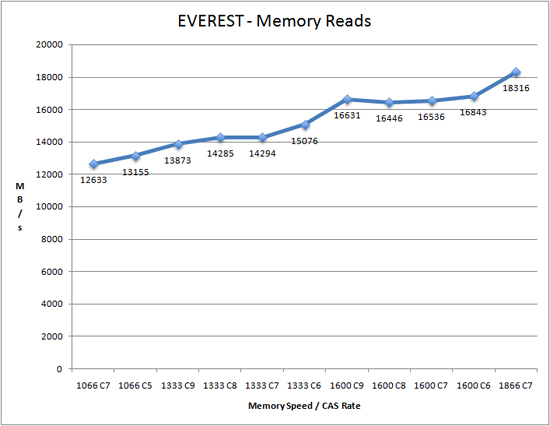
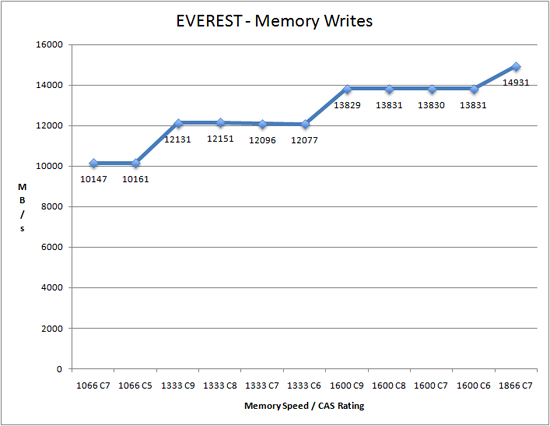
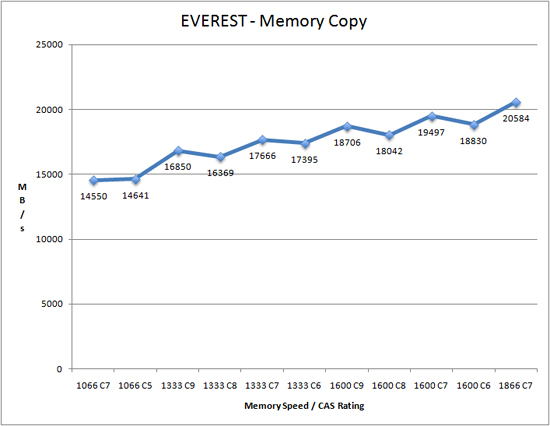
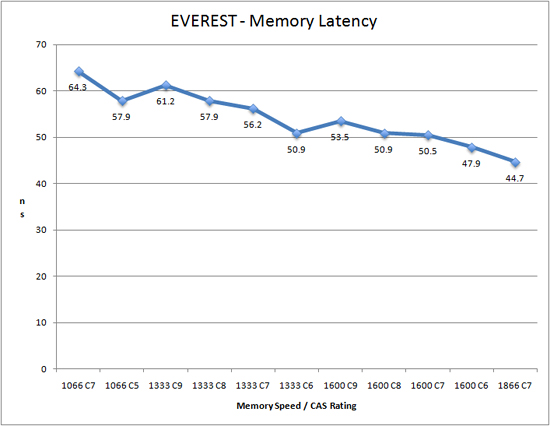
Memory companies love to see these benchmarks in reviews. Of course we enjoy them also as they do give an indication of potential performance improvements in applications, especially the write, copy, and latency results. However, we always temper our expectations with these particular results. Going from 1066 C7 to 1866 C7 nets a 45% improvement in memory reads, 47% in writes, 41% in copy speeds, and 30% in latency. Just remember these results once we get to the application benchmarks.


PCMark Vantage x64
Futuremark's PCMark Vantage x64 is probably the single most diverse set of benchmarks that can be run on a system to mimic real world usage scenarios. We utilized the three test suites out of PCMark Vantage x64 that typically respond well to either memory latency (Memories/Productivity) or bandwidth (TV/Movies) improvement. We run each test three times and average the results.
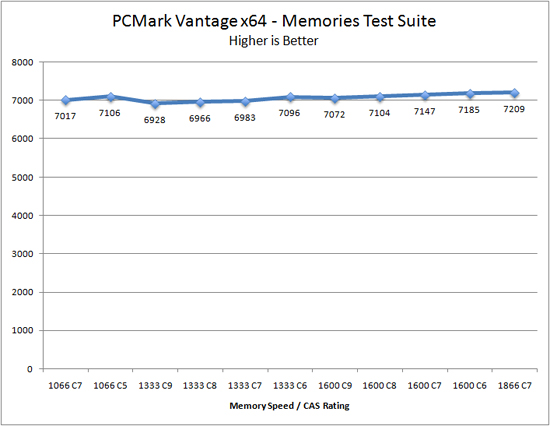
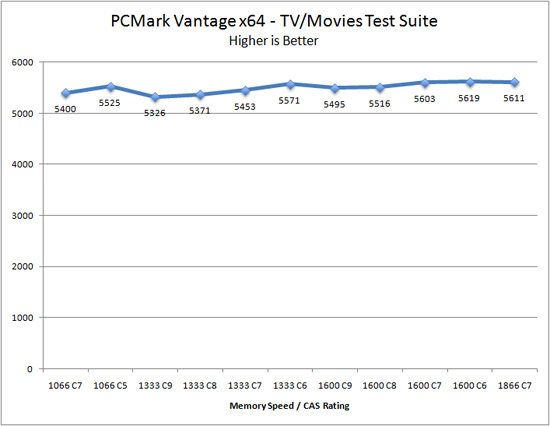
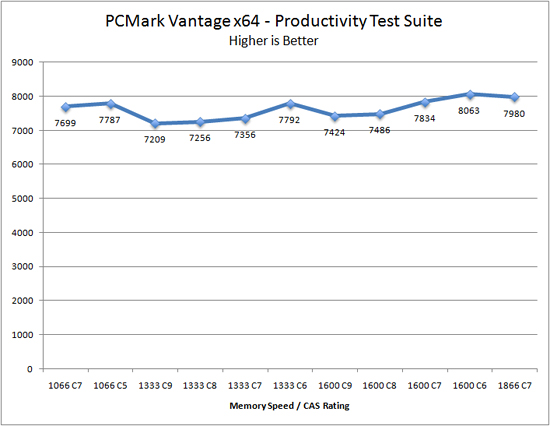
Well that's depressing, there's hardly any performance improvement.
The Memories test suite follows a familiar pattern, as it tends to be sensitive to latency adjustments. We can already see that performance with DDR3-1066 C5 is equal to DDR3-1600 C8. There is a 2% performance improvement moving from 1066 C7 to 1866 C7.
Surprisingly, the TV/Movies test suite responded well to both latency and bandwidth improvements with DDR3-1066 C5 and DDR3-1333 C6 outperforming the other memory speeds until we installed theDDR3-1600 C7 kit. Going from 1066 C7 to 1866 C7 will net almost a 4% improvement in performance, but is something most users will never notice in these applications.
The Productivity test suite has always been sensitive to latency and it shows as we once again see DDR3-1066 C5, DDR3-1333 C6, and DDR3-1600 C6 performing very well in this office application bench. We net a performance increase just over 3% by moving from 1066 C7 to 1866 C7 at stock CPU settings.


 Facebook
 Twitter
 RSS
RSS


47 Comments
View All Comments
BrianInfo - Thursday, July 30, 2009 - link
1.) The recommended DDR3-1066 Patriot PSD36G1066KH is non-ECC and unbuffered. Will this be an issue for the personal desktop use, mainly for video/audio transcoding/muxing?
2.) The article does not specify how to achieve the CAS5. Does anyone succeed the CAS5 with this Patriot DDR3-1066 and/or overclocked DDR3-1200?
3.) Is it possible to achieve the CAS5 with other brand, such as GeIL CAS7 GV36GB1066C7TC or Crucial CT3KIT25664BA1067??
4.) According to Tom's Hardware, not all the X58 motherboards support CAS5 http://www.tomshardware.com/reviews/cheap-x58-moth...">http://www.tomshardware.com/reviews/cheap-x58-moth...
so does it mean I cant obtain the ideal performance with the combination of "ASRock X58 Extreme" motherboard with "Patriot PSD36G1066KH" Tweaked-CAS5 DDR3? I really like the Asus P6T SE but the layout of the two (blue) PCI Express 2.0 x16 slots, too close to each other is killing me:(
iwodo - Sunday, June 28, 2009 - link
Spend the extra money on an SSD rather then faster Memory. Although i would love to see how Tri Channel differs from Dual Channel. ( Same results? )And how integrated Graphics differs in memory speed.
lemonadesoda - Friday, June 26, 2009 - link
Gary, you obviously get paid by wordcount. Too much waffle. Get to the meat faster.And what about this $200 between cheap and expensive DDR3 kits? How about seeing WHERE that $200 could have been spent in OTHER upgrades, ie. CPU or GPU, and running benchmark comparisons against THAT setup vs. the first.
Otherwise, thanks for running all the tests and creating the data for us to review :-)
PrinceGaz - Thursday, June 25, 2009 - link
As soon as I looked at the chart on the first page of the article, it was clear that the DDR3-1600 C9 memory would represent the best bang for the buck. It was only marginally higher priced than the DDR3-1066 C7 (and the DDR3-1066 C5 doesn't count as you overclocked the DDR3-1066 C7 for that purpose), and was sure to perform at least as good, and probably better than significantly higher priced DDR3-1333 modules at C8, and almost as good as the DDR3-1333 C7.Given that faster memory modules only ever have a negligible effect on real-world performance (unless you are a pirate and spend a lot of time using PAR2 checkers to rebuild damaged files from newsgroups, or WinRAR to then extract the original files, the sort of stuff I certainly won't say I do), then you may as well get the cheapest brand-name memory available. If you're spending in the upper mid-range on your CPU, then go for slightly faster (like the 1600 C9) but still quite cheap memory-modules. The only people who should be getting those top-of-the-range modules or anything close to that price level are those who have already decided on the fastest Core i7 CPU avilable (i7 975 currently), as otherwise they're wasting their money on the wrong bit of hardware.
Souka - Thursday, June 25, 2009 - link
I'm more confused than ever... what to buy?Putting together a new system...
Win7 or Vista x64
i7-920 CPU
x58 MB
ATI 4890 video
Memory? I'd like to go with 6GB (3x2gb), thought I had my choices narrowed down to:
Opt1: $138 mushkin 6GB(3x2GB) 1333(PC3 10666) Model 998706, Cas6, 6-7-6-18
Opt2: $175 mushkin 6GB(3x2GB) 1600(PC3 12800) Model 998691. Cas6, 6-7-6-18
But after reading this article, and your comments... I'm very uncertain....help!
PrinceGaz - Thursday, June 25, 2009 - link
Given a choice between either DDR3-1333 or 1600 memory with identical timings (6-7-6-18), but a $37 price difference, I'd probably go for the 1333, especially as you have decided on an i7-920. If you want to spend a little more to improve yours sytem performance, the memory speed is the last place to look at to do so.SiliconDoc - Sunday, July 5, 2009 - link
I took just the opposite from it - he has a 4980 there - overclockable nicely, is saving quite a bit with lower cpu, and what else can get him another 2,5,7,14 % in framerates, especially minimum in some cases ? I think the higher ram is much better and worth it after seeing this articles results.He will OC the 4890 and the cpu likely, so that fast ram will give it that great finisging kick and make it awesome.
Spend the $37 and be happy - definitely.
Hrel - Thursday, June 25, 2009 - link
G.Skill 1.5-1.6v 1333 Cas 8-8-8-21 = 65Crucial 1.8v 1333 Cas 6-6-6-20 = 64 (sold out right now)
OCZ 1.9v 1600 Cas 7-7-7-24 = 54 (after 20 mail in rebate)
Patriot 1.9v 1600 Cas 7-7-7-20 = 95 (free shipping)
Patriot 2.0v 1600 Cas 7-7-7-20 = 100 (Green, which I like)
So basically, it really ONLY makes sense to buy the OCZ 1600 Cas 7 for 54 bucks, why pay more for less?!!!
sonci - Wednesday, June 24, 2009 - link
Really boring for me,lucky, I didnt read it all
StraightPipe - Wednesday, June 24, 2009 - link
cough * troll*