



DFI UT P35-T2R: Tweakers Rejoice!
by Rajinder Gill on October 18, 2007 2:00 PM EST- Posted in
- Motherboards
Overclocking with the DFI UT P35-T2R Motherboard
The last three months have seen the overclocking enthusiast sector bombarded with motherboards based around the Intel Bearlake (P35) chipset. While it has become an expectation for many to see boards from the main players up front and ready to go at product launch, early adopters have naturally expected DFI to be fashionably late to the ball with their own LANParty series offering. In terms of business, the enthusiast sector is an area of the retail market where being late does not earn the "money shot"; vital sales are lost in delays, no matter how good the product is - the delay is costly. So costly that many of the leading players in the once hot AMD S939 sector such as DFI, abit, MSI, Albatron, Chaintech, Shuttle, and EPoX have seen their market shares dwindle (sometimes drastically to the point of not being around anymore) since the introduction of the Core 2 Duo from Intel and the resulting market switch by the enthusiasts to the blue camp.
This time around DFI managed a reduced delay period of two months behind the official Intel Bearlake chipset rollout, greeted by applause from most tweakers who have been awaiting a killer product from the company since the "glorious" NF4 era. We thought the RD600 would fill that role last year, but it came up short in performance even though the BIOS options foretold the future about DFI's BIOS designs on Intel product. DFI managed to hit a home run with the Infinity 965-S Dark. Unfortunately, everyone had left the P965 ballpark to watch the P35 play in a new stadium by that time. Hopefully, their X38 product will be released in the coming weeks but until then (probably afterwards also based on early numbers), we think most people will be more than satisfied with the UT P35-T2R - provided you can afford it and do not have a need for multi-GPU benchmarking.
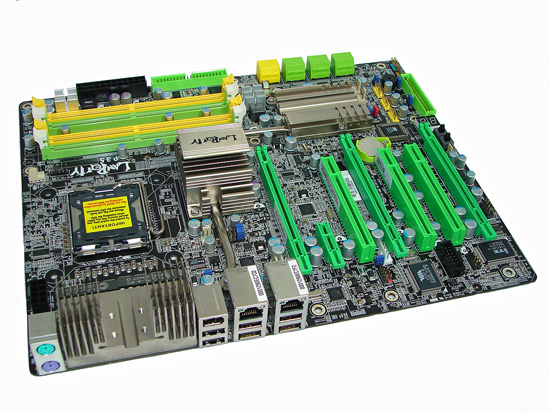
Beyond color enhancing UV lights to show off the board, the enthusiast knows that beauty in electronics, as with all other things, can often lie only skin deep. Rigorous in-house testing by DFI to iron out BIOS kinks was chosen over sending out boards at the chipset launch. This was done in an attempt to nail issues before users spent their hard earned dollars for partial functionality. As a matter of fact, anyone who buys motherboards close to official chipset launch dates should be fully versed in the ritual BIOS flashing regimen often required for long-term usefulness. Running a few quick benchmarks featuring high front side bus speeds might grab some early headlines, but it does not indicate a board's actual performance capability or stability. Put in perspective for the end-user, the two month delay is not such a bad thing, if a more solid and compatible motherboard is the end result.
Due to the very extensive BIOS options on this motherboard, assessing a product like this demands extra time. It also forces you to go over the options with greater detail while explaining their use and determining the worth of performance benefits when changing these options. While we are certainly not BIOS engineers, we are hoping that the time we have taken to go beyond the scope of normal motherboard review criteria will be welcomed by our readers, who are often just as confused as we are when we first take a look at a new DFI BIOS.
The goal then of this article is to take a focused look at how to properly set up and overclock this latest DFI offering, and even if you're not specifically planning on purchasing this motherboard we hope to provide some insight into what is involved in reaching top overclocks with Intel's impressive P35 chipset. In the near future, we will be able to provide direct overclocking performance comparisons and capabilities of this board against additional motherboards in the upper-end market sector. In the meantime, our results today are more of a dog and pony show as to what the board is capable of under various overclocking scenarios.
Additionally, we will be providing a catalog of "How to Guides" that will outline the BIOS settings utilized, BIOS option explanations, and recommended setups in our motherboard forum as we roll out these articles in the coming weeks. We welcome your input, suggestions, and ideas for improving this type of content. For now, let's take a look at DFI's latest board and its general performance results before we hit on the overclocking features.
The last three months have seen the overclocking enthusiast sector bombarded with motherboards based around the Intel Bearlake (P35) chipset. While it has become an expectation for many to see boards from the main players up front and ready to go at product launch, early adopters have naturally expected DFI to be fashionably late to the ball with their own LANParty series offering. In terms of business, the enthusiast sector is an area of the retail market where being late does not earn the "money shot"; vital sales are lost in delays, no matter how good the product is - the delay is costly. So costly that many of the leading players in the once hot AMD S939 sector such as DFI, abit, MSI, Albatron, Chaintech, Shuttle, and EPoX have seen their market shares dwindle (sometimes drastically to the point of not being around anymore) since the introduction of the Core 2 Duo from Intel and the resulting market switch by the enthusiasts to the blue camp.
This time around DFI managed a reduced delay period of two months behind the official Intel Bearlake chipset rollout, greeted by applause from most tweakers who have been awaiting a killer product from the company since the "glorious" NF4 era. We thought the RD600 would fill that role last year, but it came up short in performance even though the BIOS options foretold the future about DFI's BIOS designs on Intel product. DFI managed to hit a home run with the Infinity 965-S Dark. Unfortunately, everyone had left the P965 ballpark to watch the P35 play in a new stadium by that time. Hopefully, their X38 product will be released in the coming weeks but until then (probably afterwards also based on early numbers), we think most people will be more than satisfied with the UT P35-T2R - provided you can afford it and do not have a need for multi-GPU benchmarking.
Beyond color enhancing UV lights to show off the board, the enthusiast knows that beauty in electronics, as with all other things, can often lie only skin deep. Rigorous in-house testing by DFI to iron out BIOS kinks was chosen over sending out boards at the chipset launch. This was done in an attempt to nail issues before users spent their hard earned dollars for partial functionality. As a matter of fact, anyone who buys motherboards close to official chipset launch dates should be fully versed in the ritual BIOS flashing regimen often required for long-term usefulness. Running a few quick benchmarks featuring high front side bus speeds might grab some early headlines, but it does not indicate a board's actual performance capability or stability. Put in perspective for the end-user, the two month delay is not such a bad thing, if a more solid and compatible motherboard is the end result.
Due to the very extensive BIOS options on this motherboard, assessing a product like this demands extra time. It also forces you to go over the options with greater detail while explaining their use and determining the worth of performance benefits when changing these options. While we are certainly not BIOS engineers, we are hoping that the time we have taken to go beyond the scope of normal motherboard review criteria will be welcomed by our readers, who are often just as confused as we are when we first take a look at a new DFI BIOS.
The goal then of this article is to take a focused look at how to properly set up and overclock this latest DFI offering, and even if you're not specifically planning on purchasing this motherboard we hope to provide some insight into what is involved in reaching top overclocks with Intel's impressive P35 chipset. In the near future, we will be able to provide direct overclocking performance comparisons and capabilities of this board against additional motherboards in the upper-end market sector. In the meantime, our results today are more of a dog and pony show as to what the board is capable of under various overclocking scenarios.
Additionally, we will be providing a catalog of "How to Guides" that will outline the BIOS settings utilized, BIOS option explanations, and recommended setups in our motherboard forum as we roll out these articles in the coming weeks. We welcome your input, suggestions, and ideas for improving this type of content. For now, let's take a look at DFI's latest board and its general performance results before we hit on the overclocking features.


 Facebook
 Twitter
 RSS
RSS


30 Comments
View All Comments
Rocket321 - Tuesday, October 23, 2007 - link
I would like to see the overclocking results put into a graph or chart of some kind.I guess tweakers might like the screenshots as "proof" that the overclock ran, but personally I trust you and would rather just have one place to look rather than clicking to enlarge multiple screenshots sequentially.
It was a great review though, I look forward to the future tweaker guides & reviews.
Raja Gill - Wednesday, October 24, 2007 - link
There will be a more typical Anandtech look to future articles, with the DFI board revisited for a round up on a suite of benchmarks, this will be used to cross compare with other boards, clocked to equivalent with board maximums in the range and voltage. In terms of the screenshots, it is nice to have 1 persons trust, but there are many we have to please and not everyone is always as convinced..thanks for the suggestions..
Next up is the Asus Maximus Formula..
regards
Raja
Jodiuh - Thursday, October 25, 2007 - link
Specifically Windvd conversions from divx/xvid to DVD would be wonderful as I've found this app benefits from a solid OC.beoba - Friday, October 19, 2007 - link
It'd be great if this came with a glossary."Strap"?
retrospooty - Saturday, October 20, 2007 - link
strap is a term used for memory clocking. for example, at 266mhz bus, memory can be "strapped" to one of the following.266x(stap2)=533 or DDR 1066
266x(strap1.5)=400 or DDR 800
266x(strap1.25)=333 or DDR 666
If you are running at stock 266 there is no way to have DDR 950 because it has to be strapped to one of the above settings.
I use the 1/1 strap so my bus speed is 500x(strap1)=500 or DDR 1000, in most cases 1/1 is the most efficient, if you can utilize it with your particular hardware, do it.
Avalon - Thursday, October 18, 2007 - link
Unfortunately, DFI's asking price of admission continues to rise for each new board they release. I was mildly annoyed when they started selling boards for $200+ that had little to no tangible benefit over $100-$150 boards, but now they're at the $300 mark? No thanks.This board is for someone who likes to spend his time tweaking and not actually using his computer.
retrospooty - Saturday, October 20, 2007 - link
"This board is for someone who likes to spend his time tweaking and not actually using his computer."The article title is called "Tweakers Rejoice" after all. The idea is not to tweak forever . I did spend alot of time over the first few weeks, but now that its tweaked, I just use it as is.
Avalon - Sunday, October 21, 2007 - link
Yes, I am quite capable of reading the article title. My whole point is that you are working for diminishing returns that I feel could be better spent using your system. If you're doing it to set a record, fantastic. I support that.retrospooty - Sunday, October 21, 2007 - link
Understood... This is obviously not the motherboard for you. I personally love the BIOS options and CMOS reloaded functionality. That alone makes the extra cost well worth it to me. Asus BIOS just sucks, and I have had too many quality problems with them in the past, and Gigabyte just underperforms. I like to know I will not be held back by my motherboard for the next couple of CPU's I buy (will likely get a dual core Penryn on release for under $200, then a high end quad core Penryn a year or so later when it is under $200).I do see your point, but in spite of this article's stock speed comparison (totally pointless for a OC geared mobo), and similar results with one particular CPU, that looks as if it has an FSB limit equal on all 3 boards (meaning the CPU is holding it back) This board overclocks and performs better than any ASUS, or Gigabyte, or any other board out there. If AT tested the max FSB limits on a dozen or so CPU's, or if they had a "golden sample" that had a high FSB limit, you would see the difference. Also if they had time to test many diff RAM stocks and to tweak the memory settings you would also see the difference. Its a good article, but no reviewer has time to really dig into this mobo and all it has to offer. I do feel the article did a good job at explaining that.
JNo - Sunday, October 21, 2007 - link
"I like to know I will not be held back by my motherboard for the next couple of CPU's I buy"I don't know much about overclocking and I hold your views valid Retrospooty but surely this is still a lot of money that will still be needed to replaced in the short/medium-term if a) you want to start using DDR3 once prices come down b) if GPUs come out that take advantage of PCI-E 2 standard (as used on X38). So all that money is only paying for great OC'ing potential for *now* only... no?