



ASUS P5N-E SLI: NVIDIA's 650i enters with a Bang
by Gary Key on December 22, 2006 5:00 AM EST- Posted in
- Motherboards
First Thoughts
Once again we have to ask the $64,000 question: did NVIDIA succeed in designing a competitive chipset when compared to the Intel P965? Our answer to that question is a very reserved yes. While the chipset was very competitive in the majority of our early benchmark results, we have to wonder if this is due to the ASUS implementation or if our results indicate the actual strength of the chipset. Until we are able to test more motherboards based on this chipset it will be difficult to give a final answer. We have some hunches however and believe the chipset is competitive but certainly does not deliver a knockout blow to the P965.
Our initial thoughts are based upon how sensitive the board is to memory timing changes and types of memory utilized. We found the memory and chipset timings are tweaked very tightly resulting in a very narrow band of settings that are stable. We have discussed our memory timing issues with ASUS several times and currently we are awaiting a full response. While this is a drawback to the board, if you have memory capable of running at 4-4-4-12 1T at DDR2-800 then this board offers excellent gaming performance and very good application performance. ASUS can be congratulated for getting excellent results in the game and synthetic benchmarks, but it appears to be at the expense of memory compatibility. Of course, P965 also had quite a few issues with memory compatibility when it first launched, so perhaps NVIDIA and the board manufacturers just need a bit more time to become acquainted with the needs of the chipset.(Update - ASUS will be providing a Beta BIOS early next that addresses our memory timing issues.)
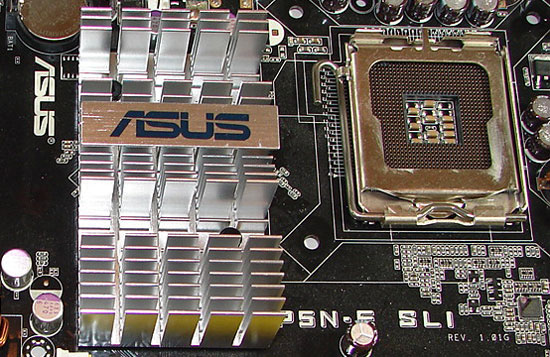
We have tested the board for over a week now with a wide variety of components in several different configurations. The board has proved to be extremely stable and performs very well when the right memory settings are applied. We still have significant testing left to complete once our retail kit arrives, but at this time we really like the chipset and the motherboard. The performance of the board and the fact it has a decent set of features leaves us wondering why we would spend over a $100 more for the 680i boards. Sure, the 680i boards have additional features such as dual Gigabit Ethernet connections with DualNet technology, dual x16 graphics slots along with a slot designed for physics capability, an additional two SATA 3Gb/s and USB 2.0 ports, and enhancements like LinkBoost, SLI Ready Memory, and extended overclocking capabilities. However, does every user need these additional features?
We think not, and we believe the 650i SLI chipset offers basically the same or better performance as the 680i about 95% of the time for significantly less money. It may turn out that this chipset isn't so much of a P965 killer but instead is a 680i killer in most cases. This is actually good news as this chipset was designed for the mainstream performance market and the 680i really is meant for the small but very vocal enthusiast sector. Coming back to the P965, we found the 650i SLI offered similar performance in most cases and excelled in gaming where its main purpose in life exists.
The advantages the 650i SLI offers is official SLI support, native IDE chipset capability along with support for four IDE devices, flexible memory and FSB settings, and a similar price to performance ratio when compared to the P965. The main negatives we see are increased power consumption, memory bandwidth is lower overall, and FSB overclocking is comparatively lower (although the true capabilities of the chipset are not yet fully known)than the upper end P965 motherboards.
In many ways that's the biggest concern at this time: the unknown. We do not know how this chipset will perform when utilized in other board designs and what the average cost for the board will be in the near future. We have seen the ASUS P5N-E SLI offered for around $129.99 and at that price with the right set of memory, we think it is a great bargain, especially if you plan on running an SLI setup or have multiple IDE devices still in use. We still have a lot of questions about this chipset and motherboard, too many to pass final judgment on either one at this time, but we will report back in the near future with additional test results and hopefully a look at several other new boards based on the 650i SLI chipset. We think this chipset has a bright future in the mainstream performance market and believe ASUS has, at first look, designed a very good board around it.
Once again we have to ask the $64,000 question: did NVIDIA succeed in designing a competitive chipset when compared to the Intel P965? Our answer to that question is a very reserved yes. While the chipset was very competitive in the majority of our early benchmark results, we have to wonder if this is due to the ASUS implementation or if our results indicate the actual strength of the chipset. Until we are able to test more motherboards based on this chipset it will be difficult to give a final answer. We have some hunches however and believe the chipset is competitive but certainly does not deliver a knockout blow to the P965.
Our initial thoughts are based upon how sensitive the board is to memory timing changes and types of memory utilized. We found the memory and chipset timings are tweaked very tightly resulting in a very narrow band of settings that are stable. We have discussed our memory timing issues with ASUS several times and currently we are awaiting a full response. While this is a drawback to the board, if you have memory capable of running at 4-4-4-12 1T at DDR2-800 then this board offers excellent gaming performance and very good application performance. ASUS can be congratulated for getting excellent results in the game and synthetic benchmarks, but it appears to be at the expense of memory compatibility. Of course, P965 also had quite a few issues with memory compatibility when it first launched, so perhaps NVIDIA and the board manufacturers just need a bit more time to become acquainted with the needs of the chipset.(Update - ASUS will be providing a Beta BIOS early next that addresses our memory timing issues.)
We have tested the board for over a week now with a wide variety of components in several different configurations. The board has proved to be extremely stable and performs very well when the right memory settings are applied. We still have significant testing left to complete once our retail kit arrives, but at this time we really like the chipset and the motherboard. The performance of the board and the fact it has a decent set of features leaves us wondering why we would spend over a $100 more for the 680i boards. Sure, the 680i boards have additional features such as dual Gigabit Ethernet connections with DualNet technology, dual x16 graphics slots along with a slot designed for physics capability, an additional two SATA 3Gb/s and USB 2.0 ports, and enhancements like LinkBoost, SLI Ready Memory, and extended overclocking capabilities. However, does every user need these additional features?
We think not, and we believe the 650i SLI chipset offers basically the same or better performance as the 680i about 95% of the time for significantly less money. It may turn out that this chipset isn't so much of a P965 killer but instead is a 680i killer in most cases. This is actually good news as this chipset was designed for the mainstream performance market and the 680i really is meant for the small but very vocal enthusiast sector. Coming back to the P965, we found the 650i SLI offered similar performance in most cases and excelled in gaming where its main purpose in life exists.
The advantages the 650i SLI offers is official SLI support, native IDE chipset capability along with support for four IDE devices, flexible memory and FSB settings, and a similar price to performance ratio when compared to the P965. The main negatives we see are increased power consumption, memory bandwidth is lower overall, and FSB overclocking is comparatively lower (although the true capabilities of the chipset are not yet fully known)than the upper end P965 motherboards.
In many ways that's the biggest concern at this time: the unknown. We do not know how this chipset will perform when utilized in other board designs and what the average cost for the board will be in the near future. We have seen the ASUS P5N-E SLI offered for around $129.99 and at that price with the right set of memory, we think it is a great bargain, especially if you plan on running an SLI setup or have multiple IDE devices still in use. We still have a lot of questions about this chipset and motherboard, too many to pass final judgment on either one at this time, but we will report back in the near future with additional test results and hopefully a look at several other new boards based on the 650i SLI chipset. We think this chipset has a bright future in the mainstream performance market and believe ASUS has, at first look, designed a very good board around it.


 Facebook
 Twitter
 RSS
RSS


27 Comments
View All Comments
Thats Me - Tuesday, March 6, 2007 - link
I currently have an Intel D945Gnt motherboard that has proven to be a looser in various ways. Using an Intel Dual-Core 3.2 Ghz processor, 2x512 Mb dual channel RAM. Am considering change to the Asus P5N-E motherboard so need advice--will my existing CPU work Ok in the Asus?HELP!
jdrom17 - Tuesday, January 23, 2007 - link
Just wondering if you are going to update the review, as ASUS released a new BIOS version yesterday (Jan 22) which says it fixes memory compatibility.It may solve the issues you ran into, and I'd like to know if it does.
MikeeeE18 - Tuesday, January 9, 2007 - link
I read some of the reviews over here and it was a big help in oc my E6600 on the p5n-e. Currently im runin it at 3.21ghz, but my mem timings are wack. Im kinda new to this so any help would be appreciated. I have the system set to 1425 fsb (qdr) x 9 (multiplier) using pc5300 mem 2gb pqi and evga 7950gt ko. I tried setting the fsb to 1608 like it says in one of the reviews but it overloaded the system. Hoping to get some results out of this so i can make this thing a bit faster. Thanks.Operandi - Tuesday, January 2, 2007 - link
Nice review, bonus points for the fan control information.Lord Evermore - Monday, December 25, 2006 - link
Testing? But that would delay getting the product out to market before the competition, and possibly stuff up their overly enthusiastic deadlines and announcements. Not to mention costing money that they could save to let the customers beta test it. The people buying these things are tweakers anyway.
Hey, the software industry gets away with releasing shoddy, half-finished products all the time, and in fact gets the same people to keep buying them. Not to mention releasing essentially the same product with a slightly different name (nF5/nF6).
PoorBoy - Saturday, December 23, 2006 - link
I would like to know where you are setting this FSB to 402X9 (Exactly what are you setting to 402 ?)or other FSB# Settings. I just received 2 of theses Boards and Compared to a Gigabyte DQ6 or ASUS P5W DH Board which I have also I'm at a complete loss with this Board. So far no where in the BIOS do I see where I can make this change, I've been in all the Sections & Sub Sections of the BIOS but have yet to find where to change the FSB ... ???Gary Key - Monday, December 25, 2006 - link
Go into the BIOS -Enter the Advanced Section -
Change AI Tuning to Manual -
Go to FSB & Memory Config -
Changed Linked mode to Unlinked, feel free to change the FSB (QDR) rates. In this BIOS, 402FSB will be set as a 1608 (QDR) in this field.
I beleive section 2.24 of the manual has further details if my memory serves me. I just arrived at the airport and will be offline for a week in a few moments. ;-)
PoorBoy - Monday, December 25, 2006 - link
Thanks for the Tip Gary, that's what I figured I had to do. The only problem is the FSB (QDR) only allows me to set the FSB between 533 & 3000. That's not going to work for me, even @ 533 with a 9 Multiplier that's way to high a CPU Clocks speed for the system to run.I tried backing off the Multiplier to 6 and going with 533 which should be about 3.2Ghz & about where I want to run the PC. The PC booted up but was only showing me a 1.59Ghz for the CPU ... ??? I'm starting to dislike this MB immensely, sometimes more is not better IMO...All the different Options, Linked, Unlinked, AUTO, Manual, I guess is something for the Die Hard OClockers but for somebody like me who just wants to go in the BIOS & set the FSB & Voltage without all the Head Scratching on what the different Options are this isn't a good board for them.
I would return the boards but the policy where I got them is for replacement only for defective boards so I may have to just eat them & get something else that I'm familiar with. I do have 4 E6600's running on different boards @ 3.5-3.6Ghz with no problems & a X6800EE running @ 3.8Ghz also with no problems. Live and learn I guess ... Thanks again ... Steve
Marlowe - Saturday, December 23, 2006 - link
It would be very interesting if you could test the 8800GTX SLI setup in high resolution in several games that are known for acctually benefiting from SLI! So we can see how the performance difference is between the 2x16x on the 680i and the 2x8x on the 650i :-) Maby having 2x16x pci-e is more "placebo" than really important for perfomance? ;-)I also think it's interesting that there are no s775 motherboard chipset with 2x16x pci-e lanes. Both the 975X and RD600 offers "just" 2x8x pci-e if I am correct. Only the RD580 chipset for s939 and AM2 have the 2x16x pci-e feature. I wonder how the upcoming R600 cards will perform on these different platforms, how they also in Crossfire perform on the two different "speed grades" of motherboards :-) I wonder if ATI/AMD will come with a s775 chipset with true 2x16x pci-e for the release of R600 :-)
semo - Sunday, December 24, 2006 - link
yeah me too. i remember there were discussions about the pci-e transition because apparently the agp interface was quite sufficient for the traffic gf cards generated back then. i think it's also because the agp interface was not so reliable when approaching its limits but i'm really not too sure about that.anyway, it's interesting to know whether today's gf cards make benefit of the higher digital bandwidth