



ASRock 775Dual-VSTA: Does DDR2 matter?
by Gary Key on August 8, 2006 6:35 AM EST- Posted in
- Motherboards
System Configuration
Our memory benchmark system uses the following components:
Our test system represents a blend of performance and pricing requirements for a budget Core 2 Duo system. While the choice and wattage of the power supply could be varied to less expensive alternatives we believe having a high quality power supply is critical for system stability and overclocking potential. The performance of the Seagate 320GB drive is near the top of the performance charts while offering excellent capacity for a cost of around $95. If you are upgrading your hard drive with the rest of the system this drive should be at the top of your list. Our EVGA 7600GS video card choice represents a very good mid-range alternative and ensures you have respectable game performance at resolutions under 1280x1024 for less than $130.
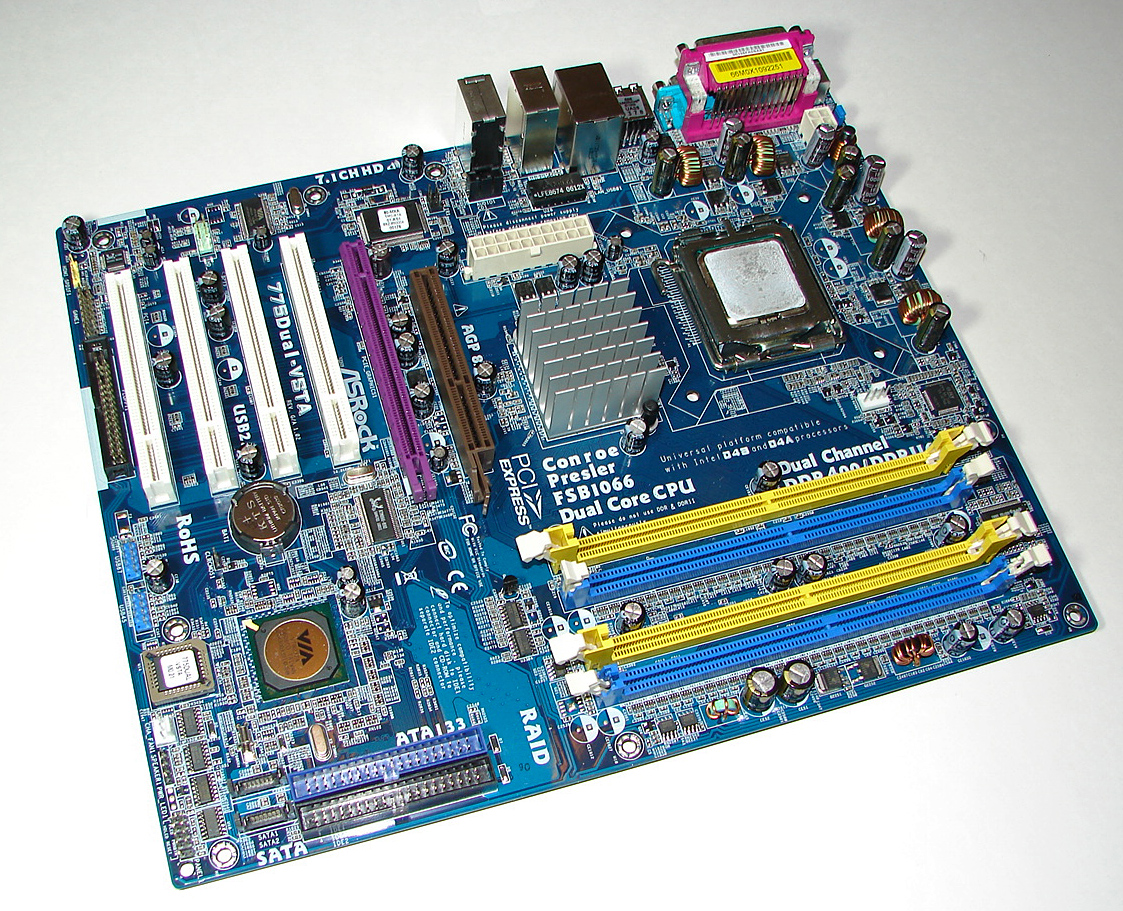
Our board is the ASRock 775Dual-VSTA that features the VIA PT880 Pro Northbridge and VT8237A Southbridge with VRM and BIOS updates that now fully support Core 2 Duo. The ASRock 775Dual-VSTA is a very unusual board considering all of the available upgrade options and is available at a low entry price of $55.
The board is laid out nicely and certainly caters to those who value IDE and PCI devices. The VT8237A only supports two SATA 1.5Gbps drives but the board does support four IDE devices. The overall feature set of the VIA chipset is the same as the Biostar PT880 Pro board we reviewed a few months back.
Our memory benchmark system uses the following components:
| Performance Test Configuration | |
| Processor: | Intel Core 2 Duo E6300 (Dual core 1.86GHz 2MB Unified Cache) |
| RAM: | 2 x 512MB Patriot DDR-400 2 x 512MB Transcend JetRam DDR2-667 |
| Hard Drive: | Seagate 320GB 7200.10 (16MB Buffer) |
| System Platform Drivers: | VIA 5.09a |
| Video Card: | 1 x EVGA 7600GS PCI-E - All Standard Tests |
| Video Drivers: | NVIDIA 91.31 |
| CPU Cooling: | Stock Intel Heatsink |
| Power Supply: | OCZ PowerStream 520W |
| Motherboards: | ASRock 775Dual-VSTA (VIA PT880Pro) |
| Operating System: | Windows XP Professional SP2 |
| BIOS: | AMI 1.50 |
Our test system represents a blend of performance and pricing requirements for a budget Core 2 Duo system. While the choice and wattage of the power supply could be varied to less expensive alternatives we believe having a high quality power supply is critical for system stability and overclocking potential. The performance of the Seagate 320GB drive is near the top of the performance charts while offering excellent capacity for a cost of around $95. If you are upgrading your hard drive with the rest of the system this drive should be at the top of your list. Our EVGA 7600GS video card choice represents a very good mid-range alternative and ensures you have respectable game performance at resolutions under 1280x1024 for less than $130.
Our board is the ASRock 775Dual-VSTA that features the VIA PT880 Pro Northbridge and VT8237A Southbridge with VRM and BIOS updates that now fully support Core 2 Duo. The ASRock 775Dual-VSTA is a very unusual board considering all of the available upgrade options and is available at a low entry price of $55.
 |
| Click to enlarge |
The board is laid out nicely and certainly caters to those who value IDE and PCI devices. The VT8237A only supports two SATA 1.5Gbps drives but the board does support four IDE devices. The overall feature set of the VIA chipset is the same as the Biostar PT880 Pro board we reviewed a few months back.


 Facebook
 Twitter
 RSS
RSS


55 Comments
View All Comments
shambf00 - Monday, December 4, 2006 - link
Gary, please, how were you able to change the memory ratio?I have DDR 400mhz on this motherboard with the E6300, however, the motherboard sees it as DDR 333mhz even after I set the speed manually.
Can you (or anyone else who knows about this) tell me where to change the memory ratio so my ram can run at it's normal speed?
Thanks!
lumbergeek - Friday, February 9, 2007 - link
The only way I was able to change the memory ratio (this board with E6300, 2GB Mushkin low-latency DDR400 and an AGP ATI 1650pro) was to play around with the manual setting for RAM and FSB - the board seems to select the multiplier on it's own. If anyone knows how to adjust it manually, I'd love to know about it myself!tomppi - Thursday, August 24, 2006 - link
..have had some 2-3-2-6-1 kingston memory for 2 years now (KHX3200AK2_1G)used to be on a ASUS A7N8X-E Deluxe. only did 2.5-3-3-12-1
now with the asrockdual-vsta i can't keep it stable unless i run at ~3-3-3-12-2 (400mhz)
why can't I even come close to the speeds shown in this article :(
GoatMonkey - Wednesday, August 9, 2006 - link
I have a possibly stupid question. Will this board work with only one stick of memory or do they need to be added in pairs. I have a single 1GB DDR400 stick in my Athlon XP3200 that would be nice to be able to use, but if I have to buy new memory anyway I might as well get the DDR2.Gary Key - Wednesday, August 9, 2006 - link
No Question is Stupid. :)However, sometimes my answers might appear that way. ;-)
The board works fine with a single stick of memory but you will be regulated to single channel operation. This places a 3%~7% performance penalty on most applications although you will need benchmarks to tell the difference in most cases.
johnsonx - Wednesday, August 9, 2006 - link
Perhaps it might be worthwhile to show performance numbers for the single-channel situation in one of the upcoming articles? I'm sure many people are in similar situations. My 754 machine just has a single 1Gb DDR400 stick as well, so if I were to consider a value Core 2 cpu & board combo (of the sort Fry's may offer in the coming months) I might want to continue using that memory if it will work and not completely cripple the performance.veryevilmike - Thursday, August 10, 2006 - link
Is the asrock 775-HDTV rev2 (using the ati xpress200 chipset) one of the budget boards on the review list? It is limited to single channel but was contemplating this as a stopgap for a few months until rd600 & co arrive, when the board would become a cheap htpc. its also one of the only uATX conroe boards available.All up, congrats on doing such a useful 'realistic' review early on in the piece - makes a nice change from all the super-expensive stuff that is not in the picture for 99% of people.
GoatMonkey - Wednesday, August 9, 2006 - link
Sounds good to me. I could go with that for a while and later upgrade to the DDR2 and new video card, and a better motherboard at some point after that. An e6600 should be available for around $350 (one of these days anyway), and then this board for under $75 or so. Roughly $400 to $425 for a significant upgrade and an easy path for other components sounds good to me.Sunrise089 - Wednesday, August 9, 2006 - link
Now after the most obvious subject line of all time, here's what I'm thinking:I continue to be impressed with Conroe's performance, but grow more and more dissapointed with Conroe's performance scaled to price. With s939 basically any price paid could get you very near FX-57 speeds. Cheap DFI Infinity board + Cheap Opteron 144 or a lucky 3000+ = 2.6+ghz on air with a good cooler. An FX-57 might hit 3.0ghz on air if you were very lucky.
Conroe doesn't seem to work that way. Sure the top 2 or 3 processors perform the same, give or take, but the lower cache processors loose a lot of performance (much more than the above mentioed Athlons). Then, getting a cheaper motherboard really lowers maximum overclock. Then high-performance memory costs a lot more, and probably adds more performance as well. Finally really cheap parts like this totally cripple performance.
I think as more people come to relize this we will see a reality check from the community, where many on the high end will end up with awesome Conroe systems, but many others will realize with their budgets a nicely upgraded s939 X2 system with their existing servicable DDR memory and a newly discounted X1900XT will be a better overall platform dollar for dollar. This user is certainly beginning to lean that way. And heck, by the time I have to upgrade for a second time Conroe should be available with a 1066mhz FSB anyways.
Paladin165 - Wednesday, August 9, 2006 - link
"the lower cache processors loose a lot of performance"Wheres your evidence for this? Hasn't it been established that the performance hit is around 3% on average? (http://www.anandtech.com/cpuchipsets/showdoc.aspx?...">http://www.anandtech.com/cpuchipsets/showdoc.aspx?...