



nForce4 SLI Roundup: Painful and Rewarding
by Wesley Fink on February 28, 2005 7:00 AM EST- Posted in
- Motherboards
Firewire and USB Performance
It is really difficult to put together a simple, repeatable, and consistent test to measure USB and Firewire Performance. Since our goal was to make this a standard part of motherboard testing, we needed a benchmark that was reasonably simple to run and that would also provide consistent results on the same test bed. We finally determined that an external USB 2.0, Firewire 400, and Firewire 800 hard disk might be a sensible way to look at USB and Firewire throughput.Our first efforts at testing with an IDE or SATA drive as the "server" yielded very inconsistent results, since Windows XP sets up cache schemes to improve performance. Finally, we decided to try a RAM disk as our "server", since memory removed almost all overhead from the serving end. We also managed to turn off disk caching on the USB and Firewire side by setting up the drives for "quick disconnect" and our results were then consistent over many test runs.
We used just 1GB of fast 2-2-2 system memory set up as a 450MB RAM disk and 550MB of system memory. Our stock file was the SPECviewPerf install file, which is 432,533,504 bytes. After copying this file to our RAM disk, we recorded the time to write from the RAM disk to our external USB 2.0 or Firewire 400 or Firewire 800 drive using a Windows timing program written for AnandTech by our own Jason Clark. The copy times in seconds were then converted into Megabits per second (Mb) to provide a convenient means of comparing throughput. Higher Rates therefore mean better performance.
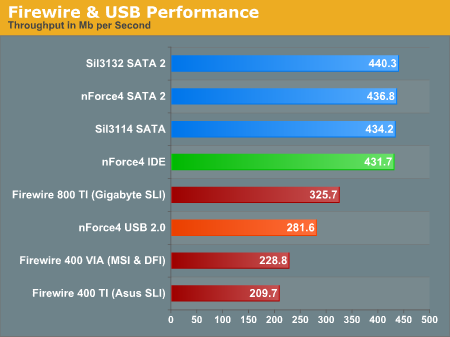
Our test is just one of many throughput tests, but in this benchmark, it is clear that the VIA Firewire 400 is faster than TI's 1394a chip.
All of the SATA solutions also slightly outperform IDE in our timed copy from RAM disk. We did not have SATA 2 drives to test with the onboard nVidia SATA2 or the MSI Sil3132, but it is still interesting that throughput with a SATA 1 drive is still a bit faster on the SATA 2 controllers than on SATA 1. We are looking forward to testing the SATA 2 controllers with true SATA 2 drives, which should begin appearing in the next few weeks.


 Facebook
 Twitter
 RSS
RSS


108 Comments
View All Comments
TigerFlash - Monday, July 4, 2005 - link
I thought this link would be rather important to see:http://forum.msi.com.tw/index.php?topic=82427.0
TigerFlash - Monday, July 4, 2005 - link
NightCrawler - Thursday, May 5, 2005 - link
You make a big deal out of the fact that the DFI can hit 318 but they both do the same 2.8 ghz, users won't see much difference, if any.Asus: Maximum OC:
(Standard Ratio) 234x12 (Auto HT, 2-3-3-7, 1T, 2.8V)
2808MHz (+17%)
Maximum FSB:
(Lower Ratio) 255x11 (2805MHz) (4X HT, 2.5-3-3-7, 2.7V)
(1:1 Memory, 1T, 2 DIMMs in DC mode)
(+28% Bus Overclock)
DFI: Maximum OC:
(Standard Ratio) 238x12 (Auto HT, 2-3-2-7, 1T, 2.9V)
2856MHz (+19%)
Maximum FSB:
(Lower Ratio) 318x9 (2862MHz) (Auto HT, 2.5-4-3-7, 2.9V)
(1:1 Memory, 1T, 2 DIMMs in DC mode)
(+59% Bus Overclock)
DeanO - Monday, April 18, 2005 - link
Don't know if anyone's noticed yet, but I just took a trip over to MSI's website, and guess what? Only the SLI mobo has the Creative chip. The Neo4 (i.e. nF4 Ultra chipset) mobo uses the Realtek ALC850. I for one was disappointed...That makes for an interesting decision: the SLI board is still cheaper than the Ultra board plus a Creative 24-bit sound card. Hmmm...
phusg - Friday, March 4, 2005 - link
New PCI card with C-Media DDL chip: http://www.avsforum.com/avs-vb/showthread.php?s=&a... ge=20&pagenumber=1Currently only available via ebay apparantly:
http://search.ebay.com/HDA-Digital-X-Mystique-7-1-...
If it has the same performance as Soundstorm remains to be seen. Reading the thread the EAX support is just as dodgy as it was on Soundstorm.
ElFenix - Thursday, March 3, 2005 - link
What chipsets did your USB and firewire drives have?thanks for the great review!
bjorn44 - Thursday, March 3, 2005 - link
Anyone know how they did the memory benchmark with memtest86 3.2? I can't find any option for testing bandwidth.Thanks,
Bjorn
giz02 - Wednesday, March 2, 2005 - link
Well if it's any consolation, PCSTATS have updated thier site review of the MSI Neo4 Plat SLI (and will probably make two more updates to it)- now states 96Khz
- will modify DICE statement
- they are indicating that the sil3132 can do raid5, but I'm not sure that it can...
Wow Roomraider, that's quite the system you have there.
Roomraider - Wednesday, March 2, 2005 - link
#82 u r absolutely correct sir. I have the top SB card available(Audigy 4 Pro)& the only way i get DTS or Dolby Digital of any form is SPDIF out Via Coax or Fiber optic cable with settings for (Passthrough) to my Yamaha 7.1 Amp.MOBO Gigabyte Ga-K8NXP-SLI
CPU AMD Athlon 64 FX-55
Cooler Gigabyte 3D CoolBlue Ultra Gt
PSU Thermaltake Purepower 650 Watt
MEMORY 4xCorsair 512Mb 3200XMS PRO Tracer Ram/Dual channel 2-2-2-5
Video 2xBFG 6800GT OC PCIE W/Serials in order
HDD 2xWD-74 GB Raptor HDD/Raid(0)configged
2xMaxtor 300 GB SATA HDD
OPTICAL 2xPlextor PX716SA-SATA 16xDual Layer+-DVDRW-48xCDR
CASE Lian-Li P60 W/clear side panel
MODS 4 Blu 80mm/1 Blu 92mm(roof/exh)& 4 Blu Cold Cathode Lite Strips
MONITOR Sony SDM-P234 23" 1920x1200 native
SOUND Creative Audigy-4 Pro,YamahaDSP-A3090 7.1ch amp/Boston Micro90 spks/Bose AM-5 W/Sub
ADD-ON MSI TV@nywhere Personal Cinema FX5200 TV/FM tuner
Tatunkhamon - Wednesday, March 2, 2005 - link
I admit this is slightly OT, but as I first got excited about the possible DD-encoding feature on the MSI-mobo and then let down by the obvious lack of it, I was happy to find these news:http://news.designtechnica.com/article6709.html
http://www.engadget.com/entry/1234000683034067/
I know many of us don't like the DRM/HDCP-features of HDMI, but HDMI certainly is the way to transmit high-definition, multichannel audio *without the need* to compress ie. encode to DD. And live content, such as games, would not probably have the copyprotection flags on, anyway. Of course, getting enough coverage for HDMI in both h/w and s/w will take time, but I bet this is the way it's ment to be played in the near future.
For example, think about combining this with s/w generated mc-audio and Intel HDA. No need for badly implemented codec/DAC in this model. Of this combined with discreete graphics card and the audio generated with the help of vector processing on the card.. I just hope Intel/Nvidia/ATI/whoever would start a strong enough, open standard to compete with EAX. Then Creative would either have to run, fast, or join their forces.
Meanwhile, because there is not much HDMI-support (except for the earlier, non- multichannel-high-def-audio-supported HDMI-standard, for mainly graphics) some solution providing DD-encoding to be sent over standard S/PDIF would still be very, very desired for many of us.
I end this thread-hijacking attempt here and apologize if being OT. Now back to our regular programming... :)
Wbr, Tatu