



No more mysteries: Apple's G5 versus x86, Mac OS X versus Linux
by Johan De Gelas on June 3, 2005 7:48 AM EST- Posted in
- Mac
The G5 as Server CPU
While it is the Xserve and not the PowerMac that is Apple's server platform, we could not resist the temptation to test the G5 based machine as a server too. Installed on the machine was the server version of Mac OS X Tiger. So in fact, we are giving the Apple platform a small advantage: the 2.5 GHz CPUs are a bit faster than the 2.3 GHz of the Xserve, and the RAM doesn't use ECC as in the Xserve.
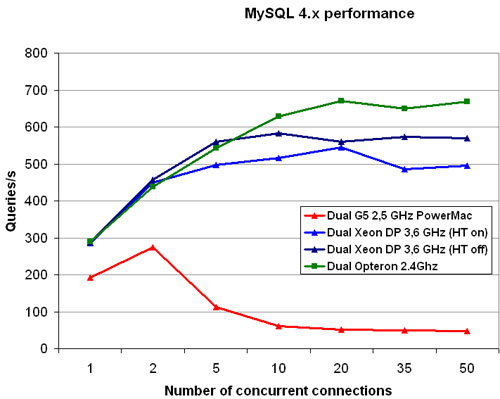
| Dual G5 2,5 GHz PowerMac | Dual Xeon DP 3,6 GHz (HT on) | Dual Xeon DP 3,6 GHz (HT out) | Dual Opteron 2.4Ghz | |
| 1 | 192 | 286 | 287 | 290 |
| 2 | 274 | 450 | 457 | 438 |
| 5 | 113 | 497 | 559 | 543 |
| 10 | 62 | 517 | 583 | 629 |
| 20 | 50 | 545 | 561 | 670 |
| 35 | 50 | 486 | 573 | 650 |
| 50 | 47 | 495 | 570 | 669 |
Performance is at that point only 1/10th of the Opteron and Xeon. We have tested this on Panther (10.3) and on Tiger (10.4.1), triple-checked every possible error and the result remains the same: something is terribly wrong with the MySQL server performance.
SPEC CPU 2000 Int numbers compiled with GCC show that the G5 reaches about 75% of the integer performance of an equally clocked Opteron. So, the purely integer performance is not the issue. The Opteron should be quite faster, but not 10 times faster.
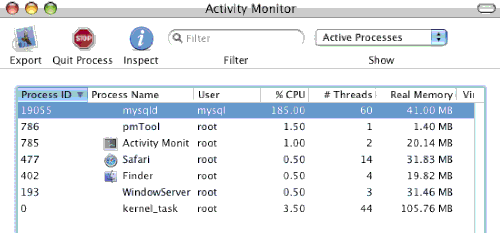
We checked with the activity monitor, and the CPUs were indeed working hard: up to 185% CPU load on the MySQL process. Notice that the MySQL process consists of no less than 60 threads.
| Concurrency | Dual Powermac G5 2.5 GHz (Panther) | Dual Powermac G5 2.7 GHz (Tiger) | Dual Xeon 3.6 GHz |
| 5 | 216.34 | 217.6 | 3776.44 |
| 20 | 216.24 | 217.68 | 3711.4 |
| 50 | 269.38 | 218.32 | 3624.63 |
| 100 | 249.51 | 217.69 | 3768.89 |
| 150 | 268.59 | 256.89 | 3600.1 |
The new OS, Tiger doesn't help: the 2.7 GHz (10.4.1) is as fast as the 2.5 GHz on Panther (10.3). More importantly, Apache shows exactly the same picture as MySQL: performance is 10 times more worse than on the Xeon (and Opteron) on Linux. Apple is very proud about the Mac OS X Unix roots, but it seems that the typical Unix/Linux software isn't too fond of Apple. Let us find out what happened!


 Facebook
 Twitter
 RSS
RSS


116 Comments
View All Comments
edchi - Tuesday, June 26, 2007 - link
I haven't tried this yet, but will do tomorrow. Here is what Apple suggests to create a better MySQL installation:
http://docs.info.apple.com/article.html?artnum=303...">http://docs.info.apple.com/article.html?artnum=303...
grantma - Tuesday, April 18, 2006 - link
I found Gnome was a lot more snappy than OS X desktop under Debian PowerPC. You could tell the kernel was far faster using Linux 2.6 - programs would just start immediately.heaneyforestrntpe68 - Thursday, October 21, 2021 - link
At least the non-ECC RAM, that is. https://bit.ly/2XwdzPtpecosbill - Wednesday, June 15, 2005 - link
I'm not going to waste my time searching to see if these same comments below were made already, but the summary of them is those who are performance oriented tune their code for a CPU. You can do the same for an OS. Also, the "Big Mac" cluster in VA tech speaks otherwise to raw performance as OS X was the OS of choice. From macintouch.com:Okay, stop, I have to make an argument about why this article fails, before I explode. MySQL has a disgusting tendency to fork() at random moments, which is bad for performance essentially everywhere but Linux. OS X server includes a version of MySQL that doesn't have this issue.
No real arguments that Power Macs are somewhat behind the times on memory latency, but that's because they're still using PC3200 DDR1 memory from 2003. AMD/Intel chips use DDR2 or Rambus now ... this could be solved without switching CPUs.
The article also goes out of its way to get bad results for PPC. Why are they using an old version of GCC (3.3.x has no autovectorization, much worse performance on non-x86 platforms), then a brand spanking new version of mySQL (see above)? The floating point benchmark was particularly absurd:
"The results are quite interesting. First of all, the gcc compiler isn't very good in vectorizing. With vectorizing, we mean generating SIMD (SSE, Altivec) code. From the numbers, it seems like gcc was only capable of using Altivec in one test, the third one. In this test, the G5 really shows superiority compared to the Opteron and especially the Xeons"
In fact, gcc 3.3 is unable to generate AltiVec code ANYWHERE, except on x86 where they added a special SSE mode because x87 floating point is so miserable. This could have been discovered with about 5 minutes of Google research. It wouldn't had to have been discovered at all if they hadn't gone out of their way to use a compiler which is the non-default on OS X 10.4. Alarm bells should have been going off in the benchmarkers head when an AMD chips outperforms an Intel one by 3x, but, anyway ...
I hate to seem like I'm just blindly defending Apple here, but this article seems to have been written with an agenda. There's no way one guy could stuff this much stuff up. To claim there's something inherently wrong with OS X's ability to be a server is going against so much publicly available information it's not even funny. Notice Apple seems to have no trouble getting Apache to run with Linux-like performance: [Xserve G5 Performance].
Anyway ... on a more serious note, a switch of sorts to x86 may not be a hugely insane idea. IBM's ability to produce a low power G5 part seems to be seriously in question, so for PowerBooks Apple is pretty much running out of options. Worse comes to worst - if they started selling x86-powered portables, that might get IBM to work a bit harder to get them faster desktop chips.
-- "A Macintosh MPEG software developer"
christiansen89 - Monday, December 6, 2021 - link
Guess there's no one arguing that the PPC is not keeping its pace with the current market, but rather OS/X able to do Big Iron computing. And if rumors are true, where will you be able to get a PPC built once Apple drops IBM for Intel? https://tvzyon.com/aladdin0tw - Tuesday, June 14, 2005 - link
This is my first time to see someone use 'ab' command to conduct a test, and trying to tell us something from the test.In my opinion, ab is never a 'stress test' tool for any reason, especially when you want to conclude some creditable benchmark from this test. If we can accept 'ab', why I have to code so much for a stress test?
The 'localhost' is another problematic area, DNS. Why not using a fixed ip as an address? The first rule of benchmaking is isolated the domain in question, but I can not see you obey these rule. So how can you interpret your result as a performance faulty, not a dns related problem?
I think you should benchmark again, and try some good practices used in software industry.
Aladdin from Taiwan
demuynckr - Sunday, June 12, 2005 - link
jhagman, the number in the apache test table means the request per second that the server handles.jhagman - Wednesday, June 8, 2005 - link
Hi again, demuynckr.Could you please answer to me, or preferably add the information to the article. What the does the number in the apache test table mean and what kind of a page was loaded?
I assumed that the numbers given were hits per second or transfer rate. I've been testing a bit on my powerbook (although with a lower n) and I can very easily beat the numbers you have. So it is apparent that my assumption was wrong.
BTW, gcc-3.3 on Tiger knows the switch -mcpu=G5
rubikcube - Wednesday, June 8, 2005 - link
I thought I would post this set of benchmarks for os x on x86 vs. PPC. Even though XBench is a questionable benchmark, it still is capable of vindicating these questions about linux-ppc.http://www.macrumors.com/pages/2005/06/20050608063...
webflits - Wednesday, June 8, 2005 - link
"Yes I have read the article, I also personally compiled the microbenchmarks on linux as well as on the PPC, and I can tell you I used gcc 3.3 on Mac for all compilation needs :)."I believe you :)
But why my are results I get way higher than the numbers listed in the article?