



The Real Conroe Successor: Clarkdale & All You Need to Know about Westmere
by Anand Lal Shimpi on September 24, 2009 6:00 PM EST- Posted in
- CPUs
On-package GPU and Graphics Turbo
Arrandale and Clarkdale are two-die packages. There's the 32nm CPU die and next to it is a 45nm DirectX 10 GPU die (no DX11 support until possibly Larrabee).
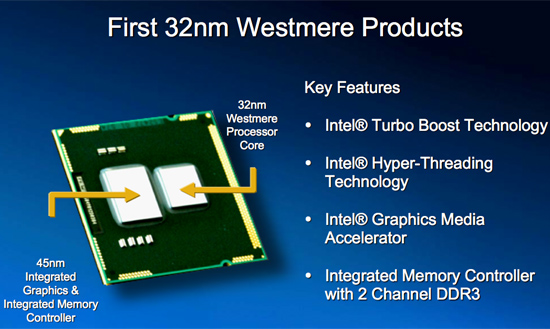
This isn't Larrabee (yet), it's a direct descendent of the graphics in G45. While G45 was built on a 65nm process, the 'dale graphics is built on a 45nm process.
The smaller transistors enable much higher performance. While G45 had 10 shader cores, the 'dale GPU increases that to 12. A number of performance limiting issues have now been resolved, so we should see much more competitive performance from Intel's graphics.
The memory controller has been moved off of the CPU die and is on the GPU die instead. It's still on-package so you get decently low latencies, but it shouldn't technically be as low as on Lynnfield. This is a temporary problem that fixes itself once the CPU/GPU are on the same die with Sandy Bridge.
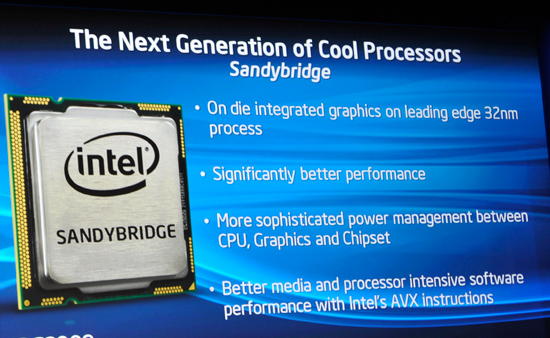
Sandy Bridge brings on-die graphics
I've already explained turbo mode quite a bit so I won't rehash it here. The technology basically allows you to run your CPU at the fastest possible frequency regardless of how many cores are active. Westmere has this.
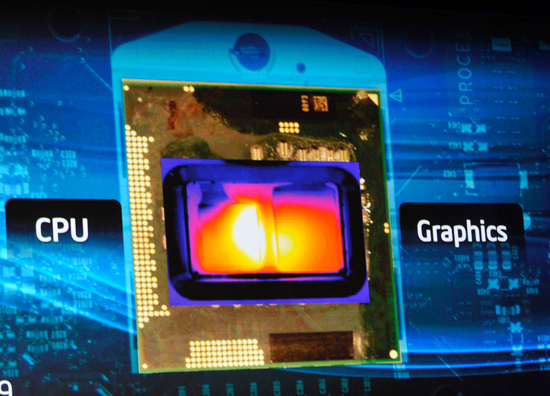
Arrandale will support graphics turbo modes, while Clarkdale won't. Clarkdale graphics is already running as fast as possible regardless of TDP.
If the GPU demand is higher than the CPU demand, the CPU will allocate more of its TDP to the GPU and vice versa.


 Facebook
 Twitter
 RSS
RSS


96 Comments
View All Comments
Wolfpup - Friday, October 16, 2009 - link
Dual core CPUs in 2010, AFTER we've had quad core for three generations, and even have a fairly reasonably priced Core i7 in NOTEBOOKS now? Boooooring!cosminliteanu - Wednesday, September 30, 2009 - link
Hi,anybody know when Intel will add support for USB 3 and SATA 6 GB? And most important in which chipset/platform will be ?
Thanks.
NeBlackCat - Tuesday, September 29, 2009 - link
Once again AMD will be getting my money as I'm not being forced to buy two motherboards to get the CPU that I want now (Clarkdale) and it's immediate successor.
I'm sure you're gutted.
SFNR1 - Tuesday, September 29, 2009 - link
what PSU was being used?IKeelU - Monday, September 28, 2009 - link
I hope that mini-ITX is < 100$. I'll finally be able to upgrade from my existing atom board and its measly 2 SATA ports.cjs150 - Tuesday, September 29, 2009 - link
Exactly. Personally I am excited by this. I need to build a couple of things for the home network1. HTPC - this needs to be very very quiet. This new CPU and Mini ITX board looks spot on if (and it is a big if) Intel actually delivers on HD acceleration for both video and audio
2. Small home server to replace the ancient thing currently flogging its guts out. This looks close - low power is good but I have two big requirements. (a) standard PCI slot for my RAID card which is an 8 port SATA raid card (Broadcomm) which just works exactly as it should. (b) with all the HD streams 2 xGb ethernet ports would be nice to allow for future expansion (and yes I know it is overkill). Looks like the current minim-itx board fails on both
CrimsonFury - Thursday, October 8, 2009 - link
An 8 port SATA controller is very limited via standard PCI.Even a PCI-E x1 slot would double the bandwidth (x4 or or x8 would be better)
Just use one of the mini-ITX boards that has a PCI-E x16 slot and check a PCI-E sata controller in there.
Holy Smoke - Saturday, September 26, 2009 - link
Am I the only one who finds the tock-tick thingy retarded?It's the wrong sequence, dammit! It's like an army going 3-4-1-2 fer chrissakes!
2good2btrue - Monday, September 28, 2009 - link
Okay, how is this the wrong sequence?They optimize the circuit design, from a known good/working design, then they optimize it at the smallest current size possible.
How is this retarded?
strikeback03 - Monday, September 28, 2009 - link
I'd guess he is arguing that the tick should be the new microarchitecture, and the tock should be the shrink of that.