



How Much Does it Cost to Build a P55 Motherboard?
by Anand Lal Shimpi on August 21, 2009 3:00 PM EST- Posted in
- CPUs
In the golden age of motherboards there were dozens of manufacturers and profit margins were nice and healthy. Manufacturers could differentiate themselves based on performance, quality and features. The CPU folks had a different plan in mind. AMD and Intel have been on the road to integration for the past two decades and the motherboard manufacturers have largely suffered because of it.
When the memory controller was in the chipset and there were 3 or 4 competitors in the chipset space, motherboards actually performed differently. These days the memory controllers are integrated onto the CPU die and performance is as high as possible. SATA, audio, ethernet and USB are all either fully integrated into chipsets or only require a small support chip on the motherboard itself. Within the next decade or so these features will move onto the CPU die as well.
My first 430VX motherboard that eventually spawned into AnandTech set me (actually my parents, I was 14) back around $130. Prices haven’t really changed, yet the expectations from end users have gone up. Granted there’s this new ultra high end market that didn’t really exist back then, but the majority of motherboards sold have far more features and don’t cost much more than what they used to.
The pressure is on the motherboard makers to deliver affordable P55 solutions. Without affordable motherboards, Lynnfield will fail - so Intel and end users are both expecting a healthy supply of ~$100 motherboards. As I’m about to show you, doing so is quite difficult.
This is the LGA-1156 socket:
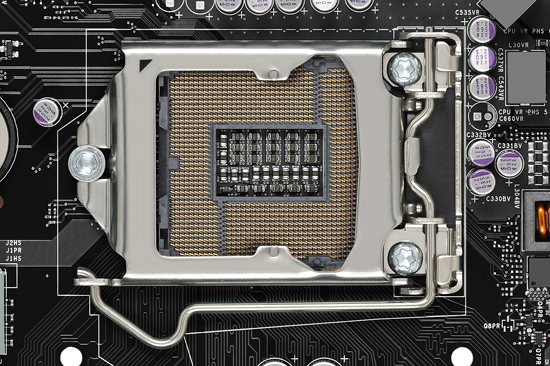
The socket itself costs a couple of dollars, but even that is significantly more than LGA-775. The motherboard makers I spoke with pegged the LGA-775 socket at well under $1 per socket. The bulk of the 1156 socket isn’t the cost of the device, but rather the licensing fee that has to be paid to Intel for each socket. I’ve heard numbers approaching $7 per socket, per board once you include the licensing fees. As volumes go up, the price per socket will go down, but for smaller manufacturers this is a tough pill to swallow. It’s far easier to build an expensive motherboard than it is to build a cheaper one.
Intel realizes this and helps the manufacturers with rebates and marketing assistance. So the license fee ultimately may be lower for some makers but getting specifics on this is impossible. Worries of lawsuits abound :)
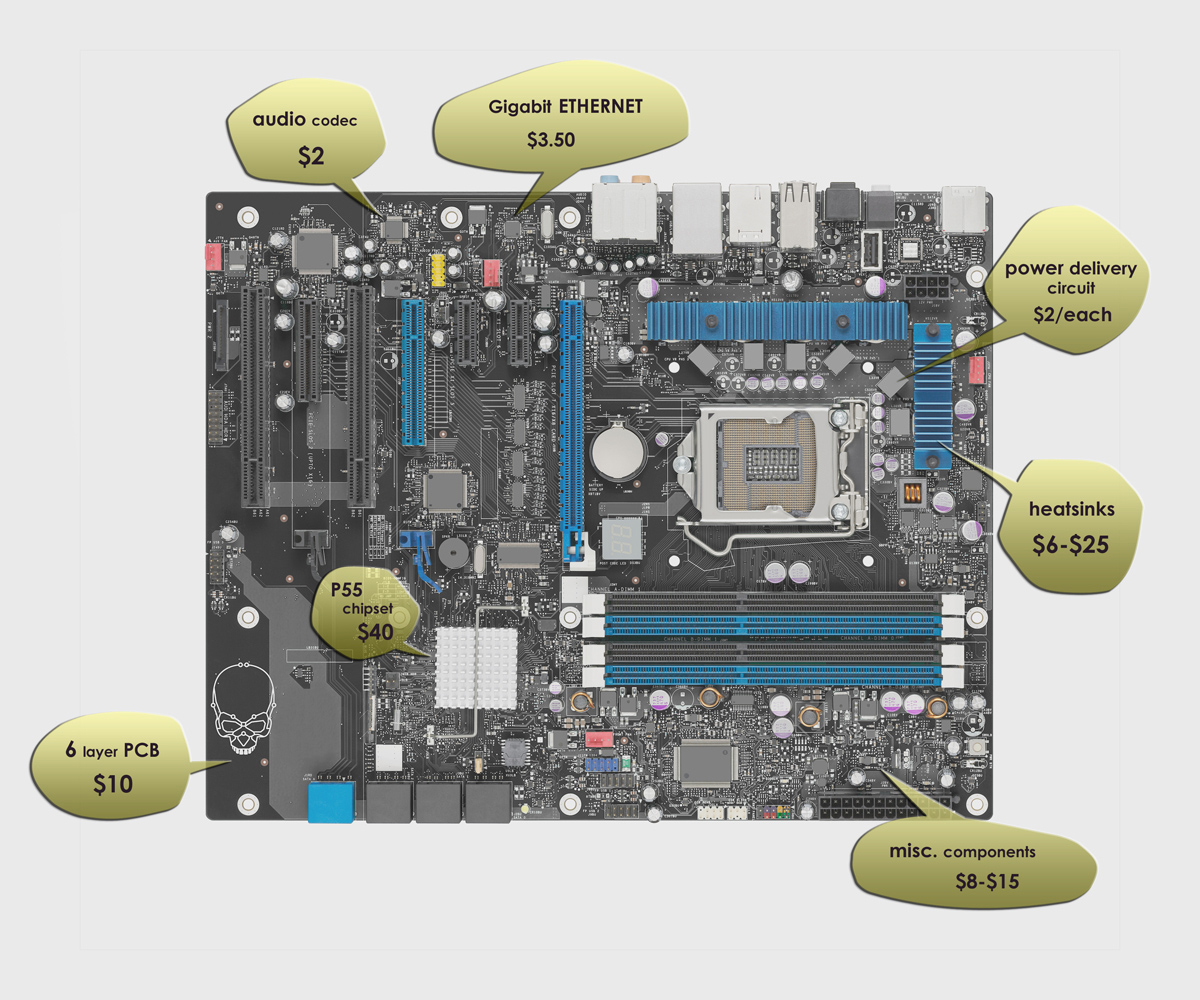
For the most part the motherboard makers look at the socket and associated licensing fees as part of the chipset cost. Despite Intel moving the north bridge and memory controller on die, Ibex Peak, otherwise known as the P55 PCH is no cheaper than P45:
| Chipset | Price |
| Intel X58 IOH | $70 |
| Intel P55 PCH | $40 |
| Intel P45 MCH | $40 |
| Intel ICH10R | $3 |
If you start at $40 for the motherboard, you’ll need to add another $10 for a 6-layer PCB. A 6-layer PCB is necessary if you want to run SLI at this point, otherwise you can get by with a cheaper $5 4-layer PCB. Mentioning SLI also requires validation and support from NVIDIA. That’s $30,000 up front plus an average of $5 per motherboard.
| Low End | Mid Range | High End | |
| P55 PCH | $40 | $40 | $40 |
| NVIDIA SLI License | $5 | $5 | $5 |
| 6 Layer PCB | $10 | $10 | $10 |
| Audio Codec | $2 | $2 | $2 |
| PCIe Gigabit LAN | $3.50 | $3.50 | $7.00 |
| Power Delivery Circuits | $12 | $16 | $23 - $55 |
| Misc PCB Components | $8 | $12 | $15 |
| Heatsinks | $6 | $10 | $25 |
| Labor/Overhead | $9 | $10 | $24 |
| Logistics/Sales | $9.50 | $13 | $18 |
| Total Cost | $105 | $121.50 | $201 |
An audio codec and Gigabit ethernet will together set you back about $5. Figure more for more expensive codecs and another $3.50 if you want dual GigE ports.
P55 motherboards will have a range of 4 to 24-phase power delivery circuitry. Each phase costs about $2 in components although the high end motherboards with high quality MOSFETs/chokes/capacitors will reach $3 per phase for the digital solutions. If we look at Gigabyte’s 24-phase UD6 that would be about $48 just in power delivery circuitry for the motherboard without volume discounts.
The power connectors, switches, LEDs, I/O back panel and other components on the motherboard cost anywhere between $8 and $15 depending on the type of motherboard. Figure $8 for an entry level micro-ATX board and $15 for the highest end boards with slots and ports aplenty.
What about those fancy copper heatpipes and elaborate heatsinks? They start at $6 and go as high as $25 for the really high end motherboards with high-content copper blocks and pipes.
Then there’s assembly, labor and overhead in testing and producing the motherboard. You can count on about 10% of total material cost for an entry level board, 12% for midrange and 15%+ for the high end boards. The lower the volume the higher the overhead; the more testing required, the higher the overhead as well (gotta make sure those $250 boards work right).
The final costs are related to packaging, sales and actually getting the boards to distributors. Figure about 10% per board on average.
All of this roughly adds up to a low end board costing $105 without worrying about profits. It's only through rebates or very large scale manufacturing that a motherboard maker can even come close to making a profit on an entry-level board. Mid range boards are a bit easier to make but my mid range estimates are definitely on the lower end of the spectrum. For the high end you're looking at raw costs over $200, but at those price points it's far easier to turn a profit.
While we'll definitely see P55 motherboards hit the $100 price point, it's worth realizing how difficult that is to do. As P55 matures, these costs will fall (particularly the chipset) but initially it's going to be a tough race to the bottom.


 Facebook
 Twitter
 RSS
RSS


54 Comments
View All Comments
McDaniel - Sunday, November 8, 2009 - link
very interesting article, really i've seen a motherboard from Gigabyte(http://www.micropartsusa.com)&">http://www.micropartsusa.com)& i thought it has no chips from Intel .. Lolzz i was wrong but i felt there should be some other chips for motherboards.bh192012 - Thursday, August 27, 2009 - link
that makes me respect the cheap boards a little more. How do you manage something like this http://www.newegg.com/Product/Product.aspx?Item=N8...">http://www.newegg.com/Product/Product.aspx?Item=N8... ? $35 aftetr rebates.$7 logistics, $7 labor, $1 audio, $2 NIC, $4 PCB misc, $5 PCB, $6 pwr, .01 cent heatsink, $10 chipset? = $42.01 ... so yeah, amazing.
bh192012 - Thursday, August 27, 2009 - link
Also, make a note of how Intel can screw us w/o a competing Nvidia chipset. They're making their CPUS looks price/performance competitive with AMD by shafting us on the motherboard. Maybe AMD should take up this tactic.Mugur - Sunday, August 30, 2009 - link
I wonder if we'll ever see another non-Intel chipset for the core i cpus...?miahallen - Thursday, August 27, 2009 - link
You mention 4-layer PCB in the article...but in your cost analisys you put a 6-layer in the "low end" system and add licensing for SLI...that's a $10 investment in pur marketing as 99% of "low end" buyers will not use SLI.Useing a 4-layer PCB and saving $5 on SLI licensing would take the "low end" system cost down to $95...with a price tag of $100, that's a $5 profit on every board, and given that your prices are not factoring in volume discounts $ rebates, I'd say there's a strong argument for $100 P55 boards.
bob4432 - Tuesday, August 25, 2009 - link
i was doing some modding and needed some custom copper heatsinks made - these were not modified off the shelf units but a different amount of fins, different thickness of base, different hole locations and i only needed 3 of them - pure copper and figure the size of a ~2U xenon heatsink - not a small ram sink but a larger, normal size cpu heatsink, and i was quoted $40/ea for 100% custom - and again, 3 total units, not 30, not 300, just 3. and this was for the good c10100 copper (i think that is the number - very high thermal transfers).sorry anand, you lose credibility w/ this post :(
SmCaudata - Saturday, August 22, 2009 - link
I was not too long ago in the buisiness of designing power supplies. I made point of load 10-50 amp cards that were designed to go into servers next to the bus and processors.A 30amp supply was much cheaper than the power solutions here. Granted these CPUs need more than that, but I still feel the estimate is high.
The heatsings are WAAAY off. A aluminum finned headsink cost us much less than one dollar. These companies extrude off big chunks like a pasta maker and cut them to the proper length/width then buff out the edges. Custom sinks, sinks with individual pins, and sinks with heat pipes will cost some money but the standard power component and chipset sinks are likely in the neighborhood of $0.50 for the entire board.
All the I/O and switches again are likely in the neighborhood of $5 for everything. These things are really cheap in mass quantities.
I'm guessing that they can make the budget boards for about $75. Still doesn't give them huge profit margins. My bet is that the boards sell for 2x manufacturing cost initially and prices drop much slower than compenent cost so they can continue to make about the same $$ per board.
Rajinder Gill - Saturday, August 22, 2009 - link
Sounds about right for the off the shelf heatsinks.With reagrds to the CPU PWM, the best solution currently available (in specs) is from Volterra. The buck controller costs around $3 and each slave $2. That's around $23 + a little extra for the inductors and caps. Sounds like it should all come together under $35 (worst case). 10 phase with this solution is capable of handling peak loads upto 600w at switching frequencies over 1MHz if needed on the top-end boards. I guess some vendors go with what they feel is more marketable rather than soemthing technically superior.
JustPassing - Saturday, August 22, 2009 - link
It seems that what the article is saying is that a low-end P55 motherboard should cost about the same as a low-end P45 motherboard.Lunyone - Saturday, August 22, 2009 - link
These prices that are stated are if you were to walk into a shop or "their" shop and were going to ask for each individual part. The cost will be marked up at least 20-40% depending on what part it is. I believe most of this price breakdown is to convince people that you SHOULD buy an i5 mobo, becasue your getting such a DEAL. It's sorta like if you went down to your parts store and ordered every part for your car. It'll cost 5x or more than when you buy it off the car lot.I work in the semiconductor industry and I know that the part prices that the regular joe is going to pay, ISN'T EVEN close to what the part actually costs. This is normal business 101. I would bet that the lower end mobo's for the i5's are probably about 20% less, especially in bulk, maybe more. So when I see a $100 mobo price break down, I conclude that it probably is costing the manufacturer about $70-80, this would be including all costs involved (engineering, labor, etc.). Now some places have different profits, mainly because of the labor costs and the manufacturing costs, so there will be different profits to be had.