



AMD's SB750: Enabling Higher Phenom Overclocks?
by Gary Key on July 23, 2008 12:00 AM EST- Posted in
- CPUs
The web has been alive with rumors of an upcoming update to AMD's 7-series chipsets that will somehow unlock the true overclocking potential of its Phenom processors. The rumor goes something like this: an updated South Bridge (SB750) will improve communication with Phenom, removing a previous bottleneck and improving the maximum overclock possible. We can't begin to explain the many issues with the various rumors, but we have to allow that somewhere buried deep in these rumors there is a morsel of truth.
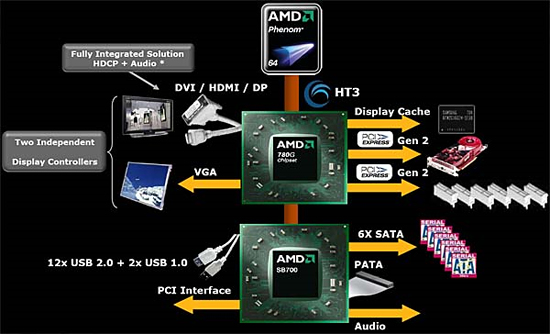
The AMD 780G chipset, the South Bridge is the chip, er, at the south end of the image. USB, SATA and Audio all stem off of this chip.
The South Bridge of a chipset is typically responsible for I/O operations. The non-critical PCIe lanes come off of this chip, as do the SATA and USB ports. Audio codecs, networking interfaces and virtually all other components are also run off the South Bridge. The North Bridge on the other hand talks directly to the CPU and connects it to much higher speed elements of the system; things like graphics cards and main memory all stem from the typical North Bridge design. The point of this explanation being that if anything were going to improve overclocking performance, we would assume it would be the North Bridge, not the SB. However, AMD has taken a different approach from traditional chipset engineering as we will soon see.
We've been waiting for a motherboard with AMD's SB750 South Bridge ever since we started hearing these rumors, and we finally received one:
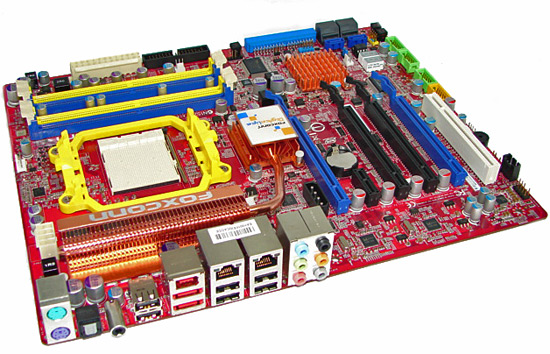
Foxconn sent us their new A79A-S motherboard that is part of their Digital Life series of products. This motherboard was not designed to be an extreme overclocker, but instead a feature rich platform that offers the capability to overclock when required. In testing to date, the board has actually gained a reputation of being an excellent overclocker along with a full featured BIOS. While the BIOS options are not as extensive as the top end 790FX products from ASUS or DFI, there are more than enough options to ensure successful overclocking for the vast majority of users. Foxconn is still developing the BIOS and we have sent our feedback on a few areas we would like to see improved, but overall, this board gets a recommendation from us.
We will take an additional look at the board during the official 790FX/SB750 launch activities next week but here are a few major features. The A79A-S includes four x16 PCIe 2.0 slots (dual x16 or quad x8 electrical), one PCIe x1 and one PCI slots, six native SATA II ports featuring RAID 0, 1, 5, or 10 support, two dual e-SATA ports, dual Gigabit LAN ports, Realtek ALC888 HD audio featuring DTS Connect and Dolby Digital Live support, 12 USB 2.0 connections, dual IEEE-1394a connections, LED Debug display, and on/Off/CMOS buttons.
Let's take a look at how all of this works, at least what we know works.


 Facebook
 Twitter
 RSS
RSS


48 Comments
View All Comments
bbqchickenrobot - Monday, August 11, 2008 - link
This article claims the PCIe slots are 1.x when they are in fact 2.0 as stated in the manual, website and other sources.Just wanted to make everyone aware of this. There are four total PCIe 2.0 that can run 2x PCIe 2.0 cards at x16/x16 or 4x PCIe 2.0 cards at x8/x8/x8/x8
To get around this, get an X2 version of the Radeon HD 3870 or 4870 and then crossfire with another one or drop down to a standard 3870/4870
MikeODanyurs - Wednesday, August 6, 2008 - link
Anyone see AMD OverDrive 2.1.2 available for download yet? It's Wednesday the 6th, official release day of 790GX+SB750.CZroe - Monday, July 28, 2008 - link
"it's unclear whether or not whatever AMD is doing here can even work on K8 if they tried."Nope. I've been waiting for a board/BIOS maker to expose this chipset setting since the Athlon XP Mobile Barton CPUs first made me aware of it. My Mobile Barton Athlon XP was basically a completely unlocked bin-sorted Athlon XP 3200+ that was stable at lower voltages expected to be run at much-lower voltages and clock speeds.
With it, I discovered that there was clearly a chipset setting not exposed when my Mobile Barton failed to reach 200/400FSB in an nForce2 Ultra400 board (the Shuttle board inside my SN45G XPC... the FN45-whatever IIRC) while the same CPU could easily do 450+FSB in an Asus A7N8X-E Deluxe and an Abit NF7-S. The solution? Drop a thin wire inside the socket to make this completely unlocked CPU *DEFAULT* to 400FSB and it runs perfectly fine and can even go higher (the L12 trick/mod).
With the default FSB being the only difference (all settings/frequencies, including the FSB, were the same), it was very clear that it was related to a calibration setting that was automatically applied by the chipset based on the default FSB (100MHZ/200FSB for this unlocked CPU). Previously, I could only get to 333FSB before Memtest 86+ would start giving errors. There were some reports of even the overclocking boards (mentioned earlier) getting higher with the L12 trick and later many had BIOS updates and board revisions that seemingly integrated the trick. Regardless, the setting was still not exposed and was likely not even something the board/BIOS makers could expose (though they could spoof the default FSB I'd assume). It looks like AMD, having full control of chipset and board-level options here, has finally let the cat out of the bag.
Although the FSB has become the HT bus, the behavior is the same. Changing the calibration setting allows for higher clocks while actually becoming unstable at lower clocks. Ever accidentally erased the OSCAL calibration value on a PIC microcontroller and had to find a working value through trial and error? I'm guessing that this is why it was automatic before.
initialised - Sunday, July 27, 2008 - link
Leads me to suspect that ACC is a means of adjusting the substrate potential to provide a bias to the bottom of the SOI stack to control the threshold voltage of the transistors.SirYes - Friday, July 25, 2008 - link
To spread the word: http://ubuntu-virginia.ubuntuforums.org/showthread...| To be honest I find it hard to believe that they have a campaign
| against Linux. There would be nothing to gain and would have
| a zero fiscal gain.
|
| I think it is a bug you have found
After looking through the disassembled BIOS for the last several hours, rebooting it, and tweaking it more, I'd say this is very intentional, I've found redundant checks to make sure it's really running on Windows, regardless what the OS tells it it is, and then of course fatal errors that will kernel panic FreeBSD or Linux, scattered all over the place, even in the table path for Windows 9x, NT, 2000, XP, and Vista, and had to correct them (Well, at least divert them off into a segment of RAM I hope to god I'm sure about)
No, this looks extremely calculated, it's like they knew someone would probably go tearing it apart eventually and so tried to scatter landmines out so as to where you'd probably hit one eventually.
So if it is a mistake, or incompetence, then it's the most meticulous, targeted, and dare I say, anal retentive incompetence I've seen.
Will14 - Friday, July 25, 2008 - link
I've never had much faith in Windows OC tools.However if this one actually works and AMD can up their speeds a little then I may switch back for my next system.
I must say my 6400-8400(cheated got an e3110 with 20% discount when first released and they were all $280 or OOS for $170). Upgrade path was seamless and I feel bad going from 1950Pro to 8800GT 512 but I follow my wallet not the company I root for.
A cheap system built off cheap Black Box edition(OC'd easily with their tool) and 4870x2 would be pretty sweet come this December if the new cores are kicking and the utils work(a lot of ifs). Not that I need a new system though, but if one did. I don't see nehalems being affordable anytime soon(unless new AMD core rocks(another if)), although my mobo would support. I like the $200 mark for processors $100 for HDD's $200 for gpu's plus generally only needing 1-4 new parts for a yearly $400ish upgrade which is cheaper and allows better performance than the $1-2k some people build.
Zisyncmon - Friday, July 25, 2008 - link
Does anyone know when they will release more info? Gary? Any estimates of when to expect another article? Or will we have to be in suspense all weekend.geok1ng - Thursday, July 24, 2008 - link
I am really hoping that AMD can make some competition on CPU market as they did on the IGP (man i am really looking forward to the next IGP offer from AMD, the 780G is the king, the next chip will be a market consolidating move for sure)and VGA markets but i am not joking when i ask:Will a 3.1Ghz ultraoverclocked quad core Phenom beat a $80 E2180@3,1Ghz in gaming and common day tasks?
As i remember the C2Ds are 15%-25% faster clock per clock, and the AMD CPUs consume MORE power for the same tasks , because they take LONGER to do the same task of a C2D.
jslusser - Thursday, July 24, 2008 - link
So does this ACC on the SB750 do anything for vanilla Phenom's? Will it unlock the multiplier on the non-black Phenoms or just make them more stable with the HT and memory over clocks?I'd like to see where the 9150e/9350e can get to with ACC and the power usage, since the voltage, etc doesn't change. So many questions...
HazaroudsSmoker - Friday, July 25, 2008 - link
First, you can't unlock the multiplier on the non Black Edition Phenoms. They are locked at the factory during manufacturing and can not be altered.Sounds like there will be an advantage still to having the SB750 with Vanilla Phenoms.
Can't wait for Benchmarks.