



NVIDIA 780a: Integrated Graphics and SLI in One
by Gary Key on May 6, 2008 12:00 AM EST- Posted in
- CPUs
After being blitzed by the NVIDIA marketing machine at CES 2008 about upcoming chipsets, we were excited about the technological possibilities NVIDA was planning to deliver a few weeks later. As it turns out, it was a few months later but as of today NVIDIA is officially introducing the nForce 780a SLI chipset and its family companions, the 750a SLI and 730a chipsets.
At first look, it appears NVIDIA has mastered the marketing checklist with features ranging from HyperTransport 3.0 and PCI Express 2.0 to the environmentally friendly Hybrid Power and performance enhancing Hybrid SLI capabilities. Of course, AMD has featured HT 3.0 and PCI Express 2.0 on their 790FX chipset since November and the 780G had Hybrid CrossFire operating since March. However, AMD does not offer Hybrid power capabilities nor does the flagship 790FX offer integrated graphics capabilities. We will have to wait a few more months for the AMD 790GX to arrive for those two features.
In the meantime, NVIDIA sits alone as it starts to roll out integrated graphics on all of its chipsets over the next few months. NVIDIA is calling this technology a motherboard GPU or mGPU for short. We think the inclusion of integrated graphics on all chipsets is a definite step in the right direction and one that we applaud if done correctly. Our first results indicate that NVIDIA is on the right path, although one that was a little bumpy for us.
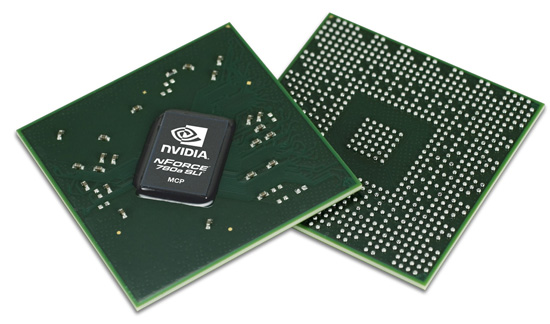
The most important design element of the nForce 780a SLI and other chipsets in this product family is the mGPU. Based upon the 8400GS core, it offers decent casual gaming and application performance as a standalone unit. This capability is nothing new as integrated graphic chipsets have been around for a long time. However, the IG performance is clearly a step above what NVIDIA has offered in the past, but a step below the current 780G from AMD. Besides offering extensive HD playback capabilities and additional monitor outputs, its primary purpose is seguing into NVIDIA’s Hybrid SLI technology.
Hybrid SLI offers two different and very distinct technologies that consist of GeForce Boost and Hybrid Power. GeForce Boost allows for the pairing of the mGPU with a discrete graphics card (dGPU) to provide SLI capability to improve 3D performance. Since the mGPU is an 8400GS in disguise, the natural pairing of this technology is with a discrete 8400GS card. NVIDIA provides support for the 8500GT also as its performance closely matches that of the mGPU, anything higher would result in a mismatch in performance and negate any benefits of adding an inexpensive dGPU.
The true technological gem is the HybridPower functionality as it allows the mGPU to function as the primary display for most application tasks and high definition playback duties while the discreet graphics card is in standby waiting to tackle demanding 3D tasks. We use the term standby, but the system actually turns off the dGPU to conserve power until required. In actual practice, we noticed a slight delay when switching from the mGPU to the dGPU, something that we believe driver and BIOS tuning can resolve. However, the biggest drawback at this time is that only two discreet graphics solutions are supported, the 9800GTX and 9800GX2 cards.
So let’s take a detailed look at the chipset specifications and delve into the performance results of the 780a SLI chipset against its immediate competition from AMD.


 Facebook
 Twitter
 RSS
RSS


38 Comments
View All Comments
SiliconDoc - Monday, July 28, 2008 - link
Very glad this happens : " The good news is that ASUS has replicated several of our problems and we expect a new BIOS release shortly for use in the motherboard review. "That's what I call useful review that isn't a waste of time. Glad you have the reputation and the pull. ( one wonders what they do at Acer - I guess they wait for you guys to tell them...)
piroroadkill - Sunday, May 11, 2008 - link
I agree with the guys who are saying they need to make discrete (not discreet, jesus) GPUs consume much less power when idling, even if that means a hybridpower style segmentation of the gpu, but it should be done all on the hardware, completely transparent to the chipset and systemKGR - Saturday, May 10, 2008 - link
Maybe hybrid sli doesnt help frame rates too much , but it can make sense when nvidia integrates the Ageia pysics in gpu, then the mgpu can take the load of physics and the dgpu the graphics in hybrid mode, i dont know if it is possible but i think it is...duploxxx - Thursday, May 8, 2008 - link
Always like to read the reviews and comments from your site, but why don't you just provide proof with real data instead of a hit in the dark. You already have big parts of the data in an other review.(http://www.anandtech.com/video/showdoc.aspx?i=3232...">http://www.anandtech.com/video/showdoc.aspx?i=3232...
" Whether or not this price tag is worth the premium over the nForce 750a SLI boards is up for debate. It's not really in our opinion as we do not believe the current AMD processor series is capable of the required computational power needed to support 3-way SLI or Quad SLI configurations. This is not a knock against NVIDIA as AMD has the same problem with Quad CrossFire; it just reflects the current state of the processor offerings from AMD."
why don't you just put 9750-9850+790fx+2-3way crossfire against q6600/q9300+x38+2-3way and compare total price/performance/power but perhaps need to add a x48 board since the lack of pci-e lanes on the x38
you could do the same with lower spec P35 but then again this board has no decent feature set against current amd chipset offerings when you talk about multi gpu setup but would still be interesting to read what happens when using CF on this board against amd770
gipper - Wednesday, May 7, 2008 - link
So why isn't the 750a going to be the perfect HTPC motherboard?Aren't the two requirements for the perfect HTPC motherboard native 1080p output via HDMI and 7.1 LPCM audio on the same HDMI connector? Also, the post processing with a phenom matches the AMD 780 chip feature set.
So, I don't understand why you would say that the AMD 780 is better for HTPC's.
Or are you guys suggesting that it's best to wait for the AMD 780 refresh that includes 7.1 LPCM because the integrated graphics perform so much better?
Gary Key - Thursday, May 8, 2008 - link
I personally believe the 750a would make an excellent HTPC system if you utilize a ATX case design, might plan on using it for gaming with a discreet video card, and can afford it. The GF8300 board that just arrived is a better solution at first glance (if a uATX design and not having SLI capability is important) and compares favorably to the 780G from a price to performance viewpoint, more so than the GF8200. We will have an update on it next week.We received the 175.16 drivers right after the article went live and will have some post-processing comparisons (174.14s did not handle this right) this weekend between the two chipsets. Right now, it is a toss up in my opinion, and due to that fact, I would go NV for the multi-channel LPCM.
The Jedi - Wednesday, May 7, 2008 - link
A couple of points here:[QUOTE]
This is absolutely unacceptable and would prevent us from recommending the 780a as anything more than just another SLI motherboard. HybridPower is quite possibly the best feature for a high-end SLI user and if it won't work with 30" displays then its usefulness is severely degraded.
[/QUOTE]
I'll tell ya I use a 26" LCD TV on my desktop and it's big enough. I don't need 2560x1600. 1080p (1200p) is fine and matches the pixels on HDTV. Anything 1080p capable is completely reasonable. Just up the AA or AF if the FPS are too fast for ya. Just because Dell or Apple says Uber-users need a 30-inch LCD to be cool doesn't make it true. 24", 26", 27", these are great on today's desks. I really think a 30" LCD on my desk would be too big.
Gary Key, you da man, seriously, but proofread the article for typos.
Last point, and this goes for all of Anandtech's staff: Respect due, but seriously: NO dGPU. Call it A VIDEO CARD. Or -- A GRAPHICS CARD. Also, no calling a product from a CPU or GPU company a 'part' . Call it a chip -- or a CPU or a graphics chip, etc.
strikeback03 - Thursday, May 8, 2008 - link
I'd love to see a 2560x1600 24-26" display, the more resolution the better. If that 9 megapixel LCD weren't several thousand dollars it would be sweet.Wolfcastle - Wednesday, May 7, 2008 - link
The author should clean up the grammar a bit. Anandtech has a large audience.James5mith - Wednesday, May 7, 2008 - link
Maybe I'm just foolish here, but for the extreme overclocking crowd, I see an immediate and tangible benefit:If you happen to fry your video card while OC'ing it, you can use the onboard video as a stopgap until you get it repaired.