



ASUS P5E3 Deluxe Overclocking: DDR3 Takes Front Stage
by Kris Boughton on November 20, 2007 4:00 AM EST- Posted in
- CPUs
Back in September we published an early first look of the ASUS P5E3 Deluxe motherboard. Based on the Intel X38 chipset, this feature-rich board provided us with the promise of good things to come. Unfortunately, rumors surrounding Intel's unexpected problems with the production and distribution of their newest performance desktop chipset were correct and prevented us from going into much more detail. We ended our preliminary examination with the promise of revisiting the board at a not-so-distant date. Our hope was that our patience in the matter would ultimately bestow upon us - first-hand - the benefits of more mature BIOS releases.
Regrettably, not much has changed in regards to the performance of the X38, although the last few weeks have given us the chance to thoroughly explore the BIOS and map some of the rather elusive feature options to improve performance. At this stage, we are finally comfortable with the X38 chipset and believe it has plenty of hidden performance potential if you know where to look for it. In truth, ASUS has given considerable attention to improving the board's BIOS functionality, but quantifying these differences can be a challenge.
In the end, it is difficult to unlock massive amounts of hidden performance when it's just not there. One thing's for certain though, motherboards based on the X38 chipset that make use of older DDR2 technology will never reach the same levels of performance we are starting to see with the DDR3 boards. A quick scan of current DDR3 memory and motherboard prices should be enough to convince just about anyone that upgrading today is serious business.
The last few weeks have presented many enthusiasts with the opportunity to catch their breath; having just experienced the P35 launch last spring, they now have to decide whether to go the X38/X48 and DDR3 route. Deciding whether to make the change to DDR3 is not very difficult: you can afford the buy-in, or you cannot. Given the choice, especially considering the rate at which DDR2 prices continue to plummet, it should come as no surprise that a large majority of users will probably find themselves in a rather favorable situation - one in which the benefits of staying with DDR2 for a little while longer make too much sense to move at this point.
Of course, it's fair to point out that it is common for the market to endure a period of significant buyer hesitation associated with the adoption of new products or technology - usually attributed to a general unfamiliarity with the benefits that come from purchasing the new technologies. As bleeding edge enthusiasts carrying enough credit card debt to send the stock market spiraling downward, we find it hard to stick with DDR2, even though this would be the wise decision at this point. However, after using DDR3 for the past few months, we find it difficult to go back for several reasons, the primary one being our ever-increasing thirst for improving the performance of our shiny new Penryn based processors.
True to fashion, ASUS has once again taken center stage, having worked hard to deliver the P5E3 Deluxe quickly into the hands of salivating enthusiasts. Competition for the title of "world's greatest overclocking motherboard" is fierce, often times having no clear winner. The measured performance margin between close competitors is frequently trivial enough that the tough decision regarding which board to buy comes down to nothing more than personal preference, even brand loyalty. This particular performance segment is exceedingly narrow though, as the number of DDR3-flavored X38 boards for the overclocker is limited at this time.
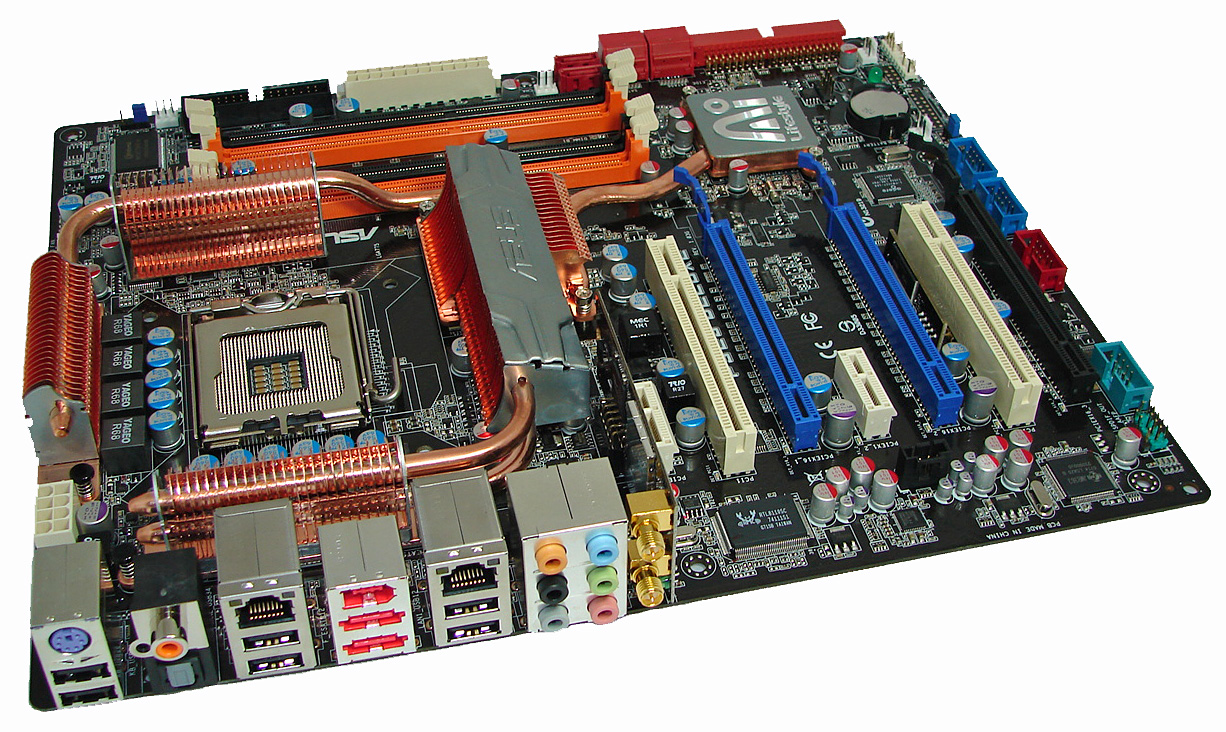
Those that find themselves entirely unfamiliar with the ASUS P5E3 Deluxe general feature set would do well to check out our first look at this capable board. This time around, we will be taking a detailed look at overclocking capabilities, specifically memory scaling and the effect on overall performance. Before we do this though, let us take a second look at the general board features and layout. We will also point out a few of the hardware features ASUS includes in an effort to improve the motherboard's ability to deliver a strong and stable overclock for Intel's latest processors.
Regrettably, not much has changed in regards to the performance of the X38, although the last few weeks have given us the chance to thoroughly explore the BIOS and map some of the rather elusive feature options to improve performance. At this stage, we are finally comfortable with the X38 chipset and believe it has plenty of hidden performance potential if you know where to look for it. In truth, ASUS has given considerable attention to improving the board's BIOS functionality, but quantifying these differences can be a challenge.
In the end, it is difficult to unlock massive amounts of hidden performance when it's just not there. One thing's for certain though, motherboards based on the X38 chipset that make use of older DDR2 technology will never reach the same levels of performance we are starting to see with the DDR3 boards. A quick scan of current DDR3 memory and motherboard prices should be enough to convince just about anyone that upgrading today is serious business.
 |
The last few weeks have presented many enthusiasts with the opportunity to catch their breath; having just experienced the P35 launch last spring, they now have to decide whether to go the X38/X48 and DDR3 route. Deciding whether to make the change to DDR3 is not very difficult: you can afford the buy-in, or you cannot. Given the choice, especially considering the rate at which DDR2 prices continue to plummet, it should come as no surprise that a large majority of users will probably find themselves in a rather favorable situation - one in which the benefits of staying with DDR2 for a little while longer make too much sense to move at this point.
Of course, it's fair to point out that it is common for the market to endure a period of significant buyer hesitation associated with the adoption of new products or technology - usually attributed to a general unfamiliarity with the benefits that come from purchasing the new technologies. As bleeding edge enthusiasts carrying enough credit card debt to send the stock market spiraling downward, we find it hard to stick with DDR2, even though this would be the wise decision at this point. However, after using DDR3 for the past few months, we find it difficult to go back for several reasons, the primary one being our ever-increasing thirst for improving the performance of our shiny new Penryn based processors.
True to fashion, ASUS has once again taken center stage, having worked hard to deliver the P5E3 Deluxe quickly into the hands of salivating enthusiasts. Competition for the title of "world's greatest overclocking motherboard" is fierce, often times having no clear winner. The measured performance margin between close competitors is frequently trivial enough that the tough decision regarding which board to buy comes down to nothing more than personal preference, even brand loyalty. This particular performance segment is exceedingly narrow though, as the number of DDR3-flavored X38 boards for the overclocker is limited at this time.
Those that find themselves entirely unfamiliar with the ASUS P5E3 Deluxe general feature set would do well to check out our first look at this capable board. This time around, we will be taking a detailed look at overclocking capabilities, specifically memory scaling and the effect on overall performance. Before we do this though, let us take a second look at the general board features and layout. We will also point out a few of the hardware features ASUS includes in an effort to improve the motherboard's ability to deliver a strong and stable overclock for Intel's latest processors.


 Facebook
 Twitter
 RSS
RSS


25 Comments
View All Comments
frede86 - Tuesday, September 2, 2008 - link
hey folksnice guide u made there m8.
but ive tryed to use that setup u recomment.
but doenst work. how come? is it because i use a dou core E8500?
Cheers
frede86 - Tuesday, September 2, 2008 - link
Core 2 dou*cEvin Ki - Saturday, February 23, 2008 - link
after reading the information on the AI transaction booster, and the Memset program, i decided to brave up, and give it a go. Memset indicated that my performance level was a 7. as my ddr2 CAS was 4, i assumed that the bios was relaxing my system a little. i simply disabled the booster option in bios with a relax of zero. rebooted, and re-ran Memset. nothing had changed. still a 7. any settings other than disabled and zero, in bios, will not POST. Memset allowed me to change the performance level to 6, apply, and save the change. nothing has changed in bios as a result of that change.my question is, what am i doing wrong, as i would expect to have seen something different in Memset with changing the bios to disabled and in effect lessening the relax?
i apologize if i have somehow missed the whole point, and do not understand this memory tweaking concept.
thanks
jwigi - Thursday, February 14, 2008 - link
Hi I have a P5k Premium and the contact between the heatsinks and the board aren't very good, i was wondering what size of screw you used and also if you needed to put any springs on them, i'm thinking of doing the same 'mod' you've done in your article on my board...thanks
plextor10000 - Thursday, January 10, 2008 - link
I was already one day playing with the settings of the mainboard, first tried to boost the E6850 from default 3Ghz to 3.6 , but could not make it stable in benchmarksSwitched to the Q6600 - and followed the guide , decrease the voltage for the CPU to 1.375 , for safety .
After step by step, i increased from 2.4 without any issue to 3.6 , running stable with my patriot 1333 on 1600
Thank you for this guide. Can i use the same settings for the E6850 also , or do i modyfie some settings to blaze the clocks of it ??
Ryujin - Sunday, January 6, 2008 - link
I recently got this board, and after reading this article, I really want to follow the advice therein and remove the thermal pads underneath the heatpipes/heatsinks and replace them with thermal paste, and replace all the plastic push-pins with screws/nuts.I've yet to start fiddling with the board, as I am still waiting for the CPU to arrive. A few pieces of advice I was looking for to ease my mind though:
- Would I be mad using Arctic Silver thermal compound, considering conductivity issues? (I could get ceramique, which is non-conductive, but it'll take quite a while, through the channels I wish to use).
- What diameter / length screws do you recommend? I figure 10mm M3 screws with lock nuts should do the trick... If they're too long, I should be able to screw them in with the heads facing the MB-tray.
- I'm going with a liquid cooling solution for my CPU. The P5E3 Deluxe included two fans that can be placed atop the heatsinks surrounding the CPU-socket for just such an occasion. However, I suspect they're rather noisy (are they?). Also, the case I'm using is the Coolermaster Cosmos, which does have ample chassi fans, so I'm wondering it is really necessary (time will tell, but I was wondering if anyone has any opinions on the subject).
cheers
kmmatney - Tuesday, November 20, 2007 - link
OK, looking at the graphs, it just seems like all I'm seeing is the benchmarks getting better with higher overall cpu speed. The overclocking guide was good, but the benchmarks are hard to figure out, since memory speed and cpu speed are getting higher at the same time.kmmatney - Tuesday, November 20, 2007 - link
OK, figured it out - we just need to compare the Asus P5E3 scores versus the Asus Maximums scores at (8 X 465) to see how much DDR3 improves things over DDR2. Seems to be 1%-5%. Yawn...TA152H - Tuesday, November 20, 2007 - link
When I read the article for the x48, I mentioned that it made no sense for the three chipsets unless the x48 was DDR3 only. Well, I have found out from another site that it will be DDR3 only.That makes the x38 really only useful as a DDR2 chipset, after the x48 is available. This assumes Intel did the right thing of course, and all the ugly overhead for DDR2 is removed from the x48. But if it is, you'd have to be a fool to buy the x38 with DDR3, since it is second best, and has overhead from a function that will not be present on the motherboard. It will give you more heat, and more power use for something that is completely useless. I didn't like Intel including both, but I guess it was to transition to DDR3, so it was a necessary evil until the x48 comes out.
retrospooty - Friday, November 23, 2007 - link
actually, that isnt true. X48 is just an X38 selected out of speed bin to be the fastest. They were going to market it as only DDR3 (that was a marketing decision not a functionality decision) but have since changed their minds.http://www.fudzilla.com/index.php?option=com_conte...">http://www.fudzilla.com/index.php?optio...amp;task...
Either way your arguments are pretty one sided. Even with DDR3 highly overclocked to 2ghz its really only a slight bit faster then DDR2. In fact DDR2 at 1000mhz 4-4-4 beats DDR3 at 2000mhz @ 9-9-9 in most real world tests and apps. Intel is currently going with tri-channel DDR3 on the next gen CPU (nehalem) with internal memory controller. Then and ONLY then is DDR3 going to be worthwhile, and even then its only worthwhile because Nehalem chipsets wont support DDR2. DDR3 is a minor speed bump not worthy of spending money on until Nehalem comes out.