
Motherboards Memory Storage Cases/Cooling/PSUs IT Computing Displays Mobile Mac CPUs & Chipsets Video Digital Cameras Linux Gadgets Systems Trade Shows Guides Home Increase Font Size Decrease Font Size Change Page Size
Intel Core 2 Extreme QX6800: The Fastest Desktop CPU, now with more cores
Date: April 9th, 2007
Topic: CPU & Chipset
Manufacturer: Intel
Author: Anand Lal Shimpi
Buy the Intel BX80562QX6800BULK Intel
Blank
 ZipZoomFly $899.99


Photo Processing Performance

We turned to the Retouch Artists Photoshop Speed Test for measuring CPU performance in Adobe's Photoshop CS3 beta.  The benchmark applies a number of actions to a test image while we measure the total time elapsed during the active portion of the test.  We report results in seconds, with lower scores denoting higher performance. 

We set history states to 1 and cache levels to 4; CS3 was configured to make use of all available system memory. 
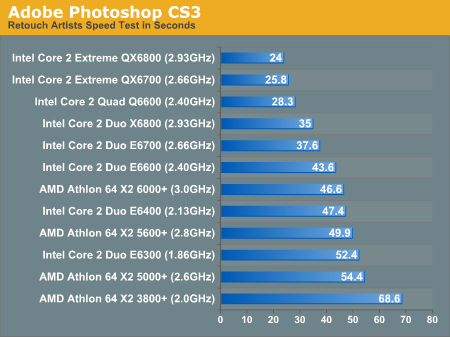
Adobe Photoshop CS3  

The speedup from going to four cores isn't as great in Photoshop as in the 3D rendering tests, but it's still significant (and worth it if you spend a lot of time in Photoshop). The AMD/Intel breakdown remains the same as we have seen in all of our other tests.

Our next test is one recommended by Intel, but the test itself appears to be fair as it is a simple task using one of Vista's built in applications: Windows Photo Gallery.  This test simply measures the amount of time required to print four sheets of thumbnails; of course we don't measure actual printing time, rather the benchmark exports the pictures to an Excel spreadsheet.  Time is measured in seconds, with lower times resulting in better performance:
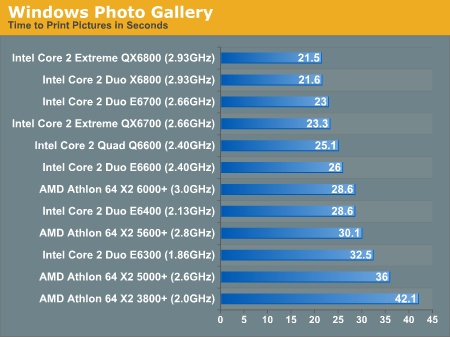
Windows Photo Gallery  

Finally we have a benchmark that was one of the first tests AMD sent around a while back to showcase what 64-bit processors could do for performance.  The application is called the Panorama Factory and it is used to stitch together multiple digital pictures in order to make one larger picture, or a panorama.  The stitching process can be quite CPU intensive so we used the benchmark to stitch together 10 6MP images of a room and reported the total process time:
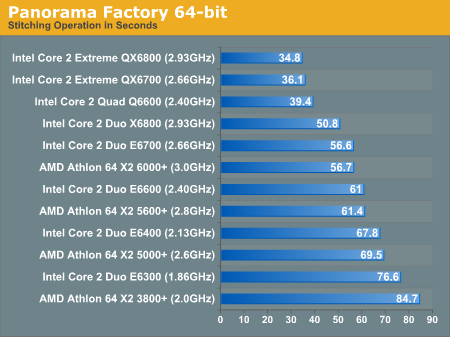
Panorama Factory 64-bit

Gaming Performance   Next Page

 
  Index

Tools Share
Find lowest prices Find the lowest prices
Digg   del.icio.us   E-mail  
Print This Article Print this article  

34 Comments - Last by D4LDarksideD4L, 248 days ago
Username:
Password:
Good god I tell ya! by KhoiFather, 956 days ago
This CPU is smoking hot!!!! I need to pick me up one of these when the price falls about 80%, yup yup!!!!

Reply
true but... by yacoub, 956 days ago
quote:

While Intel will still hold control of the world's fastest desktop processor title, AMD may actually offer better value at lower price points.

As long as you don't allow overclocking into the equation, then yes. But if you allow for overclocking, even a modestly overclocked E4300 can match or beat an E6400 and thus best the 6000+.

We rarely hear much about how the AMD chips overclock these days... is it just due to a lack of overclock-oriented boards? Have all the board manufacturers focused on Intel because that is where all the attention is and where they hope to get the most profit for their boards?

It would be interesting to see a good update on AMD overclocking on AM2. Do the chips even have much headroom? If so, are there overclocker boards available to OC them with? etc

Reply
RE: true but... by yyrkoon, 956 days ago
From my experiences, which by the way is not a lot, I have noticed that generally, desktop classed CPUs from AMD do not OC well. However, that being said, I have an Opteron 1210, paid $150usd for it, and have had it running 310Mhz CPU core(2790Ghz overall, stock is 1.8Ghz . . .), on an ABIT NF-M2 nView motherboard, with inexpencive Cosair XMS2 ProMos memory, using stock cooling. Granted, the system immediatly BSoD'd when trying to run SuperPI, but I have little doubt, that if I had a better cooler (my case is very compact, so it is pretty difficult to find something small, and efficient), that it would have been able to run this speed fine.

From what I have read, the 3600+ can hit 3Ghz using water cooling, but I have no hands on experience personally. Personally, I am very happy with my Opteron, it runs every game I play just fine, the only real problem I have with my current system, is that my current video card is already showing age, and it is only 6 months old (7600GT) :/

Reply
RE: true but... by JarredWalton, 956 days ago
I think the best AMD chips will OC to around 3GHz, give or take. The problem is, an E4300 will overclock to around 3.6GHz pretty easily (get a better CPU cooler is all you need). At that point, the E4300 is so much faster than anything AMD currently has on the desktop that I think it's a bit silly to consider AMD for serious overclocking - unless you already have an AM2 board? At stock speeds, however, AMD does quite well on pricing, especially post price-cuts.

Reply
RE: true but... by yyrkoon, 956 days ago
I do not dissagree with you 100% Jarred, you points are completely valid. However, the system in question would cost more than a comparrible AMD system, and in my case, I am very specific in what I want for features, and brand, so, it would cost me a lot more. Also this performance difference you speak of looks great on paper, and graph, but in realy world application, I bet, you, me, or anyone else, would be hard pressed to notice the difference. Perhaps if all you do is encode/decode sure, but general usage, and game playing, the noticable difference just would not be there.

Now, if you have the cash, I would reccomend to anyone who plays games, to go with Intel C2D, but know that you will pay for the speed difference, and the chances are good, unless you spend a lot, you would never know the difference. As I said before, build me a C2D system for ~$500, with an LCD monitor, and then we can talk. Granted, this AMD ~$500 system, would not play FEAR, Oblivion, or any other graphically intensive game well, but my system does using an eVGA 76000GT KO (can be had easily for ~$130usd, making the over all cost higher, but still very viable, even on a budget).

Reply
RE: true but... by TA152H, 956 days ago
I agree with you, mainly. My main system, if I have one that can be called that, is a Katmai running at 600 MHz. Why? Because it's completely fanless and it uses very little power and I don't need anything better for what it does. I have a seperate development machine, of course, and other machines I use for more demanding stuff, but 90% of the time, unless I'm testing, this computer is more than adequate for what I want.

Overclocking is important only within the tiny context of the person who is going to buy a processor to do it. Intel and AMD don't care that much about it, unless it makes their chips less reliable and then they are against it since it hurts their reputation. It's done by such a small percentage of people, it's not going to greatly impact their sales. I almost got tarred and feathered back about 10 years ago when I recommended that our company buy the Celeron 300As and overclock them to 450 MHz, rather than using Pentium IIs, which were slower and way more expensive. I never made that mistake again.

Back in the bad old days, you actually had to have a bit of a clue to overclock; you'd have to unsolder the crystal and replace it. A lot of people did this with the original PC/AT 139, so IBM changed it so you couldn't for the 239 (by putting a timing loop in the ROM). So, I guess it was somewhat more common then. But then again, the computer user back then was much more sophisticated since they were not mainstream devices like they are now.

AMD is in deep trouble, as evidenced by their recent announcement of extremely poor sales. I just do not understand their timing with respect to ATI, because it gave Intel a golden opportunity. Intel knows AMD is cash strapped, and they can't fight a price war. AMD doesn't know this though, and they are playing chicken driving a VW Bug against a Hummer. Sooner or later, AMD must lose, and they are idiotic for thinking Intel does not know this. ATI made it impossible for AMD to follow the course they are now, but they are. Good luck to them. Cost cutting isn't the answer, Intel will just extend their manufacturing lead.

One thing I don't get is the announced price cuts by Intel not being called aggressive. Call me crazy, but when you chop 1/3 of the price off of already attractive products, that's very substantial.

A lot of this points to Barcelona (what a stupid name) being really good. Intel is trying to kill AMD before it comes out, and AMD seems to believe they have to keep market share at any cost. Obviously, AMD's path is unsustainable and they would eventually go out of business on it if nothing changed. If Barcelona is really good, they could suffer a few quarters of it while waiting for Barcelona, which would presumably sell quite well if it is as good as they say. The problem is, they are losing market share even with their low prices.

One positive about all this is how much smarter consumers have become. It used to be Intel could sell whatever they had even if it sucked. But, when Intel had a bad product most recently, they lost share. Now they have a better product, they have gained it. It hasn't always been this way.

Reply
RE: true but... by yyrkoon, 956 days ago
Well, I do not know which way it is going to go, but it is either very, very good for AMD, or very, very bad. Just for the 'monopoly' Intel would gain, in AMD going out of business, and the 'you have this product, and you have to like it' effect we would get from Intel, I think it would be very, very bad for everyone, if AMD went out of business.

I have been computing for a long, long time, (since 82-83 ), and have been used to AMD being the underdog, so I do not really see this as the nail in their coffin just yet. Only time will tell, and AMD knows how to fight a price war, from the bottom up( or middle up, if you ever really considered Cyrix a compeditor ).

Reply
RE: true but... by TA152H, 956 days ago
I don't think you got my point. I'm not saying AMD will go out of business, just that their path would eventually lead them to it if nothing changed. For example, let's say they didn't have a new product out in a few months. Would they continue the policy they are on? I don't know the answer to that, but I think the upcoming new core has something to do with their current policy. I guess it would have to.

I've never thought highly of Hector Ruiz, and I think even less of him now. I liked Jerry Sanders a lot, he was charismatic and visionary, and was the only one that could stand up to Intel. Many others tried, and they failed. And it was under his leadership that AMD passed Intel with the Athlon, and much of the current situation is from technology he was responsible for. He never backed down, and made excellent strategic moves like buying NexGen when the K5 ran into snags. I never worried whether AMD would survive under him. Ruiz, I just don't like him and I don't have as much faith in him. I still don't know why they are still on the K7+ core now, it's been way too long and something better should have come out years ago. They came out with a product good enough to beat the miserable P7, but they had to know Intel would come back fighting.

But, in the worst case, and I'm not saying this will happen, AMD will be bought by someone else rather than disappear into nothingness. IBM makes the most sense, particularly since they are out of the PC business and spend a lot on semiconductor manufacturing and developing even without AMD. In fact, I am a little surprised they aren't one company already. AMD by itself is a weakling that can only grow when their competitor missteps, and when their competitor is doing well, they lose money. And IBM/AMD combined company would give Intel fits, and be their roughly their equal.

At any rate, the industry will never allow Intel to be alone as an x86 maker. It's too lucrative a market, and Intel has produced some of the worst processors known to mankind. Uncontested, people might actually have to use them. It won't happen. Then again, we somehow let Microsoft dominate with their lousy products. So, who knows?

With regards to AMD knowing how to fight a price war, they have no chance in this one, outside of the Barcelona. Intel can make the chips cheaper, and they are much better processors. Plus, they still have a better reputation. Intel can take market share from AMD and make them like it right now. There just isn't anything AMD can do with their lousy K7+ and inferior manufacturing, plus high debt. And that's what's happening, Intel is winning back market share and AMD is selling their rubbish for peanuts to boot. But still, we have Hector the jackass telling all the world that AMD will not yield any market share gains, and instead will get to 30% this year. He's a buffoon, he is not in control of the situation, Intel is, and he's trying to use bravado to cover up the fact Intel will take what they want, it's just a matter of how much money they are willing to give up to do it. I really don't like this man.

Cyrix is dead now, VIA bought them and promptly killed their line off and went with the IDT Centaur line. I actually have one of their micro-ATX motherboards and processors running at 800 MHz. It's totally quiet, and it's elegant in it's own way, but for 800 MHz it's really slow. To me, it seems like it's roughly equivalent to a 500 MHz Katmai, and I'm not exaggerating. But, it uses less than 10 watts, so I guess that's to be expected.


Reply
RE: true but... by yyrkoon, 956 days ago
This 'war' you speak of , is actually a battle, the war goes on indefinately, but yes, I got your point.

As for who 'rules' AMD, I could care less, as long as they stay around, giving Intel a reason to make good products, and vice versa. I care more about things when AMD makes stupid judgement calls, as in switching socket types too often, and not supporting them for very long, but they are not the only ones guilty fo this, and to be honest, I am not sure if there really is much of a choice, when technology advances as fast as it is now.

AMD would never dissapear into nothingness, and they *could* go back to making IC's only, they probably just would not make as much money doing that alone.

Cyrix *has* been dead, for a long, long time now, at least in the desktop arena, which, in my opinion did not happen soon enough. I remember having a Cyrix P200, and playing quake2, and getting 7 FPS, popped the CPU out, droped in a P55 233MMX Intel CPU, bumped the FSP up to 75Mhz, and watched as it got over 60 FPS with the same settings . . . (I miss the good ole Super7 days, if only because the platform did not matter, you could use any CPU in it).

Reply
RE: true but... by TA152H, 956 days ago
Actually, VIA bought Cyrix and actually released a few products based on their architecture, and then bought the Centaur line from IDT and stopped making the Cyrix based chips.

Cyrix chips weren't always bad, at least on paper. I always had problems with them though, but in some ways they were way ahead of AMD. AMD was just a clone maker until they couldn't do it, whereas Cyrix made their own processors without copying Intel microcode. The chips you're talking about had miserable floating point performance, but their integer performance was excellent. They used that silly PR rating stuff where they were actually clocked lower than they were rated at, because of their superior IPC. Cyrix was also unique in the x86 world for saying that the decoupled architecture of the K5 and P6 was not the way to go, because you'd have too much trouble with OOP as you got to deeper pipelines. It would be interesting to see if they'd still be running x86 code natively today, or running some inelegant decoupled architecture like Intel and AMD are. Apparently, since AMD and Intel survived, it was the way to go.

AMD has been making x86 processors almost as long as Intel has. IBM used them extensively in their original PCs and so did Tandy. They were a licensed second source for Intel. Intel got a little greedy with the 386 and decided they didn't want AMD making them as well, although AMD eventually just reverse engineered it and did it anyway, creating a great legal battle. AMD 386s were excellent too, they ran at faster clock speeds, and used a lot less power. Unfortunately, their 486s sucked, they were unreliable. They seemed to have a lot of cache problems, and if you turned off the cache the processor ran OK, but with it, it wouldn't work. Mainly the DX2 80/40 had this, and I have no idea why.

You complain about the Cyrix chip, but did you ever try a K5? The floating point on that processor would make a man with a hairy back cry. That's just the way it was, Intel had ferocious floating point, and everyone else had lousy floating point. It was how they were able to compete. They didn't "waste" so many transistors on something that most people never used anyway, and that helped them a lot. Even the K6 with it's low latency, but non-pipelined floating point unit was way behind the Pentium. Only the Athlon changed that.

I don't miss Super 7 at all. You had a bunch of substandard companies backing that standard, and none of the chipsets were particularly stable. The VIA MVP3 was probably the best, the ALI was miserably bad. The MVP3 had terrible memory performance, even with motherboard cache memory. Even though it and the 440BX were both rated at 100 MHz, the memory performance on the 440BX was roughly 50% greater. The P55C didn't use Super 7 though, it used the regular Socket 7 chipsets, like the 430TX and 430HX, both of which were excellent. I still run my print server off a 430HX based Pentium 233 MMX. It does the job fine, and if I want to play any games from the mid to late 1990s, it's ideally suited for it.

Reply
Comments Page 1 of 4

Unlicensed Software at Your Last Company
Anonymously Report Unlicensed Software with Our Form Now. Get Up to $1 Million.
We Buy Laptop and PC Memory! Sell to Us!
Min of 25 pieces required. Call us today at 239.354.1230.
Special Offer from The Economist
Get 12 issues of The Economist for $12. US subscribers only.
Free Forrester Risk Management Report
Demystifying Enterprise Risk Management. Download Free With Registration.
Download Microsoft Visual Studio ® Team System
Streamline Dev processes, Reduce time to market. Try Microsoft Visual Studio Team System, FREE!


Latest news by
DailyTech

 November 20, 2009

Blank
Blank
Blank
Blank
Blank
Blank
Blank
Blank
Blank

 November 19, 2009

Blank
Blank
Blank
Blank
Blank
Blank
Blank
Blank


Blank
Blank
Blank
Blank
Blank
Blank
Blank
Blank
Blank
Blank
more CPU & Chipset Discussions


pipeboost
Copyright © 1997-2009 AnandTech, Inc. All rights reserved. Terms, Conditions and Privacy Information.
Click Here for Advertising Information