



AMD's 65nm Preview Part 2 - The Plot Thickens (Updated with Information from AMD)
by Anand Lal Shimpi on December 21, 2006 12:12 AM EST- Posted in
- CPUs
Updated: Page 3 has been updated to include an official AMD response on the Brisbane performance issues we've been seeing. AMD confirmed an increase in L2 cache latency in order to support a move to larger cache sizes in the future, which may or may not happen. The rest of the article remains unchanged.
Last week AMD sent us samples of its first 65nm processors, codenamed Brisbane, and it was a step towards being competitive with Intel again. The 65nm shrink yielded AMD's most efficient desktop processor to date, but it's still a far cry away from what Intel is able to accomplish with its Core 2 processors.
Although they won't be available until sometime next year, a closer look at AMD's 65nm lineup reveals an interesting fact. Until recently, AMD would differentiate between subsequent model numbers by clock speed and cache size, alternating between the two. So while the Athlon 64 X2 4600+ and 4800+ both ran at 2.4GHz, the latter had twice the L2 cache per core at 1MB. After Intel's Core 2 launch, AMD killed all non-FX 1MB L2 parts, resulting in a processor lineup that was mostly segregated according to clock speed. (Of course they then added the X2 5200+ and 5600+ back into the mix....) With the move to 65nm, AMD is once again introducing model numbers that it had killed off before, but without playing with L2 cache sizes; instead, AMD is breaking with recent tradition and implementing non-integer clock multipliers for these "new" in-between speeds. The table below explains it all:
| CPU | Clock Multiplier | Clock Speed |
| AMD Athlon 64 X2 5000+ EE | 13.0x | 2.6GHz |
| AMD Athlon 64 X2 4800+ EE | 12.5x | 2.5GHz |
| AMD Athlon 64 X2 4600+ EE | 12.0x | 2.4GHz |
| AMD Athlon 64 4400+ EE | 11.5x | 2.3GHz |
| AMD Athlon 64 X2 4000+ EE | 10.5x | 2.1GHz |
We didn't mention this in the original article, but all of AMD's 65nm CPUs are considered to be Energy Efficient (denoted by the letters EE in the table above). With its 90nm chips, AMD specifically selected lower voltage parts to be labeled as Energy Efficient, but right now all 65nm parts are. For the sake of simplicity, especially as we compare to older EE parts, we will simply refer to these chips as 65nm chips.
Note that the 65nm 4800+, 4400+ and 4000+ all use non-integer clock multipliers, a first for the Athlon 64 line. The implications for the end user are relatively minor, although it does mean that the model numbers will translate into more consistent performance graduations. In the past, having two chips running at the same clock speed but with different cache sizes meant that one would be faster only in those applications that could use the extra cache.
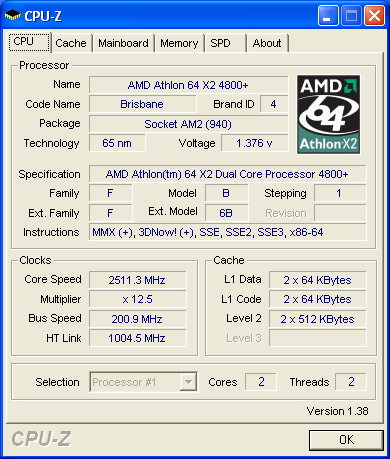
Despite support for non-integer clock multipliers, all AMD chips still only support integer memory dividers, meaning that only CPUs with even CPU multipliers can run at DDR2-800. All odd clocked (5000+) and half-clocked processors (4800+, 4400+, 4000+) run at a slower than DDR2-800 speed, even when set to DDR2-800 in the BIOS. AMD wouldn't discuss whether or not this would be addressed in the future, but if it is we'd have to wait for at least another silicon revision.
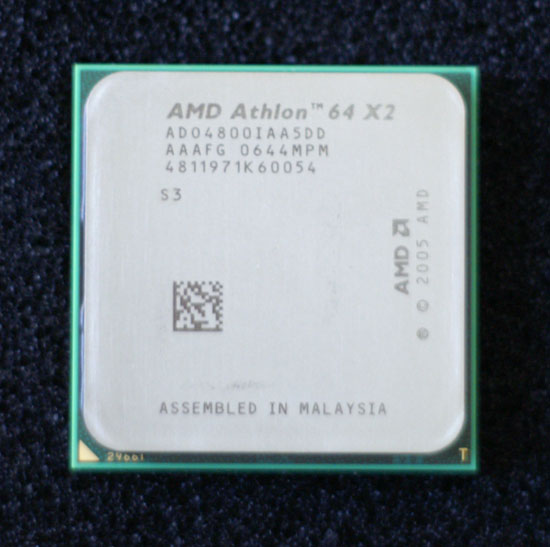
By now, none of this is new information, which brings us to why we're here today. In our original 65nm article we noticed a performance disparity between AMD's 65nm and 90nm processors, yet we had no official response from AMD as to why; today we have that answer. At the same time, we wanted to take a look at one of the half-multiplier chips and add it to our performance and power graphs, not to mention include some lower cost Intel CPUs per your requests. We've also got some more insight into the die sizes and power consumption figures we reported in our last article. In a sense, we're tying up loose ends with this piece, and shedding more light on AMD's 65nm cores than we originally did in our first, quick preview.


 Facebook
 Twitter
 RSS
RSS


52 Comments
View All Comments
OcHungry - Wednesday, January 3, 2007 - link
I was wondering if there was a way to PM or email you.I would like to bring to your attention a few concerns regarding the forum and the moderators that you need to be aware of. Is there an email or can I PM you in any way?
I would appreciate your respond.
Bayad shoma bedaneed.
tashakore
SilverMirage - Saturday, December 23, 2006 - link
I understand that we are looking at limiting games by the CPU and not the graphics card, but lets be a little realistic...some of those performance per watt figures aren't what an end user is going to be seeing when comparing his options.Wwhat - Saturday, December 23, 2006 - link
Perhaps a weird thought but AMD bought that new ZRAM process that theoretically could put a huge cache on a small space with the flaw that it had so-so latency, then they later bought version 2 of the same but so far they didn't use it.Now what if this is an experiment with that technology, or a preamble, because at some time you would expect them to start using stuff they bought the license off, although at the time of the ZRAM announcement people were projecting use in a very far future that might not be what AMD has in mind, or the situation might have changed as to the performance of current versions of ZRAM.
What do you think, any link to it?
Tujan - Friday, December 22, 2006 - link
If you look,you'll see a story here in Anandtech.com for the first AMD X2s dated June 2005. The processor there was the 'top notch,for something unheard of in the processor industry. And even so doing with DDR400 memory.What is strange in these processor scenarios. There is Moores law. And there is the 'business quarter law. The article here,of wich I am commenting to,if the first of the detail in the "new processors"-the 65Nm processors. The AMDX2xs where also "new" when the 2005 articles was published. Today,as of reading this article,the "old"(and then top notch)is no longer being supported ..or as per use,no longer maintaining the subject cache sizes. AND well,point me if I am not correct,but the "old"processors are no longer going to be manufactured.
Well I have usually considered that in these events of "new,and old"technology that somehow,if something is 18 months past.I can actually afford it. This changes a little with the new Intel setups. Since the Intel lineups finally seem to break this cycle of the previous as I explained here.
For an entire year,I saw article after article,putting AMDs top notch as base line for performance. Ney user could address something of a culminating relationship to what had performance and what they could afford. And AMDs "top notch" an "industry standard" wich of course nobody could afford. At least if somebody was passing the buck,it wasn't happening with me.
Annyway,I would just like to say I wish AMD good luck.Yet I cannot be ashamed to say that I can now put together a system for less than 1000$ with the same parts as that '"top notch"industry standard seen for the permiating part of 2005.
Am I better for thinking that way ? 18 months passed,and my dollars are spendable but not supported ? I dont think that anybody could consider an AMD setup a 'low-end setup if for example the 4800+1Mb l2 can be had for 230$.
That is the enevitable consequence is the final exhaustion of the supply of the component. Yet I could say that I have a "top notch" 2005 version of AMD technology. With 2007 PARTS! Being on the exhausted end,I dont know who could feel better about this.
Wish AMD luck. Still with their record,I probably should say that I do not wish to look forward to exhaustion,at the same time as extingusishment,as in the mentioning of taking a break to what one pays for.
mino - Thursday, December 21, 2006 - link
Just my pint into the fire:X2 4200+EE & GF6150 board (MSI K9NGM2-FID)
$240 (170+75)
E6300 $ G965 board (ASUS P5B-VM)
$285 (185+100)
Conclusion:
Anything cheaper is K8 vs. Netburst so Intel is no contender.
Anything more expensive is K8 vs. C2D clock/clock so AMD is no contender (4800+65nm is more expensive than E6400 it matches by perf.)
For decent IGP-free boards the difference is comparable.
So, going for
stock performance the choice is simple:
<$300 for CPU+MB combo go AMD X2
>$300 for CPU+MB combo go Intel C2D
for overclocking:
<$240 for CPU+MB combo go AMD X2
$240-$285 -> wait and then Intel C2D
>$285 for CPU+MB combo go Intel C2D
for power consumption (i.e. PC's for office use):
AMD X2 3800+EE to 5000+EE (anything above or down is a waste of money in this case)
for single core:
<$190 for CPU + MB combo -> go AMD A64
$190-$230 for CPU + MB combo -> go AMD X2 at $240
>$240 see dual-core recommendations
That IMO sums up the whole Desktop PC market as of now.
mino - Thursday, December 21, 2006 - link
$190-$230 for CPU + MB combo -> go AMD X2 at $240should be:
$190-$230 for CPU + MB combo -> go AMD X2 3800+ at $200
mino - Thursday, December 21, 2006 - link
The prices are Newegg based.Shintai - Thursday, December 21, 2006 - link
Anand, can you test the 65nm K8 with lower res in games and a broader selection of games so we can more truely see the difference?http://www.firingsquad.com/hardware/amd_athlon_64_...">http://www.firingsquad.com/hardware/amd_athlon_64_...
If these numbers hold water, then 65nm K8s is a disaster in terms of gaming performance.
mongoosesRawesome - Thursday, December 21, 2006 - link
I'd be interested in seeing these same performance/watt graphs using the 965 chipset. The 680i is a power hog.mino - Thursday, December 21, 2006 - link
The same power hog is 590SLI for AMD.Actually 965 vs. RD580 would hurt Intel even more ... So, go figure.