



Mobile CPU Wars: Core 2 Duo vs. Core Duo
by Anand Lal Shimpi on August 3, 2006 9:25 AM EST- Posted in
- CPUs
Application Performance using SYSMark 2004 SE
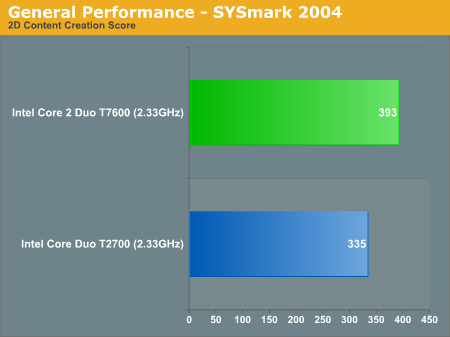
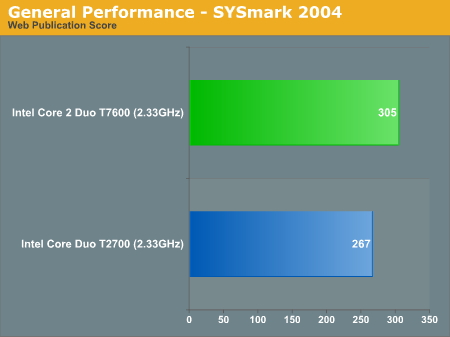
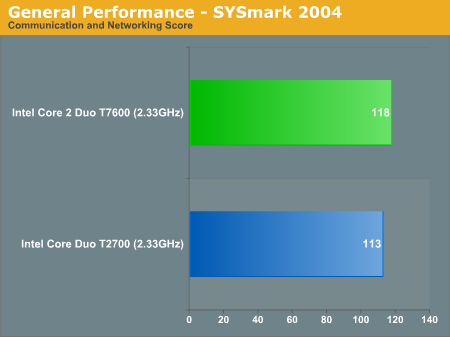
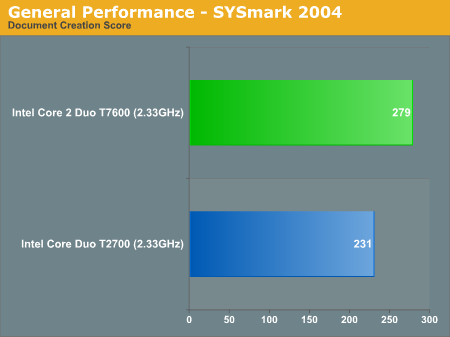
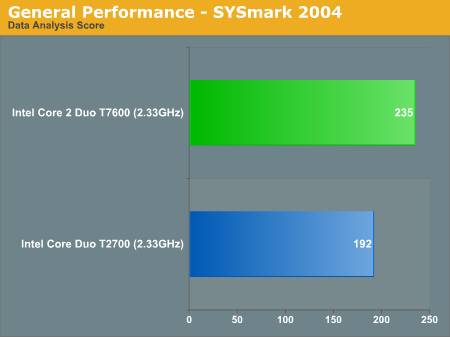
We'll kick off our look at general application performance with SYSMark 2004 SE as always, and we'll look at the overall score as well as the scores in each of the two suites - Internet Content Creation and Office productivity.
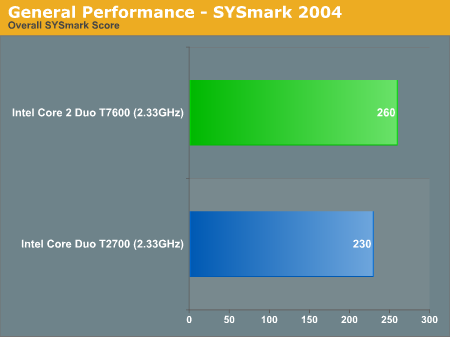
Clock-for-clock, Intel's Core 2 Duo is able to outperform its predecessor by 13% according to SYSMark 2004 SE's overall score. While the performance advantage isn't as dramatic as what we've seen on the desktop, comparing Core 2 to Pentium D, at 13% we're still looking at a performance gain that is noticeable in real world usage.
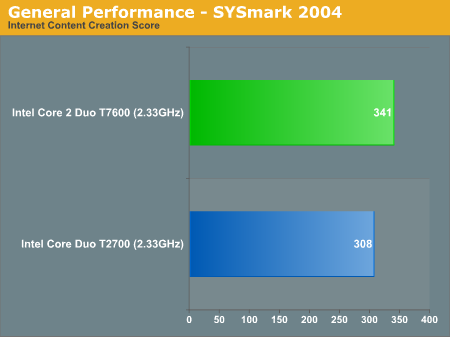
Drilling deeper and looking at the overall Internet Content Creation score, Core 2 Duo's performance advantage drops slightly to 10.7%. The performance increases we're seeing here highlight one very important point in current CPU architecture innovation. We're looking at a 10% increase in performance here, yet it required a 93% increase in transistor count to achieve (mostly because of the larger L2 cache, 4MB vs. 2MB). AMD and Intel are both looking to multi-core solutions to deliver better performance-per-transistor efficiency, rather than simply throwing more clock speed and cache at the problem.
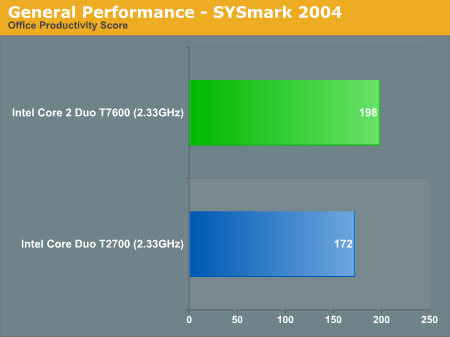
Speaking of the impacts of a larger L2 cache, we may be seeing those here in the Office Productivity suite where Core 2 Duo holds a 15.1% lead over Core Duo. The advantage is large enough to be noticeable, and definitely appreciated when you look at the fact that the Core 2 Duo we're benchmarking here has the same MSRP as its Core Duo predecessor.
The performance increases also come from the modified pipeline and internals, but we will have to get ahold of a 2MB Merom chip to determine exactly how much of the improvement comes from the added cache and how much comes from the reworked architecture.
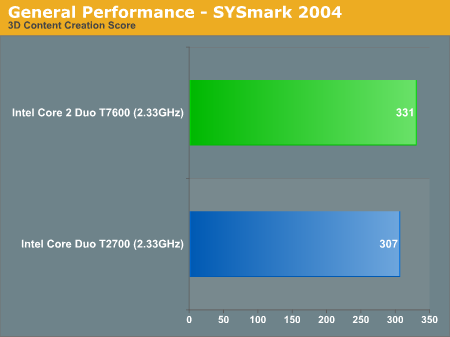
The breakdown of SYSMark 2004 SE tests are below:


 Facebook
 Twitter
 RSS
RSS


46 Comments
View All Comments
saleemi - Saturday, February 28, 2009 - link
what is the difference between Dual Core and Core 2 Duo processor?I want to buy a laptop what i will do?
Can some body please explain the difference..
kem - Thursday, December 6, 2007 - link
I have a notebook with a 940GML / Celeron 440. Can i upgrade to a CoreDuo FSB533?tatpeng - Sunday, December 2, 2007 - link
Anand,I would like seek your advice. I want to buy laptop but i confused on the Centrino Duo Core 2 Duo and Intel Core 2 Duo. I looking at the Acer Aspire Laptop Centrino Duo Core 2 Duo and Compaq Presario Intel Core 2 Duo. So i would like to know the difference. Please assist. Both is Core2 Duo but the Acer is with Centrino. Is Acer better or Compaq better?
a rabbit - Wednesday, August 30, 2006 - link
Hi,A few questions:
(1) Can we assume that the power draw numbers represent the best possible performance one can expect from Core 2 Duo mobile systems one can purchase today, or, should we assume that they represent typical performance, or, can we say we don't know because we only used one sample of Core 2 Duo?
(2) What about the Core Duo (Yonah)? Theoretically, if Intel supplied all CPUs to the reviewer, I as Intel would supply the best quality (lowest power draw) Core 2 Duo, and the worst quality (highest power draw) Core Duo for my reviewer to perform the review on.
Thanks!
-a rabbit
chetech - Friday, August 11, 2006 - link
Can a Core 2 Duo processor be fitted into an Apple Mac Mini using their new Intel Core Duo processors?wimh - Thursday, August 10, 2006 - link
Actually this is not correct: a CPU that's clocked higher also needs a higer voltage. Therefore, doing the same amount of work faster will require more energy than spreading it out over a longer time (in theory).
For this to be true in practice, you'll off course need to factor other things into account, like I/O-devices (which may have less choice in sleep states: keeping the hard disk spinning for a longer time can destroy the gain you had by slowing down the CPU), etc...
devilzangel - Tuesday, August 8, 2006 - link
."Eventually" we will have processors based on light particles vs electrons; but that is "eventually"; lets talk about the very near mobile future shall we (1 year).
1. EM64T enabling - Will DEFINATELY boost and widen the performance gap b/w Core D & Core2 D. Especially with the Vista 64bit OS system installed. EVEN when u run 32bit applications on it.
2. Quad-Core 'Santa Rosa' - Another great stride by Intel to boost performance (of course at the expense of battery life (which i might add, shouldnt matter much since most laptop users use the laptop near AC outlets). I am definately going to wait until next year to upgrade to a new laptop. Plus Vista will take advantage of the extra cores.
3. FSB, and Battery Life - Comon, lets not fool ourselves; Intel can full well come out with a 1066 config for mobiles WHENEVER they want. AND mobile MOBO can be fabricated to take advantage of it JUST as fast. BATTERY life is the ONLY culprit. I would be the FIRST to buy such a laptop. Why use a clumsy desktop with so much wattage when you can get slightly less performance with much better gains to offset the balance regardless. Lets get one thing straight ... Desktops are losing ground, Laptops are the future.
4. Shared L2 Memory Cache - The 1st Core D processors were CRUDE at best in this regard. Core 2 D Proc.s will SHARE the FULL L2 cache.
Ehh who knows what will happen in 2008, and 2009 .. IBM and Georgia Tech's 300GHZ (room temperature) processors may be producable by that time ..
Sometimes, I feel as if the corporate giants stagger the new technology into consumer hands in stages so that they may reap the profits.
devilzangel
ViperV990 - Tuesday, August 8, 2006 - link
Regarding the FSB vs battery life issue, can't they just throttle the FSB dynamically like they do with the multiplier? I mean, come on, I've been able to change the FSB speed on the fly using software since like what, the Celeron 300A days?(Forgive me if that was possible earlier. My earliest overclocking experience was with a Klamath P II 266...)
devilzangel - Tuesday, August 8, 2006 - link
In the older processors and mobos it may have been easier to access this code settings to allow HIGHER speeds than mentioned limits ..normal throttling of CPU, Cache, FSB, Fanspeed etc, is part of the architecture (or so i understand it to be) .. 'Over'throttling the FSB is something i am unsure of .. at best it is a risk.
recently though, most (if not almost all) boards have such options blocked or hidden in Bios settings and chip configurations (except the higher end GA, Asus, DFI, Abit boards).. ofcourse it very possible (and it wouldnt surprise me if it is) that the Core 2 D are ALREADY capable of 1066FSB but the chips have been locked onto 667, or 800 (the architecture of the C2D desktop chips is pretty much identical to the meroms, almost); it is possible that such mobile settings may be unstable if someone managed to crack the coding and change the frequency settings. The causes could range from MOBO coding chips, to Heat issues
It is kind of like apple; we the consumers found out around the beginning of this year that Apple always had a somewhat working version of their OS for intel hardware settings.
remember the technology staggering .. the FSB is part of it. It is like Diamonds, and Oil; limit the supply of higher and faster technology to increase the chances of a higher profit history overall.
devilzangel
IsLNdbOi - Monday, August 7, 2006 - link
I've got a Toshiba U205-S5002 which has a 945GM chipset. This article says that the 945GM supports Core 2 Duo. I need to find out now if the processor in my laptop has a PGA Socket-M or BGA CPU. I've checked Toshiba's support pages, but can't find any info. regarding the CPU's interface w/ the mobo.Anyone have any info. regarding the U205-S5002's CPU interface?