



AMD & ATI: The Acquisition from all Points of View
by Anand Lal Shimpi on August 1, 2006 10:26 PM EST- Posted in
- CPUs
AMD’s Position
Given that AMD is the one ponying up $5.4 billion dollars for the acquisition of ATI, there had better be some incredibly good reasons motivating the investment, especially considering that AMD isn't sitting on a ton of cash at the moment. AMD is obviously extremely bullish on the move, but still vague on most details as to what it plans on doing with ATI assuming the deal goes through. The majority of AMD's statements publicly have been reassuring the market that its intention isn't to become another Intel, that it will continue to value its partners (even those that compete with ATI) and still treat them better than Intel would.
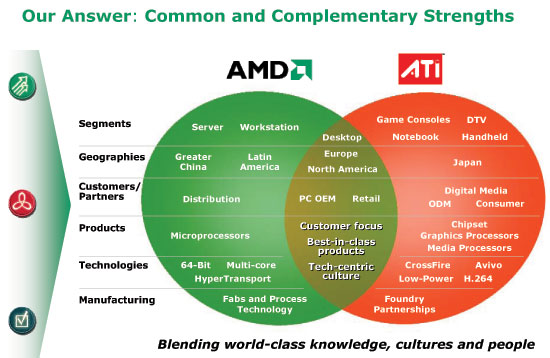
Completing the Platform & Growing x86 Market Share
While AMD has always publicly stated that it prefers to work with its partners, rather than against them like Intel does, this move is all about becoming more like Intel. From the platform standpoint, AMD would essentially be expanding its staff to include more engineers, team leaders and product managers that could develop chipsets with and without integrated graphics for AMD processors. Each AMD CPU sold helps sell a great deal of non-AMD silicon (e.g. NVIDIA GPU, NVIDIA North Bridge, NVIDIA South Bridge), and by acquiring ATI AMD would be able to offer a complete platform that could keep all of those sales in-house. From a customer standpoint, it’s a lot easier to sell a complete package to a customer than it is to sell an individual component. Intel proved the strength of the platform with Centrino and AMD is merely following in the giant’s footsteps.
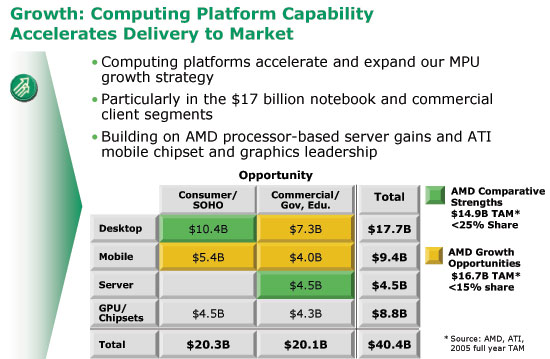
Going along with completing the platform, being able to provide a complete AMD solution of CPU, motherboard and chipset with integrated graphics could in theory increase AMD’s desktop and mobile market share. According to AMD, each percentage point of x86 market share is worth about $300M in revenues. At current profit margins of around 60%, if the acquisition can help increase AMD’s market share by enough percentage points it’s a no-brainer. AMD is convinced that with a complete platform, it could take even more market share away from Intel particularly in the commerical desktop and consumer/commerical mobile markets.
Step 2 in Becoming Intel: Find Something to do with Older Fabs
Slowly but surely, AMD has been following in Intel’s footsteps, aiming to improve wherever possible. We saw the first hints of this trend with the grand opening of Fab 36 in Dresden, and the more recent commitment to build a fab in New York. AMD wants to get its manufacturing business in shape, which is necessary in order to really go after Intel.
A secondary part of that requirement is that you need to have something to manufacture at older fabs before you upgrade them to help extend the value of your investment. By acquiring ATI, chipsets and even some GPUs can be manufactured at older fabs before they need to be transitioned to newer technologies (e.g. making chipsets at Fab 30 on 90nm while CPUs are made at Fab 36 at 65nm).
Once the New York fab is operational, AMD could have two state of the art fabs running the smallest manufacturing processes, with one lagging behind to handle chipset and GPU production. The lagging fab would change between all three fabs, as they would each be on a staggered upgrade timeline - much like how Intel manages to keep its fabs full. For example, Intel's Fab 11X in New Mexico is a 90nm 300mm fab that used to make Intel's flagship Pentium 4/D processors, but now it's being transitioned to make chipsets alongside older 90nm CPUs while newer 65nm CPUs are being made at newly upgraded fabs.
Presently, AMD has no plans to change the way ATI GPUs and chipsets are manufactured. ATI's business model of using TSMC/UMC for manufacturing will not change for at least the next 1 - 2 years, after which AMD will simply do what makes sense.
What if GPUs and CPUs Become One
If GPUs do eventually become one with CPUs as some are predicting, then the ATI acquisition would be a great source of IP for AMD. For Intel, getting access to IP from companies like ATI isn’t too difficult, because Intel has a fairly extensive IP portfolio that other companies need access to in order to survive (e.g. Intel Bus license). The two companies would simply strike out a cross licensing agreement, and suddenly Intel gets what it wants while the partner gets to help Intel sell more CPUs.
AMD doesn’t quite have the strength of Intel in that department, but by acquiring ATI it would be fairly well prepared for merging CPUs and GPUs. The process doesn't have to be that extreme, however. Remember AMD's Torrenza announcement back at its June 2006 analyst day? Part of the strategy included putting various types of "accelerators" either in a Hyper Transport slot or on-package with an AMD CPU, not necessarily on-die.
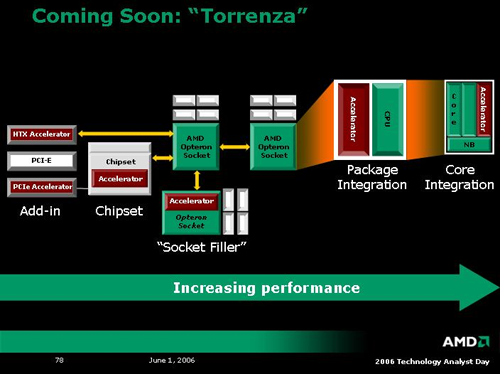
Conveniently, the "accelerator" blocks are all colored red in AMD's diagram, but you can see many areas that ATI's IP could be used here. AMD could put ATI's Avivo engine in the chipsets for HTPC or CE applications, you could find an ATI GPU in a HTX slot or integrated on the CPU package.
We're moving to quad-core CPUs next year, and there is definitely some debate about how useful that will truly be for the home computer user. Beyond quad cores, what do CPU manufacturers do to continue to sell product? Ramping up clock speeds is becoming more difficult, and while two cores definitely shows some promise, and four cores can be useful, it's really difficult to imagine a computing environment at this point where the typical user needs four or more CPU cores. Long-term, throwing more cores on could give way to putting a GPU into the core, and given the nearly infinitely parallel nature of graphics it becomes a bit easier to make use of additional transistors. Remember that ATI and NVIDIA both have flagship products with over 300M transistors, while AMD is currently using about half that for the 2x512K X2 chips. Core 2 4M is close to 300M transistors, but a large number of those are devoted to cache, and doubling cache quickly has diminishing returns.
A Great Way of Penetrating the CE Market
Intel had a huge showing at this year’s Consumer Electronics Show (CES) in Vegas, making very clear its intentions to be a significant force in the CE market moving forward. AMD unfortunately has very little recognition or penetration in the CE market, but buying ATI would change all of that. Aside from the fact that ATI is in Microsoft’s Xbox 360, an item that Microsoft wants to be entrenched in the Digital Home, ATI silicon is also used in many digital televisions as well as cell phones. By acquiring ATI, AMD would be able to gain entry into the extremely lucrative CE market.
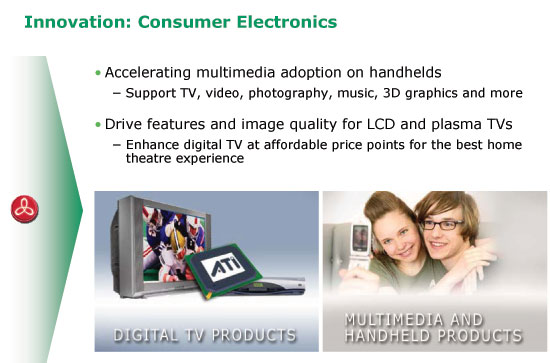
If the world of convergence devices truly do take off, AMD's acquisition of ATI would pay off as it would give AMD the starting exposure necessary to make even further moves into the CE market.


 Facebook
 Twitter
 RSS
RSS


61 Comments
View All Comments
sykemyke - Wednesday, August 9, 2006 - link
Hey, why don't we just put FPGA block on the cpu?This way, programmer could create really new Assembly command, like 3DES or something..
unclebud - Monday, August 7, 2006 - link
it was good to just read any sort of article from the site owner.was feeling that the reviews section had just fallen into the depths of fanboyism, so it was good just to hear somebody at least sometimes impartial THINKING out loud rather than just showing off.
what's really interesting to me is that the whole article mimics what was written in the latest (i think) issue of cpu from selfsame author.
good issue incidentally. will buy it from wal-mart hopefully tomorrow (they have 10% off magazines)
cheers, and keep representing -- i still have the 440bx benchmarks/reviews filed away in a notebook
jp327 - Sunday, August 6, 2006 - link
I'm not a gamer so I usually dont follow the video segment, but looking at the Torenzaslide on page 2(this article), I can't help but see the similarity between what amd forcasts and the PS3's Cell architectuter:
http://www.anandtech.com/showdoc.aspx?i=2379&p...">http://www.anandtech.com/showdoc.aspx?i=2379&p... cell
http://www.anandtech.com/showdoc.aspx?i=2768&p...">http://www.anandtech.com/showdoc.aspx?i=2768&p... K8L
Doesn't AMD have a co-op of some sort w/ IBM?
RSMemphis - Sunday, August 6, 2006 - link
I thought you guys already knew this, but apparently not.Most likely, there will be no Fab 30, it will be re-equipped to be Fab 38, 300 mm with 65 nm features.
Considering all the aging Fabs out there, it makes sense to have the 90 nm parts externally manufactured.
xsilver - Saturday, August 5, 2006 - link
of the 5.4b of ATI's purchase price, is most of that due to intellectual property?i mean as you state, ATI has no fabs.
and then regarding the future of GPU's, with CPU's now becoming more and more multithreaded, couldnt it be fathomable that some of the work be moved back to the cpu in order to fill that workload?
unless of course gpus are also going multithreaded soon? (on die, not just SLI)
eugine MW - Saturday, August 5, 2006 - link
I had to register just to say well written article. It has provided me with much more information regarding the merger than any other website.Greatly written.
MadBoris - Thursday, August 3, 2006 - link
How is the GPU on a CPU even considered a good idea by anyone?GPU bandwidth + CPU Bandwith = how the hell are mobo bus's and chipset going to handle all that competing bandwidth from one socket. Either way their is crazy amount of conflicting bandwidth from one socket, I doubt it can be done without serious thrashing penalties.
When I want to upgrade my video card, I have to buy some $800 CPU/GPU combo. :O
Call me crazy, but that sounds like an April fools joke. But who's kidding who?
It's doom and gloom for PC gaming, and AMD just made it worse.
JarredWalton - Thursday, August 3, 2006 - link
Considering that we have the potential for dual socket motherboards with a GPU in the second socket, of a "mostly GPU CPU" in the second socket, GPU on CPU isn't terrible. Look at Montecito: 1.7 billion transistors on a CPU. A couple more process transitions and that figure will be common for the desktop CPUs.What do you do with another 1.4 billion transistors if you don't put it into a massive L2/L3 cache? Hmmm... A GPU with fast access to the CPU, maybe multiple FSBs so the GPU can still get lots of bandwidth, throw on a physics processor, whatever else you want....
Short term, GPU + CPU in a package will be just a step up from current IGPs, but long term it has a lot of potential.
dev0lution - Thursday, August 3, 2006 - link
1. There was no mention of the channel in this article, which is the vehicle by which most of these products make it to market. Intel and Nvidia have a leg up on any newly formed ATI/AMD entity, in that they make sure their partners make money and are doing more and more to reward them for supporting their platforms. AMD has been somewhat confused lately, trying to keep their promises to their partners while trying to meet sales goals on the other.2. Intel and Nvidia could ramp up their partnership a whole lot quicker than AMD/ATI can (no pesky merger and integrating cultures to worry about), so now you have Nvidia with a long term, very gradual share shift on the AMD side with a quicker ramp up on the Intel side of things to replace ATI's share. Intel and Nvidia in the short term end up doing pretty well, with plenty of time to develop next gen platforms to compete with whatever the long term AMD/ATI roadmap looks like.
3. AMD/ATI got more publicity and PR over this whole deal than they probably could have gotten with their annual marketing budgets combined. Everyone inside and outside the tech world have been talking about this merger which isn't a bad way to get brand recognition for no additional investment.
s1wheel4 - Wednesday, August 2, 2006 - link
This will be the end of AMD and ATI as we know them today....and the end of both in the high end enthusiasts market...when merged; the new company will be nothing more than a mediocre company both of which will lag behind Intel and NVIDIA in performance.