



Intel Core 2 Duo E6300 & E6400: Tremendous Value Through Overclocking
by Anand Lal Shimpi on July 26, 2006 8:17 AM EST- Posted in
- CPUs
Gaming Performance using Quake 4, Battlefield 2 & Half-Life 2 Episode 1
Our gaming performance analysis starts out with Quake 4 running at 1600 x 1200 with High Quality visual settings. We used version 1.2 of Quake 4 and SMP was enabled:
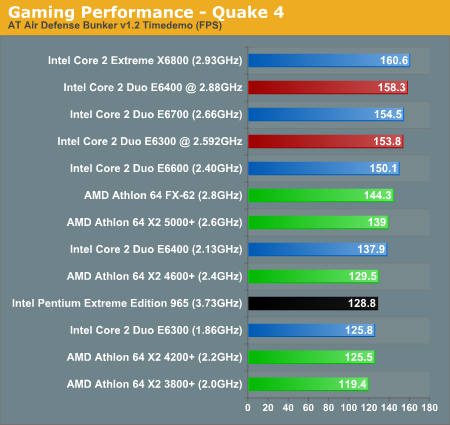
Once we shift over to gaming performance, the differences between all of the tested systems are greatly diminished. Enabling 4xAA would further reduce the difference, to the point where most of the systems would be about equal. This does not change the fact that the Core 2 Duo chips are able to outperform their AMD counterparts in terms of raw performance, so once faster graphics cards become available we should see the processors begin to differentiate themselves more. Of course, by then we might also have games that are more demanding of the GPU.
Looking specifically at Quake 4 performance -- and remember that this is one of the few games that can truly take advantage of multiple processor cores -- the Core 2 processors continue to outperform their AMD counterparts, but only by a small margin. The overall spread between the X6800 and the X2 3800+ is 35%, which is certainly noticeable, but with frame rates that are all averaging over ~120 FPS Quake 4 is clearly going to run well on all of the tested systems. We had hoped to include Prey performance as well, so that we could see how an updated Quake 4/Doom 3 engine game performs, but we ran into benchmarking issues that we are currently investigating.
Next up we've got the recently released Half Life 2: Episode 1, running at default quality settings (auto detected with a pair of X1900 XTs installed) with the exception of AA and aniso being disabled. As with all of our gaming tests in this article we tested at 1600 x 1200:
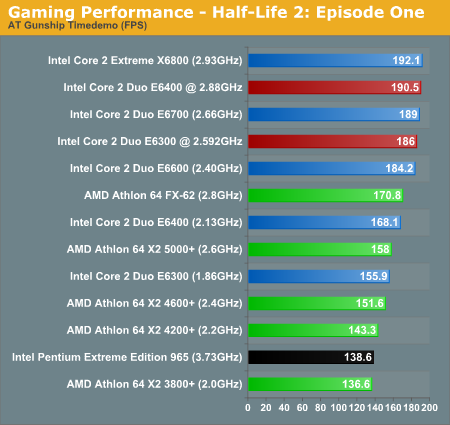
In Half-Life 2: Episode One, the Performance spread is 41%. At the top end of the spectrum, we're beginning to become GPU limited even without antialiasing enabled. Valve's Source engine clearly likes the Core 2 architecture, as even without overclocking the E6300 and E6400 clearly perform better than their similarly priced AMD counterparts.
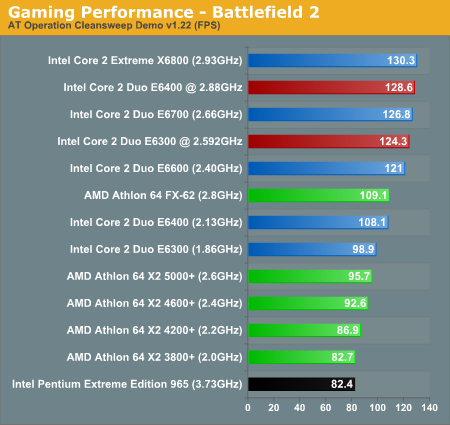
Battlefield 2 is a game that has consistently demonstrated it is more CPU limited than GPU limited, especially with high-end graphics solutions. Here the spread between the processors is 58%, and the E6300/E6400 without overclocking are faster than everything from AMD except for the FX-62. At the top end of the spectrum, we finally begin to reach the limitations of our GPUs, with the top four systems all performing within 3% of each other.


 Facebook
 Twitter
 RSS
RSS


137 Comments
View All Comments
jonp - Sunday, September 2, 2007 - link
The text above the chart for the E6400 says 2.88GHz at 360 MHz FSB at 1.350V (with a multiplier of 8).The chart however shows 1.312V; which is what my stock E6400 runs at.
So what's up?
Killer4Hire - Sunday, October 29, 2006 - link
I agree about your test making the AMD cpu's look none overclocking and at the crazy price of DDR2 ram and the MOBO i just don,t see the bang here..My 3800+ X2 non AM2 on Cheap DDR ram can,t bring it also and make the FX62 look bad.. at 2.6Ghz it scored 7232points in 3Dmark05 cpu test on cheap DDR at a $45Mobo.. where dose that put me in your chart?? oh i am sure she could do 3.0Ghz also..
sergejvictorov - Wednesday, August 2, 2006 - link
Can anyone help me as to what RAM clockspeed I need to buy in order to overclock the E6300 on an ASUS P5B Deluxe board to - let's say - 2.592 GHz? Is DDR2-675 from Corsair sufficient? Thanks in advanceNfarce - Friday, July 28, 2006 - link
Hey look, I was about to plunk down serious bux for an X2 setup to replace my aging P4 o'clkd 3.6xx system (that replaced an Athlon prior, that replaced a PIII prior.. blah blah). Don't you bedwetters know that this give and take is cool for everyone? No, I guess not for EVERYONE. I guess not for those butt pirates with their heads stuck so far up AMD's @ss that they can't see anything but "bias" in a review that shows FACTS. That's ok AMD girlz, take your soccer balls and go home now after trashing Anandtech. Don't forget to dry out your pretty pink wet panties.aznskickass - Saturday, July 29, 2006 - link
Man you are the thickest fanboy I have ever seen.Since you obviously have no interest in E6300 overclocking whatsoever, and will therefore have no fcuking clue what you're talking about, let me enlighten you:
E6300s with Gigabyte DS3 boards are hitting 3.3 - 3.5GHz on air cooling. Check XS forums if you don't believe me. That is the equivalent of an X2 @ 4.1 - 4.4GHz. What are your beloved X2 3800+s getting? 2.8GHz? 3GHz if you're lucky?
That means, with the right mobo, an o/ced E6300 can outperform an o/ced 3800+ by at LEAST 25%.
You just got owned fanboy. Get a clue FFS.
deathwalker - Friday, July 28, 2006 - link
So how long will it take AMD to come up with a competitive response to the Core 2 Duo? Or better yet...do they even have a competitive response in the pipeline?snorre - Thursday, July 27, 2006 - link
It was nice knowing you, at least uptil Intel bought you lock, stock and barrel. After reading your latest reviews I have no doubts left in my mind, you're officially gone the THG route. I used to be a lojal reader and both linked and recommended your site to other people for unbiased information, but I will stop doing this now for obvious reasons. I hope you'll wake up and smell the coffee soon before you loose any more readers. Good-bye!goinginstyle - Thursday, July 27, 2006 - link
So what are they suppose to do? Lie about Conroe's performance? You are one of the biggest AMD fanbois around, sometimes it hurts but suck it up as Intel won this round. There was not anything biased about this article or their coverage. They have been just as big AMD fans as Intel fans since the website started. Leave if you must, but do not do it because the numbers tell the truth.najames - Friday, July 28, 2006 - link
Oh boy, oh boy I want to buy one of these Conroe's right now. I'm gonna order one.Hmm, Newegg doesn't have them, Monarch doesn't have them, it seems nobody has them.
Why are we worrying about comparing vaporware to something that has been out for a long time. Why don't we just compare the Conroe to an upcoming AMD 4x4 then? It's all vaporware then at least.
Oh and let's make sure we compare lots of 64bit stuff too, after all there has been 64bit OSs around for about 15 years now.
Gary Key - Saturday, July 29, 2006 - link
I ordered two from Tiger Direct and one from ZipZoomFly. No issues, received one today and the other two on Monday. :)