



Intel Dual Core Performance Preview Part II: A Deeper Look
by Anand Lal Shimpi on April 6, 2005 12:23 PM EST- Posted in
- CPUs
I'll admit, dual core has me excited for many of the reasons outlined in Part I. A big part is that personally, I've been using multiprocessor systems in my main computer for years. I've always appreciated the benefits of multiprocessor platforms, but recommending one for a desktop user has never been really feasible. Even the cheapest 2P workstation motherboards were at least twice the price of a desktop motherboard, not to mention the cost of the CPUs. The mass market had a short affair with multiprocessing in the days of the ABIT BP6 and the Celeron 300A, but in the grand scheme of things, that was barely a blip on the radar. Now, for the first time, both AMD and Intel are ready to bring the type of robustness of multiprocessor platforms to the desktop with their dual core offerings.
Part I focused on what dual core can offer, but now it's time for a much more practical look. We've never recommended Intel's Extreme Edition line of processors nor AMD's FX series, both supposedly marketed to gamers, but not purchased by any of our gaming readers. The processors that we recommend are usually much better values for the price, and thus, today's comparison isn't based around the most expensive dual core offerings, but rather the cheapest.
A point we made in the first article was that Intel's pricing strategy for dual core is extremely aggressive, with the cheapest 2.8GHz Pentium D soon to be introduced at $241. The problem is that at only 2.8GHz, the Pentium D won't have the strongest single threaded performance, which puts buyers in a sticky situation - do you buy an Athlon 64 3500+ for great single threaded performance or will the Pentium D give you a better overall multitasking experience? Intel doesn't do much to complicate the situation, as the Pentium D 2.8GHz will be close in price to the Pentium 4 630 (3.0GHz), which isn't much of a clock speed advantage. AMD will eventually have competitively priced dual core parts, but right now, AMD doesn't appear to be looking at the mainstream desktop market for dual core Athlon 64 chips.
The three chips mentioned above are the basis of the majority of today's comparison, but the decision is far from clear cut. Let's find out why.
Power Consumption
We'll start with power consumption - the contenders? A 90nm Athlon 64 3500+ vs. the Pentium 4 630 and the dual core 2.8GHz Pentium D. As always, we measured total system power at two states: idle and under a full load. For our full load test, we used a multithreaded application, 3ds max 7, performing the CBALLS2 render test from the SPECapc benchmark.
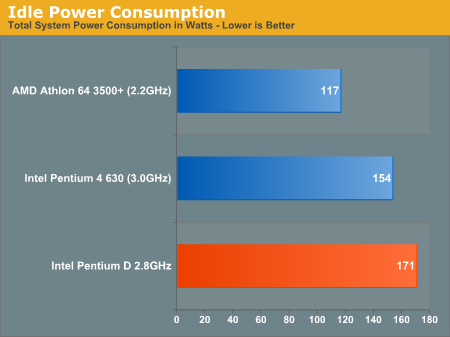
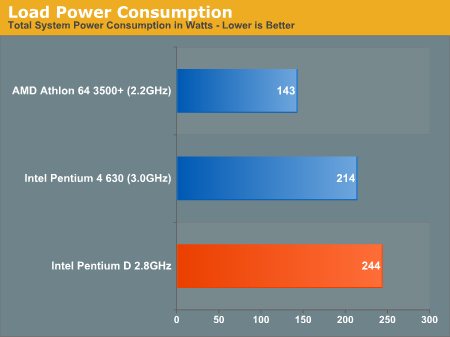
The K8 architecture simply lends itself to lower power consumptions than Intel's high frequency approach to computing with the Pentium 4 (especially Prescott). The move down to 90nm really reduced AMD's power consumption a lot, to the point where the 90nm Athlon 64 3500+ actually consumes less power under full load than the Pentium 4 630 at idle.
The Pentium 4 vs. Pentium D comparison is also interesting, as the 2nd core doesn't add all that much to overall system power consumption. In this case, we're looking at an increase in overall system power consumption by less than 15%. Intel still doesn't win in the power consumption department though; if you want something cool and quiet, AMD is still the way to go.
The Test
Our hardware configurations are similar to what we've used in previous comparisons.
AMD Athlon 64 Configuration
Socket-939 Athlon 64 CPUs
2 x 512MB OCZ PC3200 EL Dual Channel DIMMs 2-2-2-10
NVIDIA nForce4 Reference Motherboard
ATI Radeon X850 XT PCI Express
Intel Pentium 4 Configuration
LGA-775 Intel Pentium 4 and Extreme Edition CPUs
2 x 512MB Crucial DDR-II 533 Dual Channel DIMMs 3-2-2-12
Intel 955X Motherboard
ATI Radeon X850 XT PCI Express


 Facebook
 Twitter
 RSS
RSS


106 Comments
View All Comments
BoBOh - Monday, April 11, 2005 - link
Where are the code compile tests. We're not all gamers, some are software developers! :)BoB
NightCrawler - Saturday, April 9, 2005 - link
Dual core Athlon 64's in June ?fitten - Saturday, April 9, 2005 - link
- also, there should be (SMT) after simultaneous multi-threading in the quote from the paper on the IBM site.fitten - Saturday, April 9, 2005 - link
- quote should be in front of "Scalable not after.fitten - Saturday, April 9, 2005 - link
a) By definition, Intel's implementation must be different than IBM's or anyone elses' because the CPUs aren't implemented the same. Not only do they implement different ISAs, but the entire architectures are different... different number of registers, different ISA, different designs.2) Intel's definition of HyperThreading: http://www.intel.com/technology/hyperthread/
D) This paper http://domino.watson.ibm.com/acas/w3www_acas.nsf/i...$FILE/heinrich.pdf , found on IBM's site by searching, is entitled Scalable "Multi-threaded Multiprocessor Architectures". The first paragraph states: "The former [hardware multi-threading], in the form of hyper-threading (HT) or simultaneous multi-threading, appears in the Intel Xeon and Pentium 4, and the IBM POWER5."
Reflex - Friday, April 8, 2005 - link
Well first off, I am not going to do everyone's homework on this, the info is out there, you all have Google. If you ask a IBM engineer if what Intel is doing is the same as what they are doing, or even if it is really SMT, they would tell you flat out that it is not and they fullfill completely different needs in their products and are implemented completely different. Your definition seems to be that the hardware can accept two threads, therefore it is SMT. That is a VERY simplisitic definition of what SMT is, when there are actually many variations on the concept(HT is a variation, but it is not what most CPU engineers consider actual SMT).One of the primary issues here is that HT does not actually allow two simultanious threads, it is more of a enhanced thread scheduler that attempts to fill unused units with jobs that are pending. A true SMT CPU is actually architecturally able to execute two simultanious threads, its not just filling in idle parts of the pipeline with something to do(highly parallel designs). There is a ton of info on this, if you care I suggest you do the research yourself, I don't have the time(and in some ways the expertise) to write a lengthy article on the topic.
Alternatly, you can just buy into the marketing I suppose, its no skin off my teeth.
fitten - Friday, April 8, 2005 - link
I was going to comment on the phrase "true SMT" above. I'm wondering if this comes from the same lines of thought as the "true dual-core" arguments.Anyway, "HyperThreading" (HT) is just Intel marketing terminology for Symmetric MultiThreading (SMT). They are one and the same, with the same design goals... to more effectively utilize core resources by keeping the resources more busy instead of sitting around idle, particularly at the time granularity of cache misses and/or latencies.
defter - Friday, April 8, 2005 - link
#93 "Intel has labeled it as SMT, however there is another name for what they are doing(that I cannot remember at the moment). What they are calling SMT is nowhere even close to solutions like Power."Well please tell us the exact definition of SMT and the difference between the multithreading in Power and P4?
"That aside, the implementation Intel has chosen is designed to make up for inefficiencies in the Prescott pipeline"
In Prescott pipeline? Why did the HT exist in Northwood based Xeons then? Of course the SMT is designed to reduce inefficiencies in the pipeline. If the CPU can utilize most of its resources when running a single thread there isn't a point of implementing SMT.
saratoga - Friday, April 8, 2005 - link
#93: Intel labeled SMT Hyperthreading. It is effectively the same as what the newer Power processors do (make one core two threads wide).It also was not designed for Prescott, rather it was included in the P7 core from the beginning. For this reason it was available on P4s prior to Prescott.
saratoga - Friday, April 8, 2005 - link
#80:HT improves the utilization of execution resources. Its not a bandaid, its a design choice. In some cases it can be used to compensate for some other weakness, in others it can simply be to increase throughput on multithreaded workloads.
Sun and IBM use it because they build server systems and SMT makes a large difference in traditional server loads.
Intel uses it because they realized it would work well with the P4. I don't know why AMD does not use it. Probably because they don't think the Athlon has enough unused hardware on typical loads to justify the extra transistors. Or maybe just because the Athlon was not designed with it in mind and they can't justify redoing the whole thing to add a single feature. Or maybe a combination of the two.