



Intel Core 2 Quad Q9550S: A New 65W Quad-Core
by Anand Lal Shimpi on January 27, 2009 8:00 PM EST- Posted in
- CPUs
In one breath Intel dramatically cut pricing on its Core 2 Quads. Intel’s swift response was even faster than NVIDIA’s after the RV770 launch. In the following breath however, Intel introduced new, lower power, and much higher priced Core 2 Quad CPUs. Enter the S-line.
TDP binning is something that AMD has done for quite a while on the desktop. The e-suffix parts (e.g. Phenom X4 9350e) are lower TDP parts, sold at a premium, to those users who need lower power consumption.
The Phenom X4 9350e and the 9150e are both 65W quad-core parts from AMD, while all of Intel’s quad-core CPUs have been 95W. Unwilling to allow AMD any sort of advantage, Intel has finally responded with 65W quad-core offerings of its own. The difference here is that while AMD’s 65W quad-cores are all significantly lower clocked Phenom processors, Intel’s 65W chips are available at up to 2.83GHz.
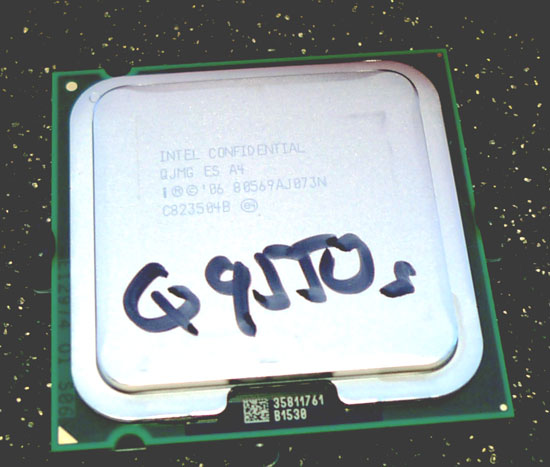
The Core 2 Quad Q9550S, Q9400S and Q8200S are all 65W TDP quad-core CPUs. They share the same specs as their non-S brethren. The only difference here is that instead of being 95W TDP parts, these CPUs can fit in a 65W thermal envelope.
| Processor | Clock Speed | L2 Cache | L3 Cache | TDP | Price |
| Intel Core i7-965 Extreme Edition | 3.20GHz | 1MB | 8MB | 130W | $999 |
| Intel Core i7-940 | 2.93GHz | 1MB | 8MB | 130W | $562 |
| Intel Core i7-920 | 2.66GHz | 1MB | 8MB | 130W | $284 |
| Intel Core 2 Quad Q9650 | 3.00GHz | 12MB | - | 95W | $316 |
| Intel Core 2 Quad Q9550S | 2.83GHz | 12MB | - | 65W | $369 |
| Intel Core 2 Quad Q9550 | 2.83GHz | 12MB | - | 95W | $266 |
| Intel Core 2 Quad Q9400S | 2.66GHz | 6MB | - | 65W | $320 |
| Intel Core 2 Quad Q9400 | 2.66GHz | 6MB | - | 95W | $213 |
| Intel Core 2 Quad Q8300 | 2.50GHz | 4MB | - | 95W | $183 |
| Intel Core 2 Quad Q8200S | 2.33GHz | 4MB | - | 65W | $245 |
| Intel Core 2 Quad Q8200 | 2.33GHz | 4MB | - | 95W | $163 |
The price premium for these new S-parts is huge. The Q9550S costs $103 more than the non-S, the Q9400S will set you back another $107 and the Q8200S is the most affordable with only an $82 premium. Note that in the case of the Q9550S and Q9400S you're actually more expensive than the entry level Core i7-920.
Intel achieves these lower TDPs by running at a lower core voltage. With a mature enough manufacturing process, which Intel’s 45nm process is, it’s quite possible to produce CPUs that run much cooler than average and on a lower voltage. CPU power varies with the square of the voltage, so any savings in voltage can result in a non-linear decrease in power consumption.
Don’t get too excited however. If you remember back to our review of the 9350e/9150e we found that the decrease in power wasn’t worth the added price. Even Intel has come forward and told us that these are primarily OEM parts and not intended for the high volume enthusiast community. With Intel being honest in its intended purpose for these S-class CPUs we don’t really have to do much to keep them honest, we just need to confirm the findings.
To do this we took a subset of our regular CPU performance tests and looked at performance, power consumption and power efficiency. We measured total system power consumption at the wall outlet, which does admittedly lessen the impact of a lower power CPU but it should give us an idea of the real world benefit of these processors. If you want to see how the Q9550/Q9550S performs across our entire suite of benchmarks take a look at AnandTech bench, our new publicly available benchmark database.
...and in case you’re wondering, no, they don’t overclock any better. Our Q9550S couldn’t get any further than the Q9550 we used in our Phenom II review.
The Test
| CPU: | AMD Phenom II X4 940 (3.0GHz) AMD Phenom 9950 (2.6GHz) Intel Core i7-965 (3.2GHz) Intel Core i7-920 (2.66GHz) Intel Core 2 Extreme QX9770 (3.2GHz/1600MHz) Intel Core 2 Quad Q9650 (3.00GHz) Intel Core 2 Quad Q9550S (2.83GHz) Intel Core 2 Quad Q9450 (2.66GHz) Intel Core 2 Quad Q9400 (2.66GHz) |
| Motherboard: | Intel DX58SO (Intel X58) Intel DX48BT2 (Intel X48) MSI DKA790GX Platinum (AMD 790GX) |
| Chipset: | Intel X48 Intel X58 AMD 790GX |
| Chipset Drivers: | Intel 9.1.1.1010 (Intel) AMD Catalyst 8.12 |
| Hard Disk: | Intel X25-M SSD (80GB) |
| Memory: | G.Skill DDR2-800 2 x 2GB (4-4-4-12) G.Skill DDR2-1066 2 x 2GB (5-5-5-15) Qimonda DDR3-1066 4 x 1GB (7-7-7-20) |
| Video Card: | eVGA GeForce GTX 280 |
| Video Drivers: | NVIDIA ForceWare 180.43 (Vista64) |
| Desktop Resolution: | 1920 x 1200 |
| OS: | Windows Vista Ultimate 64-bit |


 Facebook
 Twitter
 RSS
RSS


62 Comments
View All Comments
Tujan - Tuesday, February 3, 2009 - link
Interesting article. Not only because of the look at the new ''low''power Q CPUs. But because of the ideal of using a greater wattage CPU (such as the i920 etc) that utilizes lower total voltage. Although the 'average'consumption is less with a power saving cpu.Would be interested in consoling another comparison test on the geeky side. One in which two comparably equiped systems (or three) are rigged to an Inverter,or run from a Backup Power supply. Running the same apps. Noting which system ran out of "juice" sooner.
You could possibly say that if for example the 90 watt/130 watt killed the battery/backup sooner,although it did the applications over x amount of times (greater).
But what I am looking at is simply if at all possible to run the test. Perhaps with a timer hooked onto the battery connection to measure the juice left,and/or time battery konked out.
The H.264 test would seem to be the better test. Since it would be likely that using such a connection scenario might be most utilized.
Notice that most of the i7 core systems though,run from extremely large power supply systems. Though I have seen them run from as low as 650 watt from articles. Also note that the formulas used in your test should be calculable via math. However you might notice that there is a formula which decides the length of the power supplies capability.
Of course you would not be able to watch a movie in x amount of greater frame rate. Or in fast forward mode. Then the Inverter I have (which I have used to start my auto at times) might not even run a system that needed a cold jump at x amount of watts. X amount of Amps. I guess joules is a derivative of Amps. I could look it up,but I'll just say I dont know here.
suntrace1 - Tuesday, February 3, 2009 - link
Is there any chance to compare the underclocked Q9550 and Q9550S in the future?kzVegas - Monday, February 2, 2009 - link
Come on ! ! ! You test nearly a dozen CPUs included a Q9450 and Q9650 and you couldn't dig up a Q9550 (no S)?xeizo - Friday, January 30, 2009 - link
if one already owns a C2Q, undervolting it is a nice option. My Q9450 runs perfectly stable @ 3.4GHz wo 1.184V, I don't care much about the energy reduction but the heat reduction. I can have a already silent fan running at only 600rpm on my True, and that means a nice and silent workplace :)Normally, with higher volts it is stable at 3.7GHz(and hot) but that ain't worth it because the sound from the fans for just a little more performance.
My E8400 undervolts even better, it runs a Linux home-server 24/7 @ only 0.91V and w both bridges undervolted.
nilepez - Thursday, January 29, 2009 - link
I'm a bit confused. How do you figure going with i7 is 100 dollars more? What about the higher MB and Memory prices?I'd guess going from the S to the i7 will cost you at least $300, if not more.
I'm no advocating one over the other...but it's just wrong to quote the CPU price delta, when DDR2 can be had for a fraction of DDR3 and most i7 main board are significantly more too.
Denithor - Thursday, January 29, 2009 - link
It's closer to $150 more than an equivalent C2Q setup. X58 boards are now available for about $200 ($100 more than UD3R for example) and there's a 6GB DDR3-1333 kit for $110 shipped (about $70 higher than a 4GB DDR2 kit - remember, you're getting more memory).Denithor - Wednesday, January 28, 2009 - link
It seems like you should have included an e8400 @ 3GHz as a direct comparison to the Q9650 and PhII 940. Yes, the work would have taken longer - but the chip also runs a lot lower on power, I would imagine. And it would have been interesting to me to see how efficient those chips are compared to the quads available today.zagortenay - Wednesday, January 28, 2009 - link
There are so many people in this forum, who are literally and virtually owned by Intel and they are proud for the fact that their wallets are emptied. Really strange!Anonymous Freak - Wednesday, January 28, 2009 - link
The big problem with this review is that the power consumption setup is based on an inappropriate premise: That someone will use these chips in a high-end rig.These chips are *NOT* for someone who is running a GTX 280. I mean, that video card draws more power at idle than these chips draw at full load.
No, these chips are for thin-and-light desktops that otherwise have too small a thermal envelope for quad-core. In *THOSE* systems, the extra money is worth it, since the comparison is these new chips, or dual-core. Not these chips vs. the 95W quad-cores.
For example, Intel has two mini ITX motherboards (DG45FC and DQ45EK) that have a max TDP of 65W. Those are the target for these new chips. For ultra-small systems without a 200+W video card.
strikeback03 - Thursday, January 29, 2009 - link
Which is the reason they wrote this paragraph:The Q9550S and the other 65W quad-cores are designed for OEMs or anyone trying to cram as much power into a very small space. I’d expect that these CPUs would be better suited for something like an iMac rather than a normal sized desktop. The problem is that in a normal desktop you’ve got more than enough room to keep even a Core i7 cool, but in some of these OEM designs (like the iMac or Dell XPS One 24) there’s hardly enough room for a normal heatsink and fan.