



Intel's Atom Architecture: The Journey Begins
by Anand Lal Shimpi on April 2, 2008 12:05 AM EST- Posted in
- CPUs
Lower Power than Centrino
(This page is taken from our earlier look at the Intel Atom architecture)
With mobile Penryn Intel introduced a new power state it calls C6. In the C6 power state the CPU is in a virtual reset state, and core voltage is very close to zero. The core clock, all of the PLLs, and caches are completely turned off. All of the state data is saved in a 10.5KB storage area, similar to mobile Penryn (but smaller since there's not as much state to save). Upon exiting C6 the processor's previous state is restored from this memory, called the C6 array. It takes around 100us to get out of C6, but the power savings are more than worth the effort - it's a similar approach of power for performance that we saw in the design of the original Pentium M processor.
Clock gating (sending the clock signal through a logic gate that can disable it on the fly, thus shutting off whatever the clock connects to) is an obvious aspect of Atom's design. All Intel processors use clock gating; Atom simply uses it more aggressively - the clock going to every "power zone" is gated, something that isn't the case in mobile Core 2. Each logic cluster (205 total) in Atom is referred to as a Functional Unit Block (FUB) and the entire chip uses what Intel calls a sea of FUB design. Each FUB is clock gated and can be disabled independently to optimize for power consumption. The cache in Atom is in its own FUB, which apparently isn't the case in mobile Core 2.
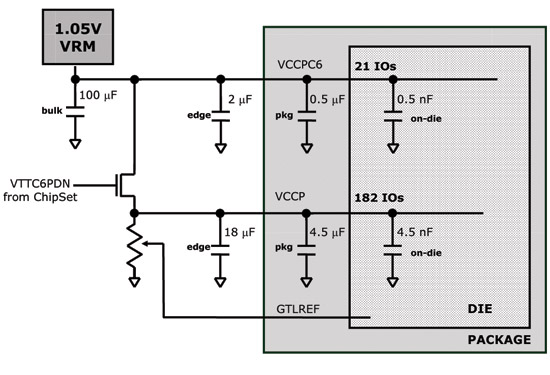
Keeping Silverthorne on life support, only 21 pins are necessary
Atom uses a split power plane; in its deepest sleep state (C6) the chip can shut off all but 21 pins which are driven by the 1.05V VRM. By having two separate power planes the chip can manage power on a more granular level. While it can't disable individual pins, it can disable large groups of them leaving only 21 active when things like the L2 cache and bus interface are powered down.
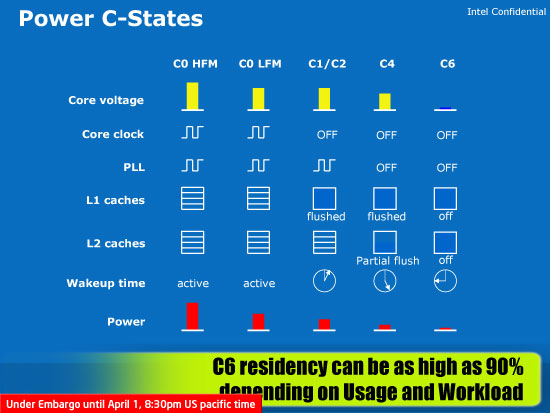
Intel mentioned that Atom will remain in its C6 sleep state 90% of the time. However, that figure is slightly misleading because it's only possible to remain in C6 when the CPU is completely idle. The 90% figure comes from taking into account a mobile device sitting in your pocket doing nothing most of the time. When in use, Atom won't be able to spend nearly that much time in C6.
Despite the implementation of a C6 power state, Atom will still lose to ARM based processors in both active and idle power. The active power disadvantage will be erased over the coming years as the microarchitecture evolves (and smaller manufacturing processes are implemented), while the idle power requires more of a platform approach. As we reported in our first Menlow/Silverthorne article:
"The idle power reduction will come through highly integrated platforms, like what we're describing with Moorestown. By getting rid of the PCI bus and replacing it with Intel's own custom low-power interface, Intel hopes to get idle power under control. The idea is that I/O ports will only be woken up when needed (similar to how the data lines on the Centrino FSB function), and what will result are platforms with multiple days of battery life when playing back music."


 Facebook
 Twitter
 RSS
RSS


46 Comments
View All Comments
adntaylor - Tuesday, April 8, 2008 - link
On that chart with price / power, you need to be clearer...For price, you show the combined price for CPU + Chipset. For power, you say just the CPU... so 0.65W for the CPU... but you're conveniently ignoring the >2W figure for the chipset!!! This absolutely flatters Intel wherever possible.
AMD are just as misleading - they describe the Geode LX as "1W" which excludes the non-CPU core parts of the chip (which is an integrated CPU + GMCH)
Just please be honest - the figures are out there in the Intel datasheets... it takes 10 minutes to check.
Clauzii - Friday, April 4, 2008 - link
I still have a PowerVR 4MB addon card, runnung in tandem with a Rage128Pro. Quite a combination w. 15 FPS in Tombraider. Constant(!) 15FPS, that is..Amazing what they actually achieved back in 95!
Clauzii - Friday, April 4, 2008 - link
Ooops!Totally misplaced that. Sorry.
wimaxltepro - Friday, April 4, 2008 - link
The Atom represents a shift in processor architecture that is the most dramatic departure for Intel since introduction of x86 processors... the philosophy of how computing itself occurs from centralized processors to distributed processing based on an extension of the popular x86 instruction set.The Atom is not about the immediate prospects for the Atom or Nehalem products: we will likely see members of Intel's new product family be used in embedded applications in consumer products and in areas where specialized communications processors are more the rule. While not optimized for use in specific networking applications, the products capitalize on the wide range of support available in IT/Networking to develop common functions that leverage the low cost, low power/processing capability to be used as a common denominator for a wide range of applications.
Intel has been built on the 'Wintel' architecture: massively integrated chips needed to handle the massively integrated operating systems and applications of Windows (and Apple) environments. The Atom allows migration and broadening out from that architectural motif to a very highly distributed architecture. So, the increased parallelism found in the internal chip architecture is enabling of changes in external system architectures and device applications that go well beyond the typical domain of Intel.. and right into the domain of 'personal wireless broadband' and SDWN, Smart Distributed Wireless broadband Network.
The decisions about in-order vs. out of-order instruction streams, memory architecture, I/O architecture have been made in light of the broad vision for how computing, networking and, out of hand, how wireless enabled broadband networking including WiMAX will occur. This should be understood for what it represents as a shift in direction for Intel both in response to broad industry shifts and as a trend setting development.
jtleon - Friday, April 4, 2008 - link
Thanks to all the flash player ads, etc., a mobile web device will continuously avoid switching to low power states. Thus one could argue that advertising will be carbon footprint enemy of the internet's future. This is already becoming the case for desktop/laptop machines.Without such continuous (arguably wasted) consumption of CPU power, then Intel's engineered power management might have a significant impact on the value of the Atom.
Regards,
jtleon
0WaxMan0 - Friday, April 4, 2008 - link
I am definatly much impressed and enthused by intels work here, the future looks interesting esp for those of us who like low power cross compatible computing products.However I have to point out that a low power modern x86 cpu has allready been done infact 4 years ago with AMD's Geode. While technically much weaker than the Atom and with out any where near the scalability (single core design etc.) the Geode has been available in the same TDP ranges for a good long while. Take a look here http://www.amdboard.com/geode.html">http://www.amdboard.com/geode.html for some old stuff.
I do hope that the Intel name and hype makes more of an impact than AMD managed.
whycode - Thursday, April 3, 2008 - link
Does the TDP quoted include the chipset? Or is that CPU only?IntelUser2000 - Thursday, April 3, 2008 - link
Anand, the Pentium M does not feature Macro Ops Fusion. Its Core 2 Duo that started Macro Ops Fusion.Anand Lal Shimpi - Thursday, April 3, 2008 - link
You're correct, I was referencing micro-op fusion. I've made the appropriate correction :)Take care,
Anand
squito - Wednesday, April 2, 2008 - link
Am I the only one shocked to see that Poulsbo is a 130nm part...