



Overclocking Intel's New 45nm QX9650: The Rules Have Changed
by Kris Boughton on December 19, 2007 2:00 AM EST- Posted in
- CPUs
Exploring the Limits of 45nm Silicon
During the course of our testing we made a rather interesting discovery regarding 45nm silicon scaling: a window exists in which CPU frequency responds in a highly proportional manner. Calculating this value later tells us that between 3.0GHz and 4.0GHz our processor requires ~0.3mV (0.0003V) more Vcore for each one megahertz increase in core frequency. Since our QX9650 is capable of running the stock 3.0GHz setting at only 0.98V, this means that achieving a stable 3.6GHz overclock requires 0.98V + (0.3mV/MHz)(600MHz) = 1.16V. This general trend continues all the way to about 4.0GHz where we found total stability at an amazingly low 1.28V. We cannot help but feel excited about Intel's new 45nm process, especially considering such early maturity.
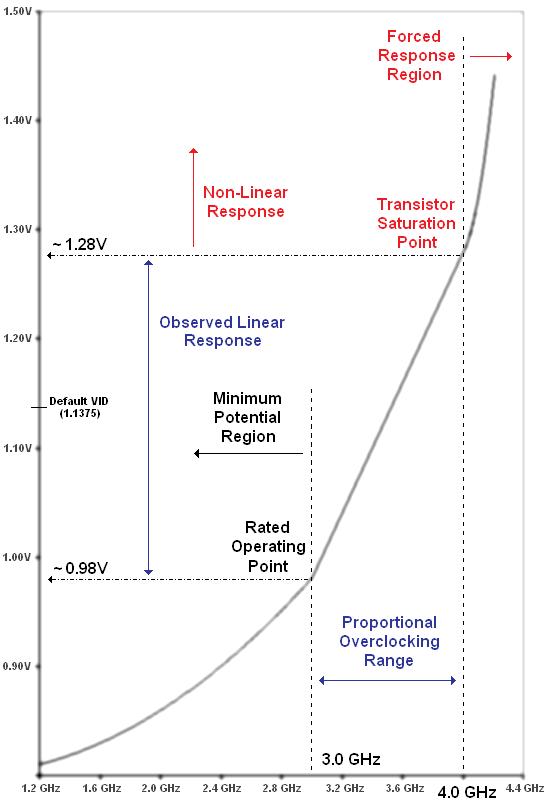
Always target the higher end of the Proportional Overclocking Region
Dropping below 3.0GHz allows us a chance to experiment in the world of low-voltage (LV) and ultra low-voltage (ULV) clocking. Two point four gigahertz (2.4GHz) was possible at only 0.90V. Additionally, the lowest possible core speed that we could dial-in using the ASUS P5E3 (6 x 200MHz = 1.20GHz) had no problems maintaining stability at only 0.81V. It's interesting to note that this is also the lowest Vcore we could supply the CPU, as VID settings below 0.85000 were not available for use. As an aside, the VRM 11.0 specification, used extensively by motherboards supporting 65nm CPUs, calls for selection values down to 0.70000V.
As expected, pushing the QX9650 above 4.0GHz, although possible, also demands more Vcore than predicted by our simple scaling equation. In fact, running well in excess of this speed requires a nearly exponential increase in voltage. At this point gains are small and generally not worth the extra heat produced because of the excess power consumed. Clearly, the more efficient silicon switching that comes with better cooling is needed if we planning to go much higher. Oddly enough, for the first time in water-cooled quad-core history, we feel as though heat is not the limiting factor. Rather than push this finding aside, we decided to examine the cause a little more closely.

We start our investigation by comparing our measured processor power consumption values with those found through use of the well-known power scaling equation (shown above). The equation wonderfully predicts what we see at lower frequencies but quickly falls behind actual measured values when looking at higher speeds:
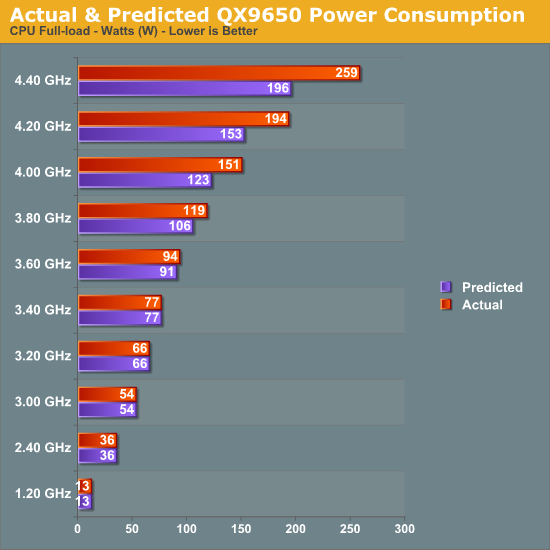
A quick check for clues as to the differences turns up one important oversight. Intel's newest power prediction equation includes an extra factor - processor capacitance. Research indicates that the capacitance associated with the transistors gates has become quite significant; possibly more so with 45nm Hi-k transistors than those made using any other previous process technology. We decided to establish the region boundary in the plot above using the point in which this effect became significant, even though the extra transistor capacitance created at higher switching frequencies begins to manifest itself as additional power required at lower processor speeds (around 3.6GHz). At 4.0GHz this additional factor accounts for 25% more power than would otherwise be predicted.
Although we cannot explain exactly why capacitance becomes such a large factor at higher speeds, average core temperature may be a factor. This would certainly help to explain why microprocessors experience such dramatic increases in switching efficiencies when super cooled. Typically, a processor needs significantly less voltage in order to run equivalent speeds under phase-change or liquid nitrogen than would be required with typical air or water-cooling. In fact, based on what we have seen, these 45nm processors may be the first of many in which overclockers find they reach silicon limits before anything else. In the past, it was comforting to know that a bigger heatsink, more powerful fan, or a better water block held the promise of a higher overclock; with 45nm this may no longer be the case.


 Facebook
 Twitter
 RSS
RSS


56 Comments
View All Comments
mariedeguzman - Friday, June 19, 2009 - link
Thanks for this post, this is a great article and a good help to those who need advices about this post.Markfw900 - Thursday, January 10, 2008 - link
My Gigabyte P35-DQ6 does have what you say is voffset, but is has NO vdroop from idle to load. I believe this is because it has a far superior power delivery system. I don't have an instrument to tell me any differences that may happen in nano-seconds on the voltage, but overall, it never seems to change. This would be consistant with a high quality board. So why do you say its a feature ? I can see how a mfg may undervolt to not go over recommended vcore for non-overclocked cpu's, but if I didn't overclock, my board wouldn't have vdroop either.Its just cheap motherboards, not a "feature". If I am wrong, please test a DQ6 and show the results.
LaGUNaMAN - Saturday, January 5, 2008 - link
One of the best tech articles I've read in awhile. (^^,)isvaljek - Tuesday, January 1, 2008 - link
"typically, even the worst "performance" memory can handle CAS3 when running at about DDR2-800, CAS4 to about DDR2-1075, and CAS5 for anything higher."Are they for real?
mindless1 - Monday, December 31, 2007 - link
Considering the heat produced I can't see a justification for the idea of drastic shifts in the cooling industry. Realistically there aren't THAT many overclockers using water cooling at all and current (including older) processors having lower power consumption were what brought the cooling industry to what it is today.You may say past some point the heat isn't the factor, but you still need a decent heatsink up until that point. 100W of heat for example is a non-trivial level even though some past parts have exceeded that.
mindless1 - Monday, December 31, 2007 - link
What I really meant to say is that it's not just a matter of getting rid of the heat but doing so without the system sounding like it has a leaf blower hidden inside, and for that many lesser heatsinks just don't cut it.mindless1 - Monday, December 31, 2007 - link
What I really meant to say is that it's not just a matter of getting rid of the heat but doing so without the system sounding like it has a leaf blower hidden inside and for that many lesser heatsinks just don't cut it.mindless1 - Monday, December 31, 2007 - link
What I really meant to say is that it's not just a matter of getting rid of the heat but doing so without the system sounding like it has a leaf-blower hidden inside and for that many lesser heatsinks just don't cut it.SilthDraeth - Friday, December 21, 2007 - link
And their TDP measurement is the same as it has always been, maximum draw.Yes ACP is a marketing tool. So what. MHZ is a marketing tool as well, and still has real world benefits. Same as ACP.
wordsworm - Thursday, December 20, 2007 - link
Best damned article I've seen out of AT in a long time. Bravo.