



Swiftech H2O-120 Compact and Corsair Nautilus 500: Is Water Better?
by Wesley Fink on September 17, 2007 6:00 AM EST- Posted in
- Cases/Cooling/PSUs
A few years ago any discussion of which was better - water or air - would inevitably end in the conclusion that water was better than even the best air coolers. In fact, many would have considered it heresy to even raise the question. We are told from many directions today that water cooling is superior, and yet there are few direct comparisons of the performance of water and current air cooling.
There have been many advances in air cooling in the last few years - so much so that the best current air coolers bear almost no resemblance to yesterday's air coolers. The top air cooler of yesterday was a configuration with a small, whining, top-mounted fan with a heavy copper heatsink and no heatpipes. This is a far cry from today's best air coolers. Now the most successful of current air cooler designs feature heatpipe towers with quiet side-mounted 120mm fans blowing toward a rear exhaust.
The multiple liquid-filled heatpipes and the large, quiet, high-output fans in use today have taken air cooling to new performance levels. Our testing here at AnandTech supports the vastly superior performance of the heatpipe tower compared to the older air cooling designs. With these results in mind, it is time to revisit the question: is water cooling still the best performer?
Certainly the reasonably priced self-contained water coolers have provided mixed test results compared to the top air coolers. The small Xigmatek AIO provided good results for its size, but the larger Evercool Silver Knight was somewhat disappointing in performance. It was reasonably clear in test results though, that the self-contained units could compete in the notch below the top of the tested air coolers, but not the top air coolers of today. None of the self-contained water coolers really cooled better or could reach the same high overclocks we saw with the best air designs. This raised the question of how "real" water cooling systems would compare.
Water cooler designs have not been completely static while air cooler design has been evolving. Water cooling manufacturers have been working toward simpler designs that are less intimidating for the average computer enthusiast. This involves several different approaches. Some look to move all of the water cooling components inside the case while others are looking at new ways to move water cooling outside the case; we will be looking at both approaches today, the former with the Swiftech H2O120 Compact and the latter with the Corsair Nautilus 500. Whichever approach they have taken, the water cooler manufacturers claim combining complete top-line pumps, waterblocks, reservoirs and radiators has resulted in top-line water cooling results with a much easier installation than traditional water cooling.
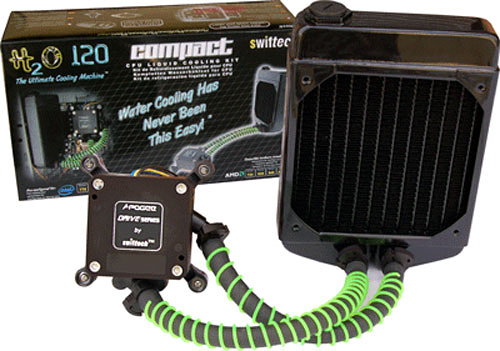
The Swiftech H2O-120 Compact combines water cooling components inside the case. Swiftech reduces the traditional four components of a water cooling system to two components. The water block and water pump are combined into the Apogee Drive Block and the radiator and reservoir are combined. By merging components the H2O Compact requires just one set of connecting hoses in the water cooling system.
According to Swiftech this simplified water system still uses the top individual components in the combined components so performance is not compromised. The simpler H2O-120 Compact also claims much easier installation, with just 15 to 20 minutes required for a complete internal installation. All of this water cooling performance also comes at a cheaper price than is typically seen with a water cooling kit. The H2O Compact was just introduced and is selling for around $150, but Swiftech tells us they expect the street price for the H2O-120 Compact kit to settle in at around $129.
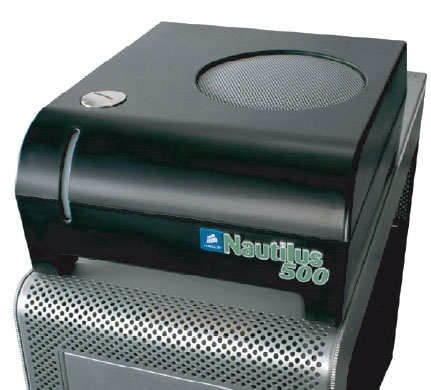
The Corsair Nautilus 500 uses a different approach to easier installation. Components remain similar to the more traditional water cooling parts, but everything except the CPU water block is integrated into an external cooling appliance. This also reduces water connections to two tubes for a much simpler and faster installation. Corsair claims the Nautilus 500 can be installed in 8 minutes, which is certainly as fast as most air cooling installs.
The Corsair Nautilus 500 also comes at a cheaper price than many other water cooling kits. Where most kits are in the $200 or higher price range, the Corsair sells for about $150 or even less. This places the Nautilus 500 in the same basic price group as the H2O-120 Compact.
Both Corsair and Swiftech claim they have not compromised in quality or performance with the simpler-to-install systems. Both say they combine top-line pumps, water blocks, reservoirs and radiators to insure top-line water cooling results with a much easier installation than traditional water cooling. In fact it appears both Corsair and Swiftech use similar components in their systems that are arranged in different configurations.
The big question then is performance. Do the Swiftech H2O-120 Compact and Corsair Nautilus 500 actually outperform the top air coolers? Are they quieter than today's best air coolers as advocates of water cooling claim? These are not frivolous questions since either water system costs two to three times the price of the top air coolers. Finally, are there other advantages to these water systems that make them a better choice even if performance is less than standout? Do the Compact H2O and/or the Nautilus 500 claim the title of best cooling system tested at AnandTech?
There have been many advances in air cooling in the last few years - so much so that the best current air coolers bear almost no resemblance to yesterday's air coolers. The top air cooler of yesterday was a configuration with a small, whining, top-mounted fan with a heavy copper heatsink and no heatpipes. This is a far cry from today's best air coolers. Now the most successful of current air cooler designs feature heatpipe towers with quiet side-mounted 120mm fans blowing toward a rear exhaust.
The multiple liquid-filled heatpipes and the large, quiet, high-output fans in use today have taken air cooling to new performance levels. Our testing here at AnandTech supports the vastly superior performance of the heatpipe tower compared to the older air cooling designs. With these results in mind, it is time to revisit the question: is water cooling still the best performer?
Certainly the reasonably priced self-contained water coolers have provided mixed test results compared to the top air coolers. The small Xigmatek AIO provided good results for its size, but the larger Evercool Silver Knight was somewhat disappointing in performance. It was reasonably clear in test results though, that the self-contained units could compete in the notch below the top of the tested air coolers, but not the top air coolers of today. None of the self-contained water coolers really cooled better or could reach the same high overclocks we saw with the best air designs. This raised the question of how "real" water cooling systems would compare.
Water cooler designs have not been completely static while air cooler design has been evolving. Water cooling manufacturers have been working toward simpler designs that are less intimidating for the average computer enthusiast. This involves several different approaches. Some look to move all of the water cooling components inside the case while others are looking at new ways to move water cooling outside the case; we will be looking at both approaches today, the former with the Swiftech H2O120 Compact and the latter with the Corsair Nautilus 500. Whichever approach they have taken, the water cooler manufacturers claim combining complete top-line pumps, waterblocks, reservoirs and radiators has resulted in top-line water cooling results with a much easier installation than traditional water cooling.
The Swiftech H2O-120 Compact combines water cooling components inside the case. Swiftech reduces the traditional four components of a water cooling system to two components. The water block and water pump are combined into the Apogee Drive Block and the radiator and reservoir are combined. By merging components the H2O Compact requires just one set of connecting hoses in the water cooling system.
According to Swiftech this simplified water system still uses the top individual components in the combined components so performance is not compromised. The simpler H2O-120 Compact also claims much easier installation, with just 15 to 20 minutes required for a complete internal installation. All of this water cooling performance also comes at a cheaper price than is typically seen with a water cooling kit. The H2O Compact was just introduced and is selling for around $150, but Swiftech tells us they expect the street price for the H2O-120 Compact kit to settle in at around $129.
The Corsair Nautilus 500 uses a different approach to easier installation. Components remain similar to the more traditional water cooling parts, but everything except the CPU water block is integrated into an external cooling appliance. This also reduces water connections to two tubes for a much simpler and faster installation. Corsair claims the Nautilus 500 can be installed in 8 minutes, which is certainly as fast as most air cooling installs.
The Corsair Nautilus 500 also comes at a cheaper price than many other water cooling kits. Where most kits are in the $200 or higher price range, the Corsair sells for about $150 or even less. This places the Nautilus 500 in the same basic price group as the H2O-120 Compact.
Both Corsair and Swiftech claim they have not compromised in quality or performance with the simpler-to-install systems. Both say they combine top-line pumps, water blocks, reservoirs and radiators to insure top-line water cooling results with a much easier installation than traditional water cooling. In fact it appears both Corsair and Swiftech use similar components in their systems that are arranged in different configurations.
The big question then is performance. Do the Swiftech H2O-120 Compact and Corsair Nautilus 500 actually outperform the top air coolers? Are they quieter than today's best air coolers as advocates of water cooling claim? These are not frivolous questions since either water system costs two to three times the price of the top air coolers. Finally, are there other advantages to these water systems that make them a better choice even if performance is less than standout? Do the Compact H2O and/or the Nautilus 500 claim the title of best cooling system tested at AnandTech?


 Facebook
 Twitter
 RSS
RSS


58 Comments
View All Comments
geok1ng - Wednesday, July 23, 2008 - link
There is no reason to dump $120+ on a budget water cooling system for CPUs since most sub$50 air coolers will do a good jobbut with SLI/crossfire systems the typical air cooling solution are suboptimal to say the least. Even you have a board that can fit 2 VGA and 2 Acellero S1s, there is no way to put good airflow averthe humungous setup!
Someone plaese give us a water cooling solution for multi GPU systems that doesnt cost MORE than the VGAs!
Cregaune - Tuesday, March 25, 2008 - link
This review has given me lots of food for thought. Frankly, I find the conclusion incredible.Perhaps you guys are right, but before people jump to your conclusions I wonder why your ambient room temps were kept within such loose margins i.e 20'C to 22'C.........a full 3'C !!!
Controlling ambient room temperature is particularly important when reviewing a water cooled system, simply because it can take an hour or more for the coolant temperature to stabilise; before you can legitimately take a reading. If, in the meantime, you let the room temperature fluctuate within such grossly wide margins, your results are next to useless....especially given the relative performance figures in your findings.
Just a thought!
Cableaddict - Friday, April 11, 2008 - link
Wesley,As far as performance goes, I'd say you present a valid argument. The specific kits you tested are not worth investing, vs a few of the best air-coolers. So far, so good, but your conclusions and general tone seem to fail badly after that one true point.
You wrote, (in this thread) "We state you will likely need to spend more than $300 to possibly outperform current top air coolers."
Nonsense. As many have mentioned, the big problem with these kits is the use of a single "220" size radiator. Using a dual-rad, or two singles, has been shown in test after test to increase cooling dramatically (even with a "lowly" Swiftech rad) So, one could buy the H2O-120 and add another radiator for $42 more. That's WELL under $200, and the performance OC'ed & under load will slightly outperform the Ultra-120. AND , it will be much less noisy.
You conclusions about noise are correct, but only at lower fan speeds.You posted a chart showing high OC / high load performance, but failed to include noise specs under those conditions. The noise comparisons at lower cooling settings do not apply at all. I've been looking at TONS of tests, specifically weighing cooling vs noise. At the high speeds needed to make the Ultra-120 types perform their best (about equal to a low-end dual radiator WC) they are much, MUCH noisier than WC, according to every test I've read.
Last: Bear in mind that many folks cannot fit those big air-coolers, espially HTPC people, or those with rack-mount music & video pc's. For such rigs, the best air coolers that will actually fit are the Gemini II, the DuOrb, etc. Even a single-rad WC setup does better than those when OC'ed & under load. (according to many tests I've seen.) With a dual-rad, WC systems decimate these air-coolers. For instance, one test put a Gemini II / dual Noctua blower against the H2O-220 kit. At 3.7 Ghz, under load, the WC was 15º cooler.
-----------
Regarding pump noise: Well again, your comparisons are fair if one is going to strictly obey the "rules" and not mod any system at all. However, One can pretty easily add sonex or other noise absorbtion to the inside of the case, and limit a good bit of that pump noise.
Going to a non-kit system, one can now choose the Lang D5 vario, dial it down a little, and add some sound isolation around it. Not so hard, and all reports say it is then virtually silent. With a dual-rad performance should still be excellent. Granted, that's approaching the $300 mark, but serious overclockers would certainly do better with such a set-up, and it would be LESS noisy.
I guess one last question must be addressed, and that is: Just how cool do we need to go? Let's say one want to OC a Q6600 (timeframe of this review) to 3.8 ghz. A $75 air-cooled rig will run under heavy load at (let's say) 60º, and a decent WC rig will run it at 50º. Is 60º safe enough, day after day, that the WC system is not worth the substantial cost? I don't know the answer. I wish I did.
-And when pushing the FSB really hard, one might worry about the rest of the mobo components. -So now we have to weight the WC advantage of being able to also cool the NB and GPU, vs the air-cooler advantage of cooling the ram,NB, mosfets, etc.
One might reasonably say that,with heavy OC, a WC set-up requires an additional case fan, and that means a little more noise.
Complicated...
Cableaddict - Friday, April 11, 2008 - link
Custom H2O-220 type system:Swiftech Apogee Drive 350 Pump / CPU water block combo $80
Swiftech MCR220-res: $55
2 Noctua fans: $50
non-evaporate hoses / clamps: ~ $20 MAX.
Hydrex: $3
------------------------------------------
$210 or less.
Swap-in a Lang Vario D5 pump and an Apogee or Fuzion waterblock, instead of the Apogee Drive 350, and you still under $275.
Test either of these systems on a Q6600 @ 3.8 Ghz, against any air system, includng the Ultra-120, and then get back to me.
Also bear in mind that either of these systems will easily also cool a GPU, with another $50 of parts.
Cableaddict - Saturday, April 26, 2008 - link
One more noise consideration:Granted this is a review of the H2O single, but for very little more money one can get the H2O with a double rad. THAT system should slightly outcool even the ultra-120, but what;s most important is that it will be MUCH quieter.
Again, the Ultra-120 types require pretty high CFM's to give good results. A dual radiator can deliver excellent performance with a pair of Nocyua 1300 rpm fans. That's bloody silent.
perfectdarth - Sunday, December 30, 2007 - link
you cant say say that watercooling is bad because a 2 budget kits get beaten by an ultra 120. watercooling does cost more but radiators and pumps last years and for $300 (no more) you could make a custom kit that would be quite a bit better than the top air coolers when cooling an overclocked cpu.you harped on how watercooling costs more and takes more time/effort but you didnt state that people that are willing to spend the extra time/money dont always do it just for better temperatures and might find it fun and a bit of a challenge the first time. putting on a heatsink isnt very satisfying, you could train a monkey to do that. you could say people who spend $800 on a graphics card to play games at max are stupid because its still the same game at medium on a $350 graphics card but if you like to lay games that look nice you would think its worth it, it was like you had your mind made up before you wrote this article
people saying that the hassle of watercooling isnt worth it is just plain ignorance, some people enjoy maintaning their car themselves but other people would go meh and go pay someone to check their oil and water. that doesnt mean that people who dont care should tell the people that do it themselves that they are wasting time or the they should tell the lazy ones they shouldnt be lazy. watercooling is a hobby just as much as it is a way to better cool your computer.
i would like to see the swiftech h20-220 Apex Ultra tested against the top aircoolers since it is a very good kit and under $300 afaik. also watercooling seems to make a much bigger difference to graphics cards than cpus.
saying that you would rather buy a phase change over a good watercooling kit is rediculous. phase is more work and just as if not more risky than watercooling because of condensation.
also why farcry and not use tat or orthos? i didnt like this article much since it is very bias towards air. i read "water is useless air is so much better" all the way through.
rabident - Tuesday, September 25, 2007 - link
You could argue heatpipe coolers are closer to water coolers than air coolers. They're basically sealed water coolers. Most use distilled water as the heat transfer medium, just like conventional after coolers, except heat pipes are more efficient because they involve a phase change (which absorbs a lot of heat).The real value with conventional watercooling is the freedom to piece together a custom cooling system that meets your needs. It lets you balance price, cooling performance, and noise the way you see fit. Plus there's a lot of room for creativity.
I think it's going be hard for water to beat air in price/performance, but if price is the #1 factor then I think the value of any after market coolers is questionable.
Starglider - Sunday, September 23, 2007 - link
This review is ok, nothing amazing but the accusations being thrown around seem unwarranted. However the basic conclusion is this; modern heatsinks are good enough that for a single medium-speed 120mm fan, cooling is airflow and radiator surface limited. With heatpipes and improved layout heatsink thermal conductivity is no longer an issue (for quality air coolers).It would be nice if this was made more explict in the conclusions, and I am dubious about the claim that you can't get a better radiator solution (e.g. dual-120mm or reserator) for under $200. The notion that water cooling won't give you any advantage other than chipset/GPU cooling is false in the general case; it is only true if you have a single 120mm fan radiator (plus it ignores the benefit of lowing case internal temps).
strikeback03 - Wednesday, September 19, 2007 - link
So is the "water additive" really just old-school green automotive coolant, i.e. ethylene glycol? Or does it just look that way?aigomorla - Tuesday, September 18, 2007 - link
http://www.vr-zone.com/articles/Swiftech_H20-120_C...">http://www.vr-zone.com/articles/Swiftec..._Compact...Sorry. This review was better writen. And shows this cooler clearly owning air.
The editor i feel now has a grudge against water cooling. He is pushing air is greater then water when it looks like he has no experience with a decient water setup.
The pump making a lot of noise? Okey, can one owner who has a DDC confirm this? Because i have 4 and none of them make loud noises.
The Liang D5 doesnt even make loud noise, and its a bigger pump.
Sorry your 300+ watercooling comment needed to beat air... thats absolute BS.
People please do some research b4 you buy into this review. I asked the editor polietly to remove that statement and he has yet to remove it. I ask you guys to check out our case and cooling forum. There is a post on this and listen to what all the members on AT are saying. Only the editot of this article believes in his 300+ needed to beat air. The rest of the members on board totally disagree with him. XS is laughing at anandtech at the moment. Even the air cooling people at XS are laughing because its a KNOWN FACT a 120x2 radiator would demolish anything AIR can bring up. Even TEC air coolers dont stand a chance.