



Enermax Infiniti 650W
by Christoph Katzer on September 11, 2007 4:00 AM EST- Posted in
- Cases/Cooling/PSUs
Temperatures
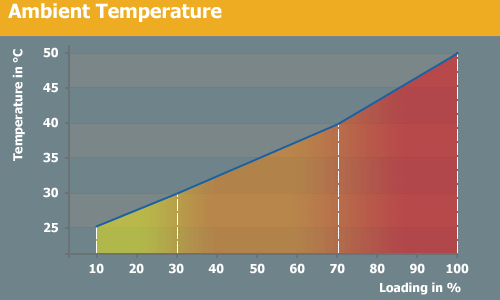
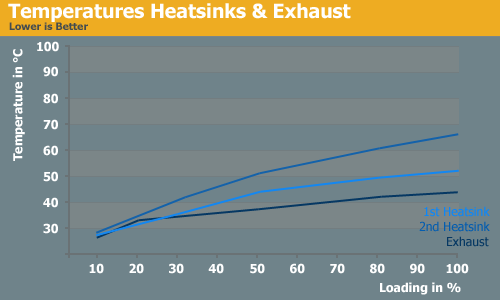
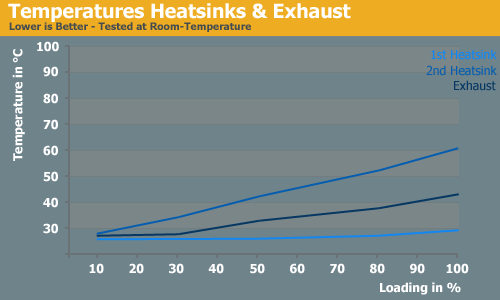
While testing the Infiniti we encountered some very strange behavior in regards to temperatures. The exhaust temperature was similar at the various loads throughout testing, whether at room temperature or in the heat chamber. The secondary heatsink also stays at almost the same temperature in both environments, which means the power supply is not really dependant on the ambient temperature. Only the primary heatsink shows any significant changes in our heat chamber. At room temperature, it was only a few degrees higher than the ambient temperature; this pattern holds in the heat chamber as well, where it remains just a few degrees above ambient topping out at ~53°C. Needless to say, the temperature results are quite impressive.
Fan Speed
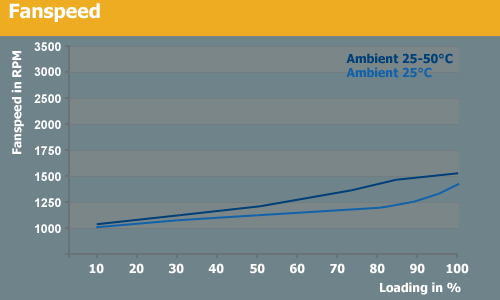
The fan behaves more like it's dependent on the load of the power supply rather than the temperature of the inside. The fan reached a maximum of 1500 RPM in our heat chamber before the safety feature kicked in to prevent overheating. While the room temperature was constant, the fan speeds up at higher loads in order to deal with the higher inner temperatures.
Acoustics
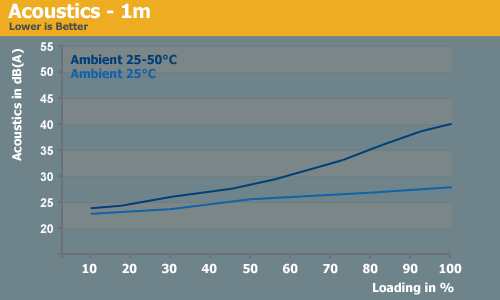
Even though the fan stays at a relatively low RPM level, the noise levels rise quite a bit, especially during the heat chamber test. We measure noise levels that are over 10dB(A) higher under heavy stress conditions than at room temperature. That means the fan really starts to make some serious noise at full speed. At the highest speed the fan is clearly recognizable since it produces 40dB(A) of noise at a one meter distance. On the other hand, in more comfortable operating environments the maximum 29dB(A) was hardly noticeable and not at all annoying. The larger fan with low RPMs does create some wind noise, but it is at a frequency that we did not find distracting and we would say subjectively the PSU is close to silent when operated at room temperatures.
After 20 minutes in our 50°C heat chamber, the Infiniti shut down with a clearly audible beep. Enermax states quite clearly that they prefer to have the PSU survive instead of burning up at high temperatures. We think the fan could spin a little faster than just 1500 RPM to help cope with the added heat (which of course would mean more noise) but that wasn't the case. One thing we might like is to get some warning beeps indicating that the PSU is about to overheat, thereby giving users an opportunity to save any critical documents and shut down gracefully rather than having the over temperature protection kick in. A hard shut down might save the PSU, but such actions aren't without potential side effects.
While testing the Infiniti we encountered some very strange behavior in regards to temperatures. The exhaust temperature was similar at the various loads throughout testing, whether at room temperature or in the heat chamber. The secondary heatsink also stays at almost the same temperature in both environments, which means the power supply is not really dependant on the ambient temperature. Only the primary heatsink shows any significant changes in our heat chamber. At room temperature, it was only a few degrees higher than the ambient temperature; this pattern holds in the heat chamber as well, where it remains just a few degrees above ambient topping out at ~53°C. Needless to say, the temperature results are quite impressive.
Fan Speed
The fan behaves more like it's dependent on the load of the power supply rather than the temperature of the inside. The fan reached a maximum of 1500 RPM in our heat chamber before the safety feature kicked in to prevent overheating. While the room temperature was constant, the fan speeds up at higher loads in order to deal with the higher inner temperatures.
Acoustics
Even though the fan stays at a relatively low RPM level, the noise levels rise quite a bit, especially during the heat chamber test. We measure noise levels that are over 10dB(A) higher under heavy stress conditions than at room temperature. That means the fan really starts to make some serious noise at full speed. At the highest speed the fan is clearly recognizable since it produces 40dB(A) of noise at a one meter distance. On the other hand, in more comfortable operating environments the maximum 29dB(A) was hardly noticeable and not at all annoying. The larger fan with low RPMs does create some wind noise, but it is at a frequency that we did not find distracting and we would say subjectively the PSU is close to silent when operated at room temperatures.
After 20 minutes in our 50°C heat chamber, the Infiniti shut down with a clearly audible beep. Enermax states quite clearly that they prefer to have the PSU survive instead of burning up at high temperatures. We think the fan could spin a little faster than just 1500 RPM to help cope with the added heat (which of course would mean more noise) but that wasn't the case. One thing we might like is to get some warning beeps indicating that the PSU is about to overheat, thereby giving users an opportunity to save any critical documents and shut down gracefully rather than having the over temperature protection kick in. A hard shut down might save the PSU, but such actions aren't without potential side effects.


 Facebook
 Twitter
 RSS
RSS


25 Comments
View All Comments
Bozo Galora - Tuesday, September 11, 2007 - link
I am beginning to agree with a poster on another PSU review comment section that your droops near or on the max wattage seem to be more than reported on other PSU review sites, especially 3.3V and 5V.It seems to be an ongoing trend in the AT PSU reviews.
I am waiting to see a PSU review here I can directly compare with another impeccable site with top notch measuring gear.
Just thinking outloud - heh.
strikeback03 - Tuesday, September 11, 2007 - link
We bought 2 of these power supplies from Newegg for new systems at work. In one, the box apparently did get dinged quite hard; the box was dented and the lip at the top on the cable side of the PSU (where you would put screws through into the case if the case has appropriate holes) was bent as well. Also, I would call the fit of the modular cables more than snug, I thought I might break the mounts in the power supply tring to get them to go in. It seems the pins were not very straight in the cables, as once they finally went in once they worked better thereafter. The cables for the Liberty worked much better, unfortunately they are not compatible without trimming.Otherwise they are nice units, and the fan is not audible over the noise of the air handling units in the lab even with the case right next to me and the side panel off.
G20C - Wednesday, September 12, 2007 - link
Could you please tell me what are the lengths of the 24 pin and 4+4 pin connectors on your Enermax Infinity 720W PSU?I have an Antec P182 and I want to buy the Enermax Infinity 720W PSU but I don't know if the 2 cables are long enough.
Makaveli - Tuesday, September 11, 2007 - link
I have the 720watt model and its a excellent PSU and well worth the money. I also don't find it loud at all, and my computer is right next to by bed!!I also believe the 720watt models fan spins at a higher RPM than the 650Watt model.
G20C - Wednesday, September 12, 2007 - link
Could you please tell me what are the lengths of the 24 pin and 4+4 pin connectors on your Enermax Infinity 720W PSU?I have an Antec P182 and I want to buy the Enermax Infinity 720W PSU but I don't know if the 2 cables are long enough.
strikeback03 - Monday, September 17, 2007 - link
Sorry, we have the 650W models, same as this review. I didn't bother measuring, I would assume it is the same as listed here.strikeback03 - Monday, September 17, 2007 - link
Oops, replied to the wrong instance of this comment. Should be below.Bjoern77 - Tuesday, September 11, 2007 - link
Any chance that this one is up for on a soonish review? That would be my fav. against the 650w infiniti.Anyway, nice review, and thx for not reviewing the 720w infiniti again, which is probably the most reviewed power supply of all time..
Christoph Katzer - Tuesday, September 11, 2007 - link
Will have Seasonic S12II next (sorry for the delay) and Seasonic will surely be happy to send me some more for evaluation.Jodiuh - Tuesday, September 11, 2007 - link
Don't they make both the Corsair 620 and PC P&C 610?