



SanDisk Ultra Plus SSD Review (256GB)
by Anand Lal Shimpi on January 7, 2013 9:00 AM ESTRandom Read/Write Speed
The four corners of SSD performance are as follows: random read, random write, sequential read and sequential write speed. Random accesses are generally small in size, while sequential accesses tend to be larger and thus we have the four Iometer tests we use in all of our reviews.
Our first test writes 4KB in a completely random pattern over an 8GB space of the drive to simulate the sort of random access that you'd see on an OS drive (even this is more stressful than a normal desktop user would see). I perform three concurrent IOs and run the test for 3 minutes. The results reported are in average MB/s over the entire time. We use both standard pseudo randomly generated data for each write as well as fully random data to show you both the maximum and minimum performance offered by SandForce based drives in these tests. The average performance of SF drives will likely be somewhere in between the two values for each drive you see in the graphs. For an understanding of why this matters, read our original SandForce article.
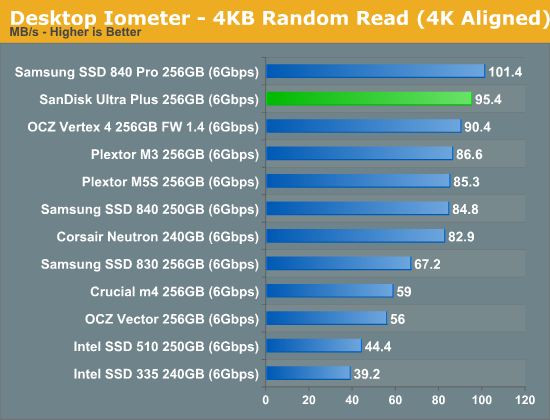
The Ultra Plus gets off to a good start, doing very well in our low queue depth random read test, bested only by Samsung's SSD 840 Pro out of our list of contenders here.
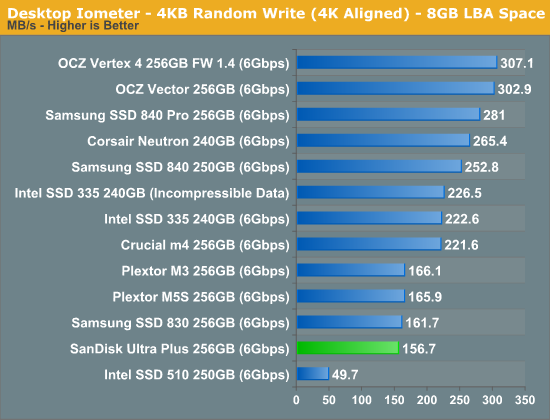
Random write performance is pretty good but the Ultra Plus doesn't hit any of the insanely high speeds set by most of the modern drives. Note that its performance is equal to the Samsung SSD 830, which was a favorite of ours. Not having a first class showing here isn't a huge problem.
Many of you have asked for random write performance at higher queue depths. What I have below is our 4KB random write test performed at a queue depth of 32 instead of 3. While the vast majority of desktop usage models experience queue depths of 0 - 5, higher depths are possible in heavy I/O (and multi-user) workloads:
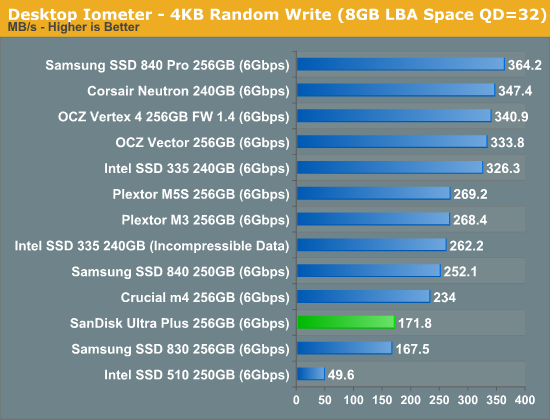
We don't see much scaling with higher queue depths, likely a limit of the Marvell SS889175's 4-channel implementation here.
Steady State 4KB Random Write Performance
SanDisk has a completely separate division that handles enterprise drives, but I was curious to see what steady state 4KB random write performance using a 100% LBA span would look like. To find out I borrowed from our Enterprise Storage tests and compared to the results from our OCZ Vector review. Note that many of these drives are enterprise focused and as a result do much better so don't get too turned off by the comparison:
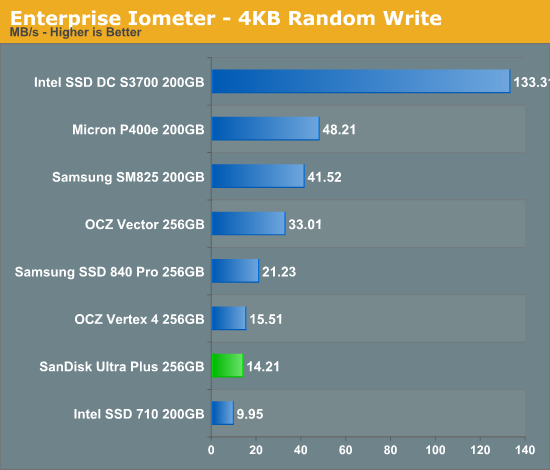
The Ultra Plus fares much better than I expected, nipping at the heels of the Vertex 4. The Vertex 4 used similar Marvell silicon so I'm not too surprised here.
Sequential Read/Write Speed
To measure sequential performance I ran a 1 minute long 128KB sequential test over the entire span of the drive at a queue depth of 1. The results reported are in average MB/s over the entire test length.
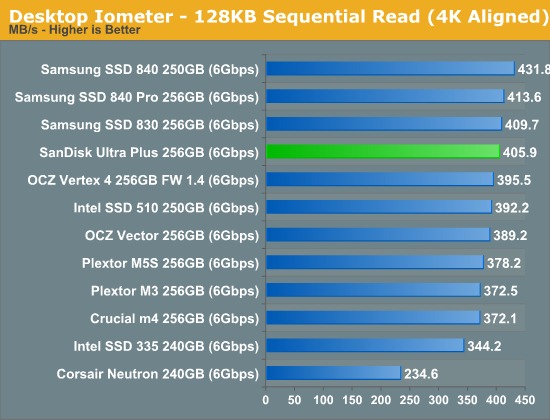
Like most drive vendors looking to address the light use client market, SanDisk's sequential read performance is actually really good.
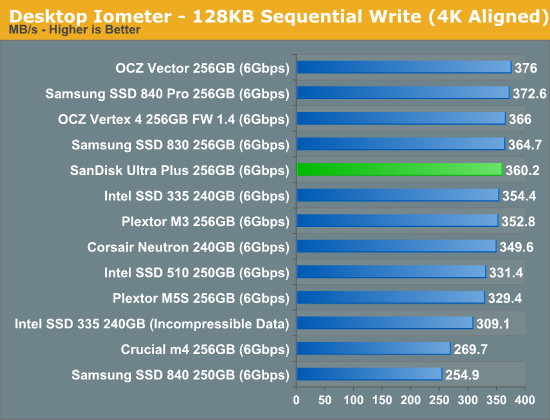
Low queue depth sequential write speed is also quite competitive, both of these will help deliver a pretty decent client experience.
AS-SSD Incompressible Sequential Performance
The AS-SSD sequential benchmark uses incompressible data for all of its transfers. The result is a pretty big reduction in sequential write speed on SandForce based controllers.
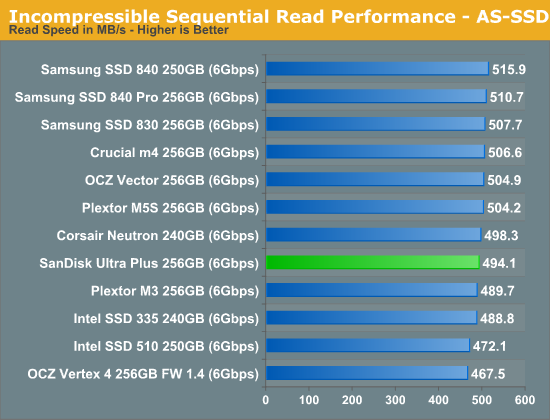
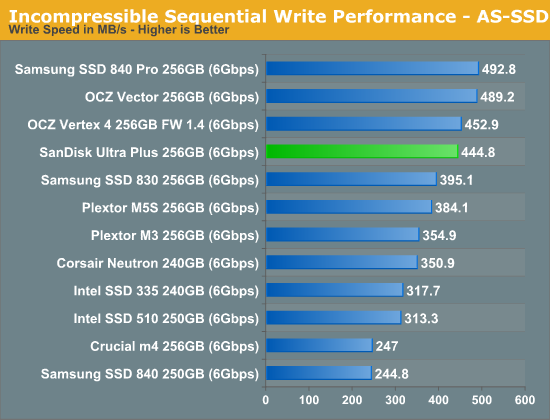
Higher queue depth sequential IO is still very good on the Ultra Plus. There's no penalty to using incompressible data as the controller does no real time data compression/de-duplication.


 Facebook
 Twitter
 RSS
RSS


38 Comments
View All Comments
name99 - Monday, January 7, 2013 - link
If you want to buy flash, buy flash.If you want to buy an iPod, buy an iPod.
But DON'T whine that an iPod (or iPhone, or iPad) costs "too much" because the flash in it is cheap.
It's not 2003. We all know Apple costs more (sometimes a little more, sometimes a lot more) than the competition. We also all know that Apple provides more (sometimes a little bit more, sometimes a lot more) than the competition. What we DON'T need is MORE fscking half-assed bitching about whether Apple does or does not "cost too much".
You want to do that, go read the comments on any damn tech site for any year from about 1976 onwards. Just don't waste our time bringing up the issue on modern threads, especially threads that have NOTHING to do with the cost of Apple's products.
Death666Angel - Monday, January 7, 2013 - link
It's not Apples products only, this applies to all tablets/smartphones. Google charges 50$/€ for an 8/16GB upgrade. Also, if you want to whine about people whining about Apple, please don't.mayankleoboy1 - Monday, January 7, 2013 - link
And if you want to whine about people whining about people whining about Apple, please dont.runeks - Monday, August 5, 2013 - link
I really have to say I agree with this.This is not a choice between an Apple (or any other company's) device costing either "$n for a 16GB version and $n+200 for the 64GB" version or "$n for a 16GB version and $n+50 for the 64GB version". It's the choice between the former or a "$n+150 16GB version and a $n+200 64GB version". See? You're happy now, because the difference in price reflects the cost of the more expensive part. Except no one will every buy a 16GB version. Why would they? Only $50 more for 64GB. At the same time they would shut out a part of the market that just wants an iPhone, which they can get for $n, if you don't have the requirement of them only selling devices with largers capacity at the added cost for the part in question.
Pricing is so much more than just the cost of a chip. It's the way the company makes its money back on an investment. They wouldn't be able to sell the larger capacity phone at +$50 because that would raise the price of the low capacity phone and shut out a part of the market that wants that $n phone. And these people would say "Oh, see, Samsung phones only cost $n for a 16GB version, why does an iPhone have to cost $n+150?" It's an eternal neverending loop of some segment of your customer base that are not quite satisfied. The people who really like the 64GB version are dissatisfied with paying $200 more than the 16GB version, but the people who only need 16GB are glad to be able to get it for $200 less than the 64GB version. You change the rules and you just make a different customer segment unhappy, or just unwilling to buy your product.
SanX - Wednesday, January 9, 2013 - link
4k read/write random/seq - 600MB/s8k read/write random/seq - 600MB/s
128k read/write random/seq - 600MB/s
8GB SDRAM power off safe cache
zyk - Wednesday, January 9, 2013 - link
It's nice to see Anand finally get some different brands to test, but unfortunately he probably missed the party on some key drives. There had been excellent prices on SanDisk's Extreme line of drives and it would have been nice to see how SanDisk's combination of high density / low die count toggle mode NAND stacked up against the likes of the Patriot Wildfire or OCZ Vertex 3 Max IOPS - Which was less extreme of a channel limitation as this marvell based drive. Also missing from his tests were drives from those such as Mushkin Enhanced who's Chronos Deluxe was frequently the cheapest togglemode+sandforce 2nd gen drive on newegg. Since all these other brands are missing from Anand's testing, it would be nice to get these charts to show a little bit more details in them about controller and NAND type rather than just linkspeed and occationally firmware version, so they don't have to be constantly looked up when making decisions.Kristian Vättö - Wednesday, January 9, 2013 - link
I finally got a Chronos Deluxe from Mushkin. I originally asked for it over 6 months ago (due to reders' request) but there were some issues with getting in contact with Mushkin.I think Anand also has a SanDisk Extreme.
To be honest, there aren't big differences between SandForce based SSDs. Corsair Force GS is an example of a SF-2281 drive with Toggle Mode NAND and FW 5.x.x, all similar SSDs I've tested (coming soon!) perform very similarly.
fritz33 - Friday, July 12, 2013 - link
I just bought a Lenovo X201 Tablet. Can i use this drive with activated Windows 7 Bitlocker? Will Bitlocker slow down this drive and wear it down noticeable? Or does this drive have a hardware encrypten like the Crucial M500 from your review? If so how would i use it instaed of Bitlocker? I am sorry but I don't have any experience in encrypted drive.