



AMD A10-5800K & A8-5600K Review: Trinity on the Desktop, Part 2
by Anand Lal Shimpi on October 2, 2012 1:45 AM ESTGeneral Performance
SYSMark 2012
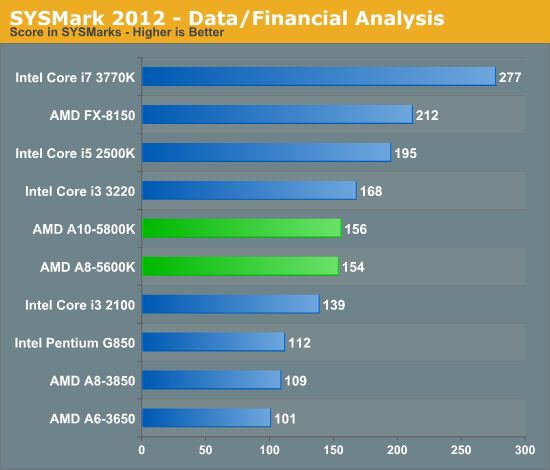
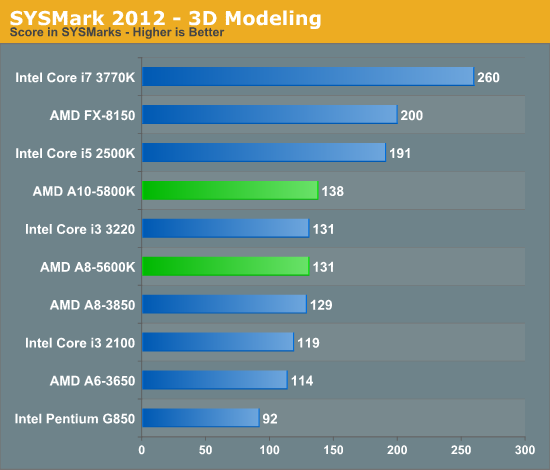
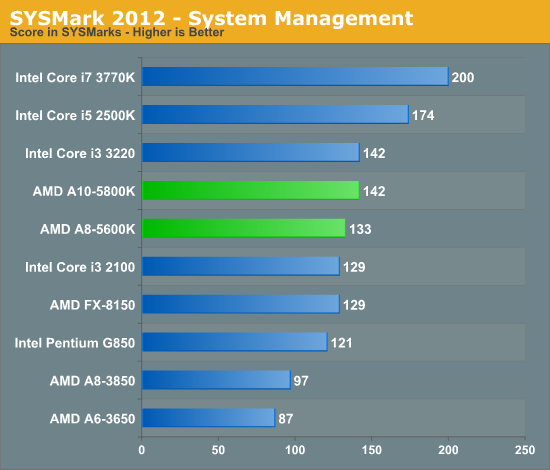
Although not the best indication of overall system performance, the SYSMark 2012 suite does give us a good idea of lighter workloads than we're used to testing.
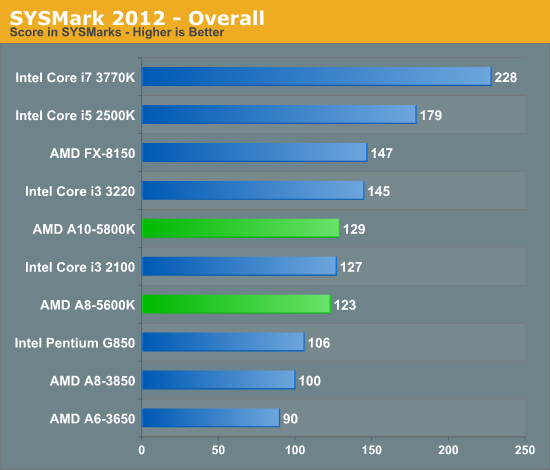
AMD does surprisingly well here in SYSMark 2012. The Core i3 3220 manages a 12% advantage over the 5800K, but that's not as much as we'd normally expect given the significant single threaded performance deficit we pointed out earlier. Once again, whether or not Trinity makes sense for you depends on how much you value processor graphics performance.


 Facebook
 Twitter
 RSS
RSS


178 Comments
View All Comments
Kaggy - Saturday, October 6, 2012 - link
It would be nice to see some benchmarks on HTML5 and video playback load on the browsers, since nowadays people spend lots of time on their browsers.Silverbuckle - Saturday, October 6, 2012 - link
It looks to me that we are seeing a race to the bottom, and Intel isn't playing. After seeing the results, if I have to start with entry level computer (what ever that means today) the best course would be Intel, i3 with a z77 chip set and a modest card.I have to update one of two computers. The older one will be replaced by this one running the Athlon IIx4 630, stock (It didn't OC worth a damn). It runs CS6 very well. So for my seat, I'll build a new box. I've been waiting to see what to follow. I have two cards available Ati 5670 and Ati 7750. So I can with no additional cost, run the 7750. That makes Intel the only game, because even if I have to lo ball the price, the i3 will equal or surpass the Trinity, using the card. I can upgrade any time all the way to i7 K series.
Given the price of the card if you must include it, you are still positioned well to upgrade the computer with a simple exchange of the processor. Not so for several years with AMD, (best guess here).
Waiting was ok, even though my gut was to go Intel. What I learned is to not be afraid to include the lowly i3.
Chipman1969 - Monday, October 8, 2012 - link
Please redo some of the Trinity benchmarks with 1866 or 2133 ddr3 ram.See http://www.phoronix.com/scan.php?page=article&...
There you can see that Trinity is doing much better with faster ram.
On Amazon G.Skill Ripjaws X DDR3-1600 is 42$ and 2166 is 52$.
medi01 - Tuesday, October 9, 2012 - link
So:"Although likely not the target market for someone buying a Trinity APU, we looked at performance of AMD's latest APU when paired with a high-end discrete GPU. The end result is a total loss for Trinity."
brand new way to piss on AMD's cookies, by Anand The Shameless...
sdoraisw - Friday, January 4, 2013 - link
If you want to compare the idle numbers you should disable the Gfx in IVB processor because trinity doesn't have integrated graphics.not just disable, you need some BIOS switch to power gate the Gfx engine completely. then you can do comparisons.
x7y9 - Saturday, January 12, 2013 - link
I just got a Toshiba S875D-S7350 laptop with AMD A10-4600M processor and tried somesimple benchmarks -- the result was pretty disappointing. Running 4 identical processes
(Ubuntu 12.04) causes the completion time of each process to degrade substantially.
I do some work with generating graphs and analysing them, so basic integer performance
is the most important thing for me.
I ran this simple benchmark and the comments show the results I got:
#!/usr/local/bin/ruby -w
# M1 -- AMD Phenom 2 X4 945 Quad core desktop
# M2 -- Intel Core i3-2310M HP laptop
# M3 -- Toshiba S875D-S7350 laptop with AMD A10-4600M
# M4 -- HP AMD A6 3400M Quad core CPU 1.4-2.3 GHz
# Machine M1 M2 M3 M4
# -------------------------------
# Single run: 158 178 234 292
# 2 parallel: 169 195 283 313
# 4 parallel 205 241 642 354
# (All times in seconds; averaged over the parallel runs)
start = Process.times
a=(0..11).to_a
cnt = a.permutation.inject(0) { |m, _| m + 1 }
finish = Process.times
user = finish.utime - start.utime; sys = finish.stime - start.stime
puts "cnt = %d, user = %ds, sys = %ds" % [cnt, user, sys]
------------------------------
Needless to say, I returned the Toshiba.
.
bomer08 - Tuesday, October 15, 2013 - link
Hello, I would like to know which configuration was used for the 3220 I3. Motherboard, HD (ssd?), RAM, Graphic ... If you have changed something in the BIOS. thanksrobytzel - Thursday, December 26, 2013 - link
hello guys, i have a big question, i own a8-5600k, along with 8gb ddr3 1600mhz, my question is why does my computer lag, but really really lag in games on facebook like farm heroes saga???i cannot explain it to myself, why i can run even crysis 2 on medium-high, but cannot run normally a stupid flash player game!!!please help.happy hollidays!