



The Apple iPad 2 Review
by Brian Klug, Anand Lal Shimpi & Vivek Gowri on March 19, 2011 8:01 PM ESTThe GPU: Apple's Gift to Game Developers
The GPU side of the A5 is really what's most exciting. As we mentioned in our iPad 2 GPU Performance analysis, the A5 includes a dual-core PowerVR SGX 543 - also known as the SGX 543MP2. In our earlier article we showed the SGX 543MP2 easily beating both an iPad 1 and the Tegra 2 based Motorola Xoom.
To understand why the SGX 543MP2 has such a performance advantage we need to first remember that NVIDIA's Tegra 2 is nearly a year late. NVIDIA's first competitive ultra mobile GPU was supposed to be shipping in products in the first half of 2010, instead it found itself shipping in 2011. While NVIDIA is good at designing GPUs, it's not good enough that it can release a product and maintain a two year performance advantage over the competition. Let's look at the architecture, shall we?
NVIDIA's Tegra 2 features a DirectX 9-class GPU. NVIDIA used to call it the GeForce ULP (Ultra Low Power) but now it's just GeForce. As a DX9 class GPU we're dealing with a conventional, non-unified shader architecture. While all OpenGL ES 2.0 GPUs can execute pixel and vertex shader instructions, the GeForce in Tegra 2 runs pixel and vertex shaders on separate groups of hardware.
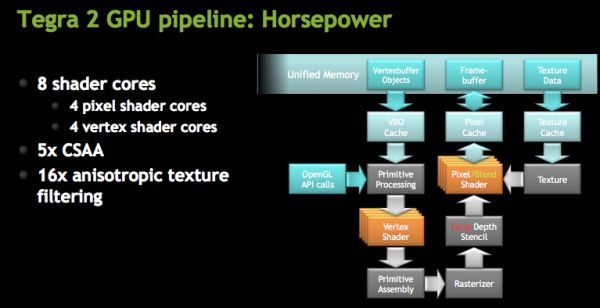
NVIDIA calls each pixel and vertex shader ALU a core. The Tegra 2 has four pixel shader cores and four vertex shader cores. The four pixel shader ALUs make up a single Vec4 and the same goes for the four vertex shader ALUs. NVIDIA wouldn't elaborate on what limitations exist when dispatching operations to the cores. All pixel shader operations happen at 20-bits per component precision while all vertex shader operations happen at 32-bits per component.
Each core is capable of executing one multiply+add (MAD) operation per clock. Do the math and that works out to be a peak rate of 8 MADs per clock for the entire GPU. The maximum operating frequency for the Tegra 2 GeForce GPU is 300MHz, however device vendors may run the GPU at a lower frequency to save on power. At 300MHz this works out to be 4.8 GFLOPS (counting a MAD as two FLOPs).
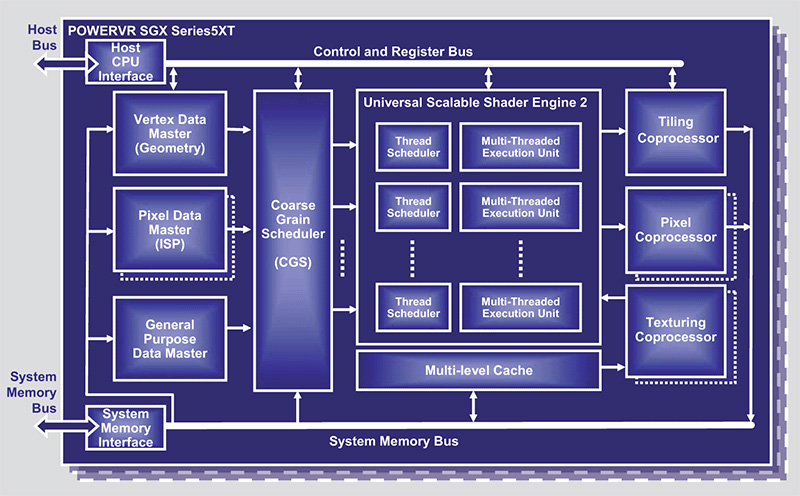
Imagination Technologies' PowerVR SGX 543MP2 is fundamentally a bigger GPU than the GeForce in NVIDIA's Tegra 2. Let's go through the math.
The SGX 543 features four USSE2 pipes. This is a unified shader architecture so both vertex and pixel shader code runs on the same set of hardware. The benefit of this approach is you get better performance in peaky situations where you're running a lot of vertex or pixel shader code and not a balance that's perfectly tailored to your architecture. The Tegra 2 will only run at peak efficiency if it encounters a mix of 50% vertex and 50% pixel shader code. The PowerVR SGX series will never have any of its execution pipes idle regardless of the instruction mix.
Each USSE2 pipe has a 4-wide vector ALU capable of cranking out 4 MADs per clock. Two of these pipes is enough to equal the peak throughput of what NVIDIA built in Tegra 2, but the PowerVR SGX 543 has four of them. As for the MP2? Go ahead and double that number again. The SGX 543MP2 is simply two 543s placed next to one another.
All of this works out to be 16 MADs per clock for the SGX 543 and 32 MADs per clock for the SGX 543MP2. At 200MHz that's 12.8GFLOPS and at 250MHz we're talking about 16 GFLOPS.
| Mobile SoC GPU Comparison | |||||||||
| PowerVR SGX 530 | PowerVR SGX 535 | PowerVR SGX 540 | PowerVR SGX 543 | PowerVR SGX 543MP2 | GeForce ULP | Kal-El GeForce | |||
| SIMD Name | USSE | USSE | USSE | USSE2 | USSE2 | Core | Core | ||
| # of SIMDs | 2 | 2 | 4 | 4 | 8 | 8 | 12 | ||
| MADs per SIMD | 2 | 2 | 2 | 4 | 4 | 1 | ? | ||
| Total MADs | 4 | 4 | 8 | 16 | 32 | 8 | ? | ||
| GFLOPS @ 200MHz | 1.6 GFLOPS | 1.6 GFLOPS | 3.2 GFLOPS | 6.4 GFLOPS | 12.8 GFLOPS | 3.2 GFLOPS | ? | ||
| GFLOPS @ 300MHz | 2.4 GFLOPS | 2.4 GFLOPS | 4.8 GFLOPS | 9.6 GFLOPS | 19.2 GFLOPS | 4.8 GFLOPS | ? | ||
At its lowest expected clock speed, the 543MP2 already has over twice the compute power of the Tegra 2's GPU at its highest operating frequency. Take into account the fact that the A5 likely has more memory bandwidth than Tegra 2 and the SGX 543MP2 is a tile based architecture with lower bandwidth requirements and the performance numbers we talked about last time shouldn't be all that surprising.
The real competition for the SGX 543MP2 will be NVIDIA's Kal-El. That part is expected to ship on time and will feature a boost in core count: from 8 to 12. The ratio of pixel to vertex shader cores is not known at this point but I'm guessing it won't be balanced anymore. NVIDIA is promising 3x the GPU performance out of Kal-El so I suspect that we'll see an increase in throughput per core.
GPU Performance
Taken from our iPad 2 GPU Performance Preview:
As always we turn to GLBenchmark 2.0, a benchmark crafted by a bunch of developers who either have or had experience doing development work for some of the big dev houses in the industry. We'll start with some of the synthetics.
Over the course of PC gaming evolution we noticed a significant increase in geometry complexity. We'll likely see a similar evolution with games in the ultra mobile space, and as a result this next round of ultra mobile GPUs will seriously ramp up geometry performance.
Here we look at two different geometry tests amounting to the (almost) best and worst case triangle throughput measured by GLBenchmark 2.0. First we have the best case scenario - a textured triangle:
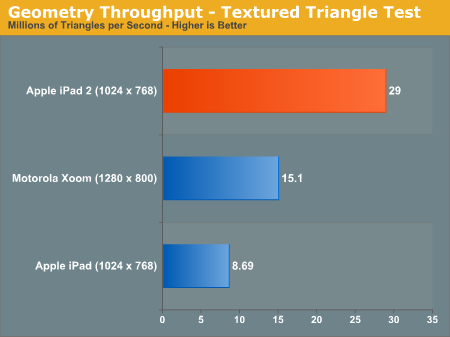
The original iPad could manage 8.7 million triangles per second in this test. The iPad 2? 29 million. An increase of over 3x. Developers with existing titles on the iPad could conceivably triple geometry complexity with no impact on performance on the iPad 2.
Now for the more complex case - a fragment lit triangle test:
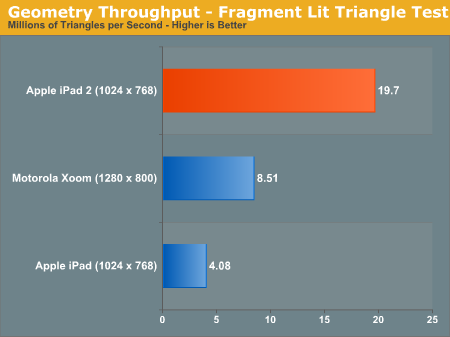
The performance gap widens. While the PowerVR SGX 535 in the A4 could barely break 4 million triangles per second in this test, the PowerVR SGX 543MP2 in the A5 manages just under 20 million. There's just no competition here.
I mentioned an improvement in texturing performance earlier. The GLBenchmark texture fetch test puts numbers to that statement:
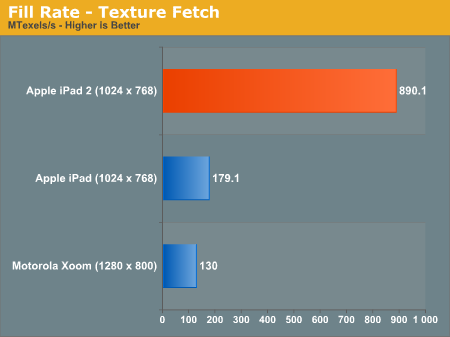
We're talking about nearly a 5x increase in texture fetch performance. This has to be due to more than an increase in the amount of texturing hardware. An improvement in throughput? Increase in memory bandwidth? It's tough to say without knowing more at this point.
| Apple iPad vs. iPad 2 | ||||
| Apple iPad (PowerVR SGX 535) | Apple iPad 2 (PowerVR SGX 543MP2) | |||
| Array test - uniform array access |
3412.4 kVertex/s
|
3864.0 kVertex/s
|
||
| Branching test - balanced |
2002.2 kShaders/s
|
11412.4 kShaders/s
|
||
| Branching test - fragment weighted |
5784.3 kFragments/s
|
22402.6kFragments/s
|
||
| Branching test - vertex weighted |
3905.9 kVertex/s
|
3870.6 kVertex/s
|
||
| Common test - balanced |
1025.3 kShaders/s
|
4092.5 kShaders/s
|
||
| Common test - fragment weighted |
1603.7 kFragments/s
|
3708.2 kFragments/s
|
||
| Common test - vertex weighted |
1516.6 kVertex/s
|
3714.0 kVertex/s
|
||
| Geometric test - balanced |
1276.2 kShaders/s
|
6238.4 kShaders/s
|
||
| Geometric test - fragment weighted |
2000.6 kFragments/s
|
6382.0 kFragments/s
|
||
| Geometric test - vertex weighted |
1921.5 kVertex/s
|
3780.9 kVertex/s
|
||
| Exponential test - balanced |
2013.2 kShaders/s
|
11758.0 kShaders/s
|
||
| Exponential test - fragment weighted |
3632.3 kFragments/s
|
11151.8 kFragments/s
|
||
| Exponential test - vertex weighted |
3118.1 kVertex/s
|
3634.1 kVertex/s
|
||
| Fill test - texture fetch |
179116.2 kTexels/s
|
890077.6 kTexels/s
|
||
| For loop test - balanced |
1295.1 kShaders/s
|
3719.1 kShaders/s
|
||
| For loop test - fragment weighted |
1777.3 kFragments/s
|
6182.8 kFragments/s
|
||
| For loop test - vertex weighted |
1418.3 kVertex/s
|
3813.5 kVertex/s
|
||
| Triangle test - textured |
8691.5 kTriangles/s
|
29019.9 kTriangles/s
|
||
| Triangle test - textured, fragment lit |
4084.9 kTriangles/s
|
19695.8 kTriangles/s
|
||
| Triangle test - textured, vertex lit |
6912.4 kTriangles/s
|
20907.1 kTriangles/s
|
||
| Triangle test - white |
9621.7 kTriangles/s
|
29771.1 kTriangles/s
|
||
| Trigonometric test - balanced |
1292.6 kShaders/s
|
3249.9 kShaders/s
|
||
| Trigonometric test - fragment weighted |
1103.9 kFragments/s
|
3502.5 kFragments/s
|
||
| Trigonometric test - vertex weighted |
1018.8 kVertex/s
|
3091.7 kVertex/s
|
||
| Swapbuffer Speed |
600
|
599
|
||
Enough with the synthetics - how much of an improvement does all of this yield in the actual GLBenchmark 2.0 game tests? Oh it's big.
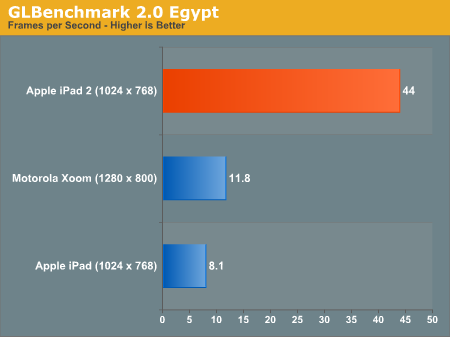
Without AA, the Egypt test runs at 5.4x the frame rate of the original iPad. It's even 3.7x the speed of the Tegra 2 in the Xoom running at 1280 x 800 (granted that's an iOS vs. Android comparison as well).
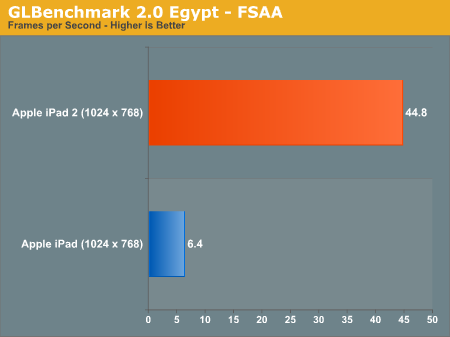
With AA enabled the iPad 2 advantage grows to 7x. In a game with the complexity of the Egypt test the original iPad wouldn't be remotely playable while the iPad 2 could run it smoothly.
The Pro test is a little more reasonable, showing a 3 - 4x increase in performance compared to the original iPad:
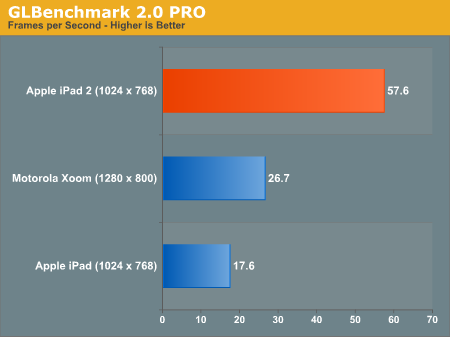
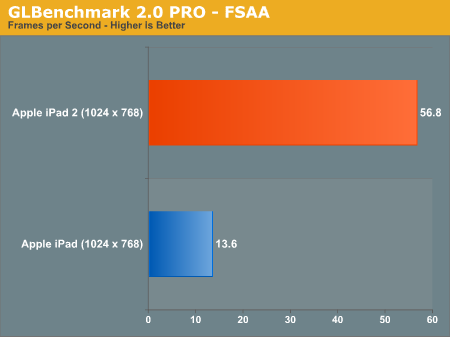
While we weren't able to reach the 9x figure claimed by Apple (I'm not sure that you'll ever see 9x running real game code), a range of 3 - 7x in GLBenchmark 2.0 is more reasonable. In practice I'd expect something less than 5x but that's nothing to complain about.


 Facebook
 Twitter
 RSS
RSS


189 Comments
View All Comments
jalexoid - Saturday, March 19, 2011 - link
The movie editing app on Honeycomb is there. And it's similar to iMovie.The Office look alike apps on iPad are still not good.
Honeycomb struggles on the apps side, because the developer hardware was not there, when it was needed.
But saying "So far only iOS has the most real apps" is a bit incorrect.
WaltFrench - Sunday, March 20, 2011 - link
“The movie editing app on Honeycomb is … similar to iMovie.”Yes, except for one thing: the YouTube of it shows it unable to show thumbnails properly and balky, rough animations. This wouldn't even get bronze at a beer-fueled coding contest.
The two are exactly as similar as night and day: they live on the same planet.
Zoomer - Saturday, March 19, 2011 - link
>>Also, when you take it out in front of a client during a lunch meeting, it tends to impress them.That's probably why most buy it.
Azethoth - Sunday, March 20, 2011 - link
I bought my iPad to turn my daily NY Times habit at Starbucks paperless. So Wi-Fi only and one year = it paid for itself.Acting as an awesome controller for my home stereo setup is a total bonus. Same with reading books again via iBooks and Kindle.
Yes, the underlying thing is I use it to consume and not to create. Unless you find an application that uses its strength in that regard it will just frustrate you as you try to do your pad-inappropriate netbook / laptop / PC / mini / mainframe or whatever apps on it.
For me its a perfect way to avoid the netbooks / laptops which I have always loathed but get a little mobility. But then I only create on a desktop with 2560 x 1600 resolution so laptops will never cut it anyway.
synaesthetic - Sunday, March 20, 2011 - link
It's pretty refreshing to see someone who has actually found a usable niche for these things.It's just not too useful to a lot of folks. I carry my laptop to class already--yeah, this big, heavy MSI gaming laptop--because I need it. If I could carry something as light as the iPad and have it do what I need... I'd be sold.
But it can't. And LCDs suck for long reading sessions. I'd rather have an ereader.
doobydoo - Sunday, March 20, 2011 - link
what is it you can't do on an ipad?LaughingTarget - Tuesday, April 19, 2011 - link
Quite a bit, really. It's a lousy drafting platform. Don't try doing anything remotely related to engineering on it. Want to create a proprietary program to tie into your own business systems at work? Don't bother, you're not putting that thing on your iPad without Apple's permission. Don't bother trying to type anything lengthy up on the thing, you'll be operating, at best, on about 1/4 speed as a keyboard. It's a useless tool for accountants, field technicians needing to keep track of customer data, worthless for engineers trying to troubleshoot a power plant turbine on-site. Hell, it's even a horrible method of ringing up orders at a fast food joint.Go down the list of what people do for a living, the meat of the modern global economy, and you pretty much found everything the iPad can't do.
kevith - Sunday, March 20, 2011 - link
Use it as an E-reader?Well, only for books, that the the censors at Macintosh find good, clean and familyfriendly enough, that is.
"When You start burning books, You will eventually end up burning people."
That fact does not change over time...
WaltFrench - Sunday, March 20, 2011 - link
Let's be a bit more honest here: Heine was talking about government-sanctioned political violence, not commercial decisions. In fact, the considerations are almost exactly opposite.Commercial decisions have dozens of considerations, including authors' willingness to grant rights (e.g., Nabokov's Pale Butterfly not in any e-form), format (the wonderful Visualizing Information, also MIA) and a host of others. Freedom of speech implies the speaker's right to choose when and how he speaks; that means Apple's right to make commercial decisions about what it offers and what it does not.
E.g., Apple no longer sells a camera, but they don't in any way restrict your ability to buy them or use them. Re books: if you like Kindle, for example, read them on the iPad. (As long as Amazon chooses to carry the work.) This is just like say, the B&N store across from my office: they don't carry titles they don't want, whether for expected lousy sales, or to keep the local Bigots United chapter from waving pitchforks at them. This freedom of Apple, which is NOT an arm of the US Government, to have its own voice, is just as important as preventing governments from banning speech.
Maybe there is somebody at Apple who wants to treat you like a child. But about a hundred times more likely is that they simply want to do the stuff they think they do best, and some people act (childlishly!) as if Apple should run by different principles.
PS: “Macintosh” is not the company you're talking about.
vision33r - Saturday, March 19, 2011 - link
The last thing you want is bring that $899 device in front of people and have app crashes and App drawer that doesn't work when you press it like a zillion times.People at work will just say you blow $899 on a netbook.
Yes, the LCD on the Xoom is the typical 10.1" you found on Acer Netbook parts bin.
How dare Motorola try to pass off a netbook for $899. How about the ASUS EEE Slate for $999 instead.