



NVIDIA’s GeForce GT 240: The Card That Doesn't Matter
by Ryan Smith on January 6, 2010 12:00 AM EST- Posted in
- GPUs
Power, Temperature, & Noise
With an idle power draw of 9W, and a load power draw of only 70W, the GT 240 should fare fairly well here. As an added bonus, with the significantly different designs of the Asus and EVGA cards, we have a chance to see the difference in performance for their respective coolers.
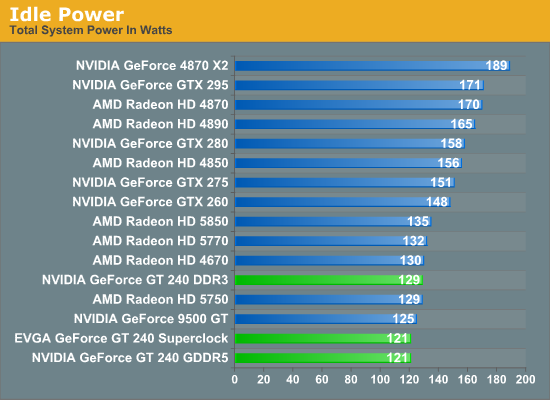
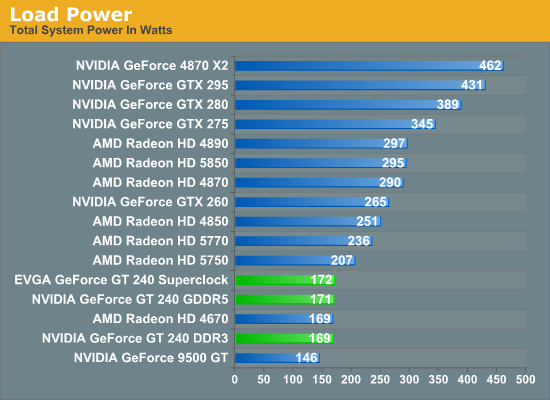
Due to some unrelated issues we don’t have the GT 220 in these charts, leaving the GDDR5 GT 240 as our least power-hungry card when it comes to idling. Unfortunately our DDR3 GT 240 refused to (or is simply not programmed to) idle, meaning that it comes in a good 8W higher than the GDDR5 versions of the cards. The lack of true idling for the DDR3 card will have some ramifications later.
Under load, these cards are still near the top of our charts. The only thing that’s significantly lower is the otherwise anemic 9500 GT while the Radeon 4670 is in a dead-heat. Between the GT 240 cards themselves, even with the different in RAM types, they’re all within 2W of each other. These would probably make fair HTPC cards, but the GT 220 should be a bit less power hungry and cooler.
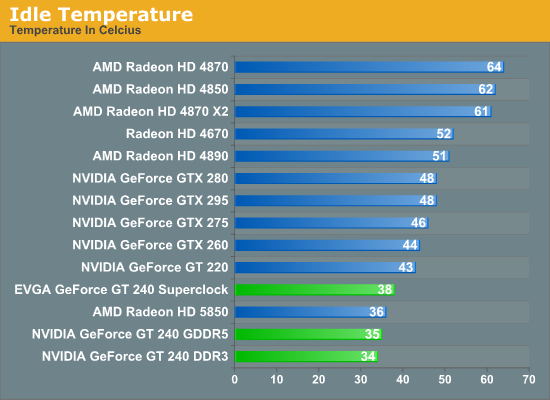
All of these cards push the limits of what’s practical for idle temperatures, although the Radeon 5850 is finally dethroned here by 2 of our GT 240 cards. The double-wide cooler on the Asus cards looks to be good for a couple more degrees than the single-wide cooler on the EVGA card is.
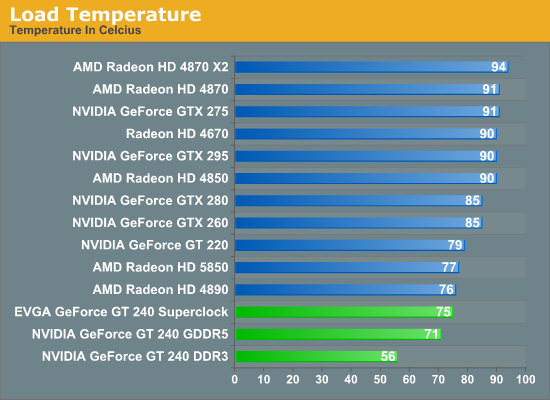
Load temperatures tell us a somewhat different story however. Ignoring the DDR3 card for a second, both the Asus and EVGA cards are quite cool. Our stock Asus card is some 8C cooler than our GT 220, and 19C cooler than the Radeon 4670. The EVGA card meanwhile is 4C cooler than the GT 220, and still 15C cooler than the 4670 in spite of the use of similar single-slot coolers. For what the GT 240 lacks in performance, it can certainly make up for in temperatures.
As for the DDR3 card, in spite of having the same cooler Asus has opted to run the fan at a higher speed. This makes it cooler, but as we’ll see it makes it louder too.
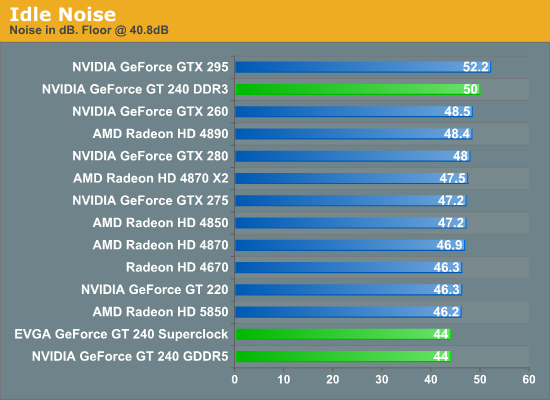
At idle, there’s not much of a story for the GDDR5 cards. They all run up against the ambient noise generated by the rest of the computer. Active and passively cooled cards are nearly indistinguishable at this point. The Asus DDR3 card however is quite distinguishable and is at the bottom of our charts. Its higher fan speeds means that it even idles at a pretty high speed, making it the second-loudest thing after the GTX 295.
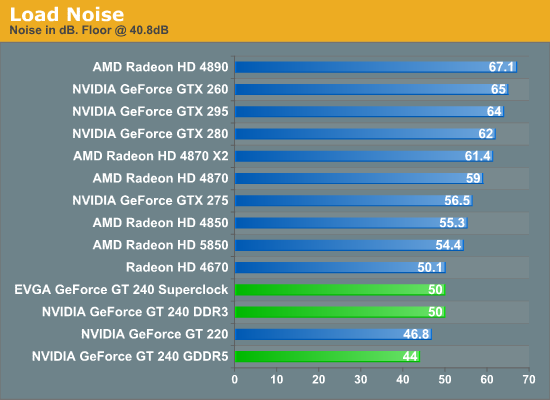
It’s under load that the story takes a turn for the most interesting. At 50dB is the Asus DDR3 card and the EVGA card – the former continuing to use its high fan speeds, and the latter having to rev up to make up for its smaller single-slot cooler. Even at 50dB, these cards are quieter than everything besides the otherwise lower-powered GT 220.
Meanwhile down at 44dB is the Asus GDDR5 card, generating the same amount of noise as if it were idling. Based on these results, the card is for all practical purposes indistinguishable from a passively cooled card. Through the combination of a large fan and a large heatsink, the amount of noise the card generates falls below the ambient noise of the rest of the computer. The card is effectively silent.
Now we suspect that if we had a rig specifically for testing silent cards we would find a more notable difference, but in our i7 920 rig there is none to be found. The Asus GT 240 GDDR5 is the quietest actively cooled card we have tested to date, something we were not expecting to find on a GT 240 card. Also bear in mind that this the second-coolest card we have ever tested, falling behind only our overly loud DDR3 card. In the future, someone is probably going to make a very nice fully-passive card out of the GT 240 if all of this can be accomplished with the Asus cooler.


 Facebook
 Twitter
 RSS
RSS


55 Comments
View All Comments
BelardA - Wednesday, January 6, 2010 - link
Anyone notice any lack of SLI on these cards? Of course they are soooo slow.Okay, the ATI 4670 (DX 10.1) came out over a year ago with an MSRP of $90~100. Considering the age, its about the same wattage and noise as the GT240 and in many cases, its a slower card.
Why bother even making such a card? Other than the profit sold from a $90 GT240 is much better than a $90 9800GT.... except nobody in their right mind would bother with a GT240
If the GT240 was a $65~80 part, nobody would complain.
But what happens when ATI releases their $100 5600 series cards? Since the 5700s are pretty much on par with the 4800s. I'm not expecting the 5600s to be that exciting. Other than being $100 DX11 cards that are faster than 4670s but maybe around 4830 performance.
Penti - Wednesday, January 6, 2010 - link
OEMs, OEMs would.BelardA - Thursday, January 7, 2010 - link
Yeah yeah, I know. OEMS love such things.Kind of sick to look at ordering forms on sites like Dell. When a basic desktop has a default price... add something like a ATI 4670 or GT240 and the price goes up $150. Apple is the WORST with their quad-SLI setup with GT120 (I think) video cards... wow, 4 slow cards at about $150 a pop! While on the same Apple order form, a single $200 ATI 4870 is available and should be faster.
aegisofrime - Wednesday, January 6, 2010 - link
I might be nitpicking, but you have listed all the ASUS results as "nVidia Geforce GT 240" instead of "ASUS Geforce GT 240" in the charts. :pRyan Smith - Wednesday, January 6, 2010 - link
For the performance data, that is correct. Not to slight Asus of course, but their cards are stock cards. Hence they're the reference values I'm using for the GT 240, and are listed as such.aegisofrime - Wednesday, January 6, 2010 - link
Ah I see. Thanks for the clarification!lopri - Wednesday, January 6, 2010 - link
Thank you Ryan for this excellent review. It's refreshing to read a sensible piece without personal drama and baseless conspiracy theories.Devo2007 - Wednesday, January 6, 2010 - link
Might want to fix the power charts as they currently list an NVidia Geforce 4870 X2 card. Unless of course that is how they have decided to compete with ATI (rebranding Radeons). :)korbendallas - Wednesday, January 6, 2010 - link
The load temperature graph has to be wrong - there's no way two cards with the same cooler and the same power consumption has such a difference in temperature.korbendallas - Wednesday, January 6, 2010 - link
Oh, the fan is bugged out... nevermind :)