



Quad Core Intel Xeon 53xx Clovertown
by Johan De Gelas on December 27, 2006 5:00 AM EST- Posted in
- IT Computing
Introduction
The Xeon 5160 (a.k.a. Woodcrest) is probably the best server chip Intel has made in the past decade. It delivers high IPC, high (3GHz) clock speed and a surprising low 80W TDP for a dual core design. But Intel's engineers saw that the fastest Woodcrest could score twice for Intel, in a slightly different form... or should we say package. Lower the voltage of a 3GHz from about 1.21 V to slightly less than 1.1V and you can only achieve 2.33GHz. However by running at 2.33GHz and 1.1V, Intel was able to cut the TDP in half. Now place two of these low voltage Xeons in one package and you get a 2.33GHz quad core Xeon and an 80W TDP. This is the essence of the CPU that bears the codename "Clovertown".
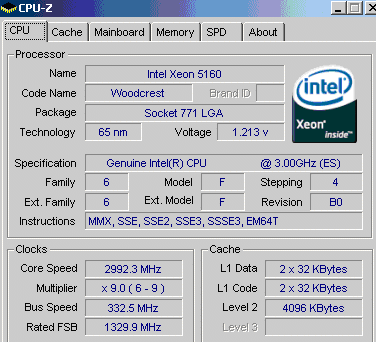
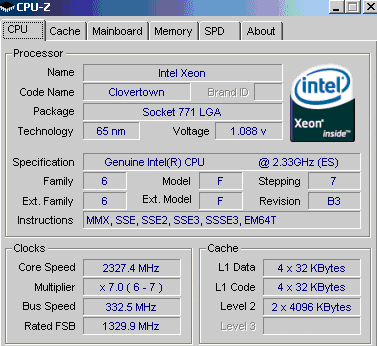
The quad core Xeon runs at less than 1.1V
The really weird thing about all this is that Intel sells those two Xeon 5160 chips with lower voltage for the same price as one of the higher clocked chips. A 2.33GHz quad core Xeon DP costs the same as a 3GHz dual core Xeon DP ($851), and a 1.86GHz quad core will cost as much as a 2.66GHz dual core. In other words, Intel is willing to give one chip "for free" just to "ignite the quad core era".
Intel is also trading in (theoretically almost 30%) single threaded performance for more multi-threaded processing power while keeping the power envelope the same. It is not as radical as Sun's T1, but the philosophy behind it is more or less the same. Is it a good bet? Well, being first to market with a quad core x86 product will probably make a big impact. It should be especially interesting for HPC and rendering applications. If you need the power of four cores in a blade server, the 65nm Clovertown or Xeon 53xx is the ideal CPU for the very crammed, "hard-to-cool" housing.
The Xeon 53xx - with the appropriate BIOS update - should have drop-in capability in 5000(x) based chipset boards. The availability of Xeon 53xx generates some very interesting choices for the server buyer. With 8 cores on a dual socket system, can it replace the more expensive quad socket systems such as those based on the Opteron 8 series or the recently launched Xeon 71xx CPUs? Should you go for a high clocked dual core Xeon or a lower clocked quad core Xeon? The "standard" answer is that it depends on the application, but that answer is boring and hardly informative. In this article we will try to give an answer to these questions as they apply to Rendering, OpenSSL, Java, SAP and MySQL applications. Jason and Ross are busy with the SQL Server benchmarks, so you can expect even more benchmarks soon.
The Xeon 5160 (a.k.a. Woodcrest) is probably the best server chip Intel has made in the past decade. It delivers high IPC, high (3GHz) clock speed and a surprising low 80W TDP for a dual core design. But Intel's engineers saw that the fastest Woodcrest could score twice for Intel, in a slightly different form... or should we say package. Lower the voltage of a 3GHz from about 1.21 V to slightly less than 1.1V and you can only achieve 2.33GHz. However by running at 2.33GHz and 1.1V, Intel was able to cut the TDP in half. Now place two of these low voltage Xeons in one package and you get a 2.33GHz quad core Xeon and an 80W TDP. This is the essence of the CPU that bears the codename "Clovertown".
The quad core Xeon runs at less than 1.1V
The really weird thing about all this is that Intel sells those two Xeon 5160 chips with lower voltage for the same price as one of the higher clocked chips. A 2.33GHz quad core Xeon DP costs the same as a 3GHz dual core Xeon DP ($851), and a 1.86GHz quad core will cost as much as a 2.66GHz dual core. In other words, Intel is willing to give one chip "for free" just to "ignite the quad core era".
Intel is also trading in (theoretically almost 30%) single threaded performance for more multi-threaded processing power while keeping the power envelope the same. It is not as radical as Sun's T1, but the philosophy behind it is more or less the same. Is it a good bet? Well, being first to market with a quad core x86 product will probably make a big impact. It should be especially interesting for HPC and rendering applications. If you need the power of four cores in a blade server, the 65nm Clovertown or Xeon 53xx is the ideal CPU for the very crammed, "hard-to-cool" housing.
The Xeon 53xx - with the appropriate BIOS update - should have drop-in capability in 5000(x) based chipset boards. The availability of Xeon 53xx generates some very interesting choices for the server buyer. With 8 cores on a dual socket system, can it replace the more expensive quad socket systems such as those based on the Opteron 8 series or the recently launched Xeon 71xx CPUs? Should you go for a high clocked dual core Xeon or a lower clocked quad core Xeon? The "standard" answer is that it depends on the application, but that answer is boring and hardly informative. In this article we will try to give an answer to these questions as they apply to Rendering, OpenSSL, Java, SAP and MySQL applications. Jason and Ross are busy with the SQL Server benchmarks, so you can expect even more benchmarks soon.


 Facebook
 Twitter
 RSS
RSS


15 Comments
View All Comments
Antinomy - Wednesday, March 7, 2007 - link
A great review, very interesting.But there are a few things to mention. A mistake in results of Cinebench test. In the overall table the uni Clovertown system got 1272 points, but in the next (per core performance) - 1169. The result was swapped with the one of Xeon 7130. And a comment about the scalability extrapolation. The result of scalability 2.33 Clover vs 3.0 Dual Woodcrest can be hardly compared due to different organization of the systems. These MoBo have two independent FSB so this means, that the two Woodcrests will be provided with twice more peak memory bandwith. This can't make no influence on the result. Also the 4 channel memory mode provides a 5% increase versus 2 channel in real bandwith, so we can't say that theese applications do not suffer from lack of memory bandwith.
It would be interesting to provide a test of uni Woodcrest system and a test of system based on Woodcrest (both uni and dual) at the same frequency as Clovertown has. And a Kentsfield\Conroe systems (despite they aren't server ones) would be nice to look at because of their more efficient usage of memory bandwith and FSB.
afuruhed - Thursday, December 28, 2006 - link
We are getting more Clovertowns. There is a chart at http://www.pantor.com/software.html">pantor.com that indicates that some applications benefit a lot. http://en.wikipedia.org/wiki/FIX_protocol">The FIX protocol is a technical specification for electronic communication of trade-related messages (financial markets).henriks - Thursday, December 28, 2006 - link
Agree with other responses - good article!Some comments on the jbb results page:
You state that JRockit is (only) available for x86-64 and Itanium. x86 and Sparc should be added to this list.
The JRockit configuration you're using enables a single-spaced GC. In that configuration, performance is tied to heap size (larger heap means fewer GC events). Increasing the heap size to 3 GB - as for the Sun benchmark results - would increase performance slightly but in particular give much better scalability when you increase the number of warehouses to large numbers.
It looks like you have not enabled large pages in the OS. Doing this would give a large performance boost and help scalability regardless of chip or JVM vendor.
Astute readers may note that your results are lower than the published results on www.spec.org. Apart from OS and possibly BIOS tuning, the reason is that the most recent results are using a newer JRockit version (not yet available for public download). This new version improves performance on this benchmark by 20-30% on x86 chips - Intel *and* AMD - with the largest positive effect on high-bin chips from the respective vendors. The effect on other Java applications vary from zero to a lot.
Cheers!
Henrik, JRockit team
dropadrop - Wednesday, December 27, 2006 - link
Considering how much we just payed for some DL585's compared to DL380's I think the performance is pretty impressive. There is still something the DL380's (and most other two socket servers) can't do, and that is hosting 64GB or more ram.I mainly take care of vmware servers, and there the amount of memory becomes a bottleneck long before the processors, atleast in most setups. I don't think I'd have alot of use for octal processors unless I got a minimum of 32GB of ram, probably 64.
rowcroft - Thursday, December 28, 2006 - link
I've run into the same challenge when planning for the quads. My take is that I'm getting dual quads for half the price of quad dual cores. With ESX 3's HA functionality I can group the host servers and get the 32GB of ram with double the cores and have host based redundancy for critical vm's.mino - Thursday, December 28, 2006 - link
there is another thing DL380 lacks: no drop-in analog to Barcelona on the horizon...Justin Case - Wednesday, December 27, 2006 - link
Finally a good article at AT, written by someone who knows what he's talking about. Meaningful benchmarks, meaningful comments, and conclusions that make sense. If only some Johanness could rub off on other AT writers...hans007 - Wednesday, December 27, 2006 - link
i think an alternative to say a dual dual core AMD though even as a server or workstation is say a quad core socket 775 cpu. I know the lower 3xxx series xeons are made for this (and are exactly the same as core 2 duo) soyou could do a comparison of 2 amd dual cores vs a single 775 quad with ECC ddr2 etc.
mino - Thursday, December 28, 2006 - link
Check QuadFX vs. Kentsfield reviews.With ECC both results will be a bit lower but the conparison remains.
A small hint: NO ONE tested QuadFX as DB server against Kenstfield....
Gues what: Quad FX is cheaper and would rules the roost on server-like tasks.
ltcommanderdata - Wednesday, December 27, 2006 - link
Well it's nice to finally see a review of the 5145, although I was hoping for more detailed power consumption numbers. The performance benchmarks were very detailed though which was great.Thought I would point out a few errors I noticed as I was flipping through. First on page 2, in the Cache2Cache Latency chart the 201 for the Xeon DP 5060 that is placed in the "Same die, same package" row should be in the "Different die, same package" row. Dempsey uses a dual die approach like Presler and Cloverton as opposed to a single die approach like Smithfield and Paxville DP. And in the last page in the conclusion, you mentioned Clarksboro having "four DIBs", which implies 8 FSBs. I believe that should read two DIBs or really a Quad Independent Bus (QIB) since I'm pretty sure it only has 4 FSBs. (On a side note, Intel slides showed those 4 FSBs clocked at 1066MHz which is really disappointing. Hopefully, now that Cloverton turns out to come in 1333MHz versions instead of only 1066MHz versions that was first announced, Tigerton (and therefore Clarksboro) which is based on Cloverton will also have 1333MHz versions.)