



Intel Woodcrest: the Birth of a New King
by Jason Clark & Ross Whitehead on July 13, 2006 12:05 AM EST- Posted in
- IT Computing
Visit with Intel
For the past two years Intel has been holding workshops in Oregon, where they invite a few of the hardware sites to view their upcoming technology. In May of this year, AnandTech made their way up to Oregon to have a look at Woodcrest. While we were there we were presented with the normal marketing hoorah, what product launch is without that? But we also had some quite interesting presentations like Virtualization, and where Intel sees that market going (it's going sky-high for those that haven't been keeping up with it).
While in Oregon, we also took a look at a running Clovertown machine. Clovertown is the code name for Intel's quad-core chip, which is coming out in early 2007. It will be a drop-in part to most Woodcrest systems, running at 1066MHz FSB. How's that for upgradeability: 4-way to 8-way in under 20 minutes (your mileage may vary).
The Birth of a New King
Out with the old, and in with the new (or so they say). In April of 2003, AMD launched their Opteron enterprise microprocessor. Since then, Opteron has been steadily chewing into Intel's server market share. To think that Intel was not going to re-tool would have been naïve, although it did take Intel a long time. Not only did they produce what we think is the best two socket server processor on the market today, but they have quad-core up their sleeve and it will most likely release before AMD has an answer to Woodcrest. We already took a look at Woodcrest running on Linux, and we're ready to follow up with some analysis of Windows Server performance.
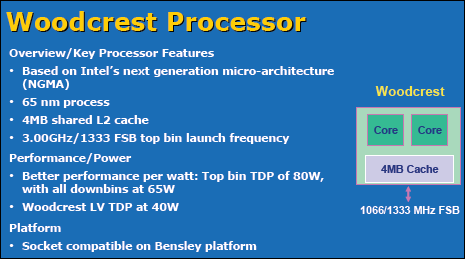
Woodcrest will share the Bensley platform with Dempsey, although we suspect Dempsey will fade away once Woodcrest parts are shipping in volume. Dempsey may have competed in terms of performance, but power consumption was not even in the same ball-park thanks to Woodcrest's new Core micro-architecture. The new processor features a 4MB L2 cache shared between each of its two cores and a 1333MHz Dual-Independent Bus architecture. Clock speeds for the Woodcrest launch will start at 1.6GHz and top out at 3.0GHz, and power consumption for the parts will range from 65W to 85W for the top bin part (3.0Ghz). The lower clocked 1.6GHz & 1.86GHz parts will run at 1066MHz FSB while the 2.0-3.0GHz parts will run at 1333MHz FSB. Intel also plans to ship a 40W version of the chip later this year that will run at 2.33GHz.
For the past two years Intel has been holding workshops in Oregon, where they invite a few of the hardware sites to view their upcoming technology. In May of this year, AnandTech made their way up to Oregon to have a look at Woodcrest. While we were there we were presented with the normal marketing hoorah, what product launch is without that? But we also had some quite interesting presentations like Virtualization, and where Intel sees that market going (it's going sky-high for those that haven't been keeping up with it).
While in Oregon, we also took a look at a running Clovertown machine. Clovertown is the code name for Intel's quad-core chip, which is coming out in early 2007. It will be a drop-in part to most Woodcrest systems, running at 1066MHz FSB. How's that for upgradeability: 4-way to 8-way in under 20 minutes (your mileage may vary).
The Birth of a New King
Out with the old, and in with the new (or so they say). In April of 2003, AMD launched their Opteron enterprise microprocessor. Since then, Opteron has been steadily chewing into Intel's server market share. To think that Intel was not going to re-tool would have been naïve, although it did take Intel a long time. Not only did they produce what we think is the best two socket server processor on the market today, but they have quad-core up their sleeve and it will most likely release before AMD has an answer to Woodcrest. We already took a look at Woodcrest running on Linux, and we're ready to follow up with some analysis of Windows Server performance.
Woodcrest will share the Bensley platform with Dempsey, although we suspect Dempsey will fade away once Woodcrest parts are shipping in volume. Dempsey may have competed in terms of performance, but power consumption was not even in the same ball-park thanks to Woodcrest's new Core micro-architecture. The new processor features a 4MB L2 cache shared between each of its two cores and a 1333MHz Dual-Independent Bus architecture. Clock speeds for the Woodcrest launch will start at 1.6GHz and top out at 3.0GHz, and power consumption for the parts will range from 65W to 85W for the top bin part (3.0Ghz). The lower clocked 1.6GHz & 1.86GHz parts will run at 1066MHz FSB while the 2.0-3.0GHz parts will run at 1333MHz FSB. Intel also plans to ship a 40W version of the chip later this year that will run at 2.33GHz.


 Facebook
 Twitter
 RSS
RSS


59 Comments
View All Comments
ashyanbhog - Tuesday, July 18, 2006 - link
Quite shocking to see Anand perform such a biased benchmark and get away so easily.Is it a coincidence that Dell did not sell AMD chips in their machines to date, and benchmarks from Dell show Intel chips perform better
Can we say tuned or skewed
photoguy99 - Thursday, July 13, 2006 - link
It's just killing fan boys like Kiijibari that Intel is the best 2-way server out there now and they have to craft these elaborate scenarios to somehow justify how AMD is still great.Man give it up - Is it not enough almost every hardware site on the net has crowned Woodcrest the new 2-way champ over AMD? How much more evidence do you want?
As I've posted before I own an FX-60 now so I don't feel great that Intel will soon be selling at Wal-mart a chip that will kick ass on my carefully overclocked FX system.
But so what? It is what it is. Sure AMD are planning new things, and when and if they are benchmarked to be superior, then you can have your day again.
For now Intel *owns* AMD except a couple niche segments - get used to it.
duploxxx - Friday, July 14, 2006 - link
i think you mean conroe... not woodcrest (the server chip) you can count the reviews on 1 hand that were made... two of them were from anand here. which are still in a large discussion about comparisson etc... and this one is comming straigth from intel...nice to see the "king" is anounced by intel themselves
vaystrem - Thursday, July 13, 2006 - link
That prevented Intel's Woodcrest computers from being considered for government bids?http://www.theinquirer.net/default.aspx?article=32...">US government unit throws Intel out over RAID problems
or
http://theinquirer.net/default.aspx?article=32818">Conroe shows dodgy RAID performance anomalies
I know its 'The Inq' but since this is a server test it would be nice to see some confirmation or exploration of this issue.
drwho9437 - Thursday, July 13, 2006 - link
The charts are almost totally inscrutable for the red-green color blind population, which is something like 5% of males. Learn to use a decent color scheme or incorperate symbol shapes as well as colors. Map makers know this...forPPP - Thursday, July 13, 2006 - link
All of you ranting about comparing 3.0 GHz Woodcrest to 2.6 GHz Operton, look here:http://www.behardware.com/articles/623-1/intel-cor...">http://www.behardware.com/articles/623-1/intel-cor... and see how much better Core 2 architecture is. Core 2 Duo 2.13 GHz beats Athlon FX-62 2.8 GHz in most benchmarks. Of course architecture is not everything, especially in enterprise market. Operton has advantage thanks to HyperTransort and advantage of Woodcrest is diminished because of FSB. But the main battle will occur with Desktops and here Core 2 Duo shines. Lets hope AMD will show something intersting soon, not only prices drop. All in all we consumers will benefit from this battle.
duploxxx - Friday, July 14, 2006 - link
you are looking at desktop... don't compare desktop with server... desktop is more the mass and low profit.... server and laptop are for the profit.Locutus465 - Thursday, July 13, 2006 - link
AMD will manage to come out with a decent competetor in the next little while and we'll have real compitition in the CPU space again. I'm sure this sucks for AMD right now, and if AMD were able to rebound and deliver a competitor in the relitive near term futer for intel too. But for consumers, competition is beautiful, already we can look twards dirt cheap A64's for your low to mid-range computing needs.FesterOZ - Thursday, July 13, 2006 - link
I tried skimming back through the article but is Anand just measuring the CPU wattage or the overall wattage draw for the whole platform (i.e. cpu, northbridge,dimms?Jason Clark - Thursday, July 13, 2006 - link
Wall folks, sorry that wasn't more clear. We'll ensure we include power measurement information in future articles. We use the same procedure as we've used in previous articles with power, an extech device and we log power througout the test duration.Cheers.