
Motherboards Memory Storage Cases/Cooling/PSUs IT Computing Displays Mobile Mac CPUs & Chipsets Video Digital Cameras Linux Gadgets Systems Trade Shows Guides Home Increase Font Size Decrease Font Size Change Page Size
Lab Update: SSDs, Nehalem Mac Pro, Nehalem EX, Bench and More
Date: May 27th, 2009
Author: Anand Lal Shimpi
Buy the Intel SSDSA2MH080G1 X25-M Solid 80GB
Blank
 Newegg $259.00


I had an epiphany the other day. Long time AnandTech readers will know that I used to do a far better job of keeping you guys apprised of what it was that I was working on. Somewhere along the way that got lost so today I’m going to try something...old, I guess. Here’s an update of what’s been going on.

The WePC Update

I've been working on a side project with ASUS called WePC.com. The idea is pretty cool: ASUS is tapping the community for ideas on what they'd like to see from its users in future notebook designs. I wrote about this at the end of last year but I've done a lot of work on it since then so I thought it'd be worthy of an update.

Last week I wrote about how simple it was to build a HTPC with a nice interface thanks to maturing integrated graphics platforms and good media center plugins. I also talked about the future arrival of Westmere and when the best time would be to buy your next laptop. Around the Athlon X2 7850 launch I talked about replacing aging PCs on a budget and seeing some pretty good performance results.

The netbook market is a very fast growing one so I broke out the crystal ball and tried to figure out where it was all going. I touched on NVIDIA v. Intel, the purported death of the desktop, SSD capacities and styling from a company other than Apple. It turns out I've written quite a bit over there, so check it out and join the discussion.

I’m working on SSDs Again

A couple major things have happened since my last in-depth look at SSDs. For starters, some drives now support the almighty Trim command. Both OCZ’s Vertex (and other Indilinx based drives) as well as the new Samsung drives should support Trim. Obviously you need the right firmware and you need an OS (or a utility) that supports Trim to take advantage of it, but it’s there and admittedly it’s there much earlier than expected.

That’s a good thing for drives like the new Samsung ones (Corsair’s new SSD is based on this drive) because their worst case scenario used performance is just bad. I’ve briefly touched on this in previous articles, but Samsung’s controllers don’t appear to do a good job of managing the used scenario I’ve been testing with. Thankfully, the latest controller’s support for Trim should help alleviate this issue. I’m still working on figuring out how to identify if a drive properly supports Trim or not.

I’ve also received the new OCZ Vertex EX (SLC) drives as well as the 30GB and 60GB variants of the MLC Vertex drives. The former is too expensive for most consumers but I’ll be putting it up against the X25-M to see how it fares in a high end desktop, all while trying to get enough together for Johan to do a proper enterprise level test. The 30/60GB Vertex drives are spec’d for lower write speeds so I’m going to be testing those (finally) to see what the real world impact is.

I can’t help but mention Windows 7 at this point, because I *really* want to switch to it for all of my SSD testing. Windows 7 is far more reliable from a performance standpoint. Although our recent article showed that it’s not really any faster than Vista, my SSD testing has shown that it’s at least more consistent with its performance results. Part of this I attribute to Windows 7 doing more intelligent grouping of its background tasks than Vista ever did, although it is surprising to me that we’re not seeing noticeably better battery life as a result.

How much would you guys hate me if I switched to Windows 7 sooner rather than later?

Nehalem Mac Pro: Upgrading CPUs

I actually finished testing the new Nehalem based Mac Pro several weeks ago, but in keeping up with tradition I had to see if it was possible to upgrade the CPUs on the new Mac Pro.

Indeed it is, but it’s a bit more complicated than you’d think.

Apple makes two models of the Mac Pro, one with two sockets and one with only a single LGA-1366 socket. The two socket model, often referred to as the 8-core Mac Pro, actually uses Nehalem CPUs without any heatspreaders. I suspect this is to enable them to run at their more aggressive turbo modes more frequently (high end Xeons can turbo up to higher frequencies than regular Xeons or the Core i7). The single socket model uses standard Xeons with heatspreaders, so there’s nothing special there.

I actually managed to kill a processor card doing the CPU swap but I’ve taken the hit so you all don’t have to :) It’ll all be included in the article, I’m simply waiting on a replacement heatsink since an integrated thermal sensor got damaged during the initial swap. For now just know that it is possible to upgrade the CPUs in these things and it’s not too difficult to, you just need to know what to expect and to be patient.

If you’re on the fence of buying today, opt for the slower CPUs and upgrade later if you’d like. And if you already have a good Mac Pro and aren’t terribly CPU bound, save the money and buy SSDs instead - in many cases the performance improvement is far greater. Once again, I’ll address all of this in the article itself.

Nehalem-EX: 2.3 billion transistors, eight cores, one die

I spent about 45 minutes on a conference call with Intel yesterday talking about the new Nehalem-EX processor for multi-socket servers. Here’s a crude picture of the die:
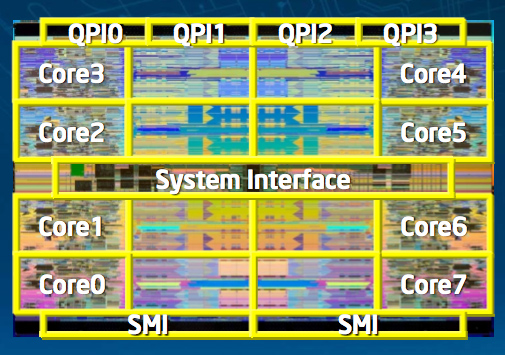

That's 2.3 billion transistors thanks to 8 Nehalem cores and a 24MB L3 cache

Nehalem-EX, which I’ve spoken about before, is an 8-core version of Nehalem. It is not socket-compatible with existing Nehalem platforms as it has four QPI links (up from two in the LGA-1366 Xeon versions). The four QPI links enable it to be used in up to 8-socket systems for massive 64-core / 128-thread servers.
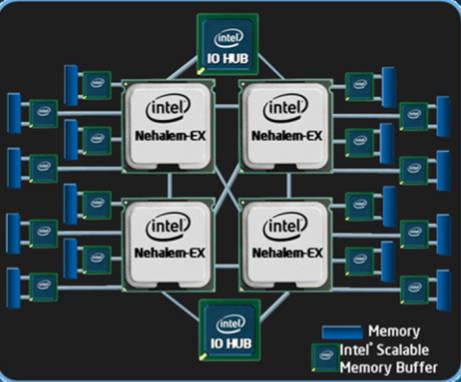

Four socket Nehalem-EX platform

Remember that the Nehalem architecture was optimized for four cores, but it was designed to scale up to 8-cores and down to 2. As such, the Nehalem-EX is actually a monolithic 8-core processor with a gigantic 24MB L3 cache shared between all 8 cores. Also remember that Intel wanted a minimum of 2MB of L3 cache per core, so Nehalem-EX actually goes above and beyond that with 3MB per core if all cores are sharing the cache equally.

Hyper Threading is supported, so that’s 16-threads per 8-core chip. I’d also expect some pretty interesting Turbo modes on an 8-core Nehalem.
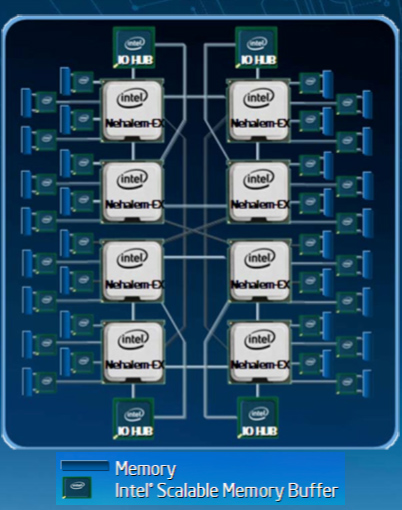

Eight socket Nehalem-EX platform, note that the CPUs connect through SMBs before getting to main memory. Say goodbye to FB-DIMMs, but hello to on-motherboard buffers.

The memory controllers are a bit different with the Nehalem-EX. Each socket supports up to 16 DIMMs, but instead of supporting FB-DIMMs Intel moved the memory buffer onto the motherboard. The Nehalem-EX memory controllers communicate directly to memory buffers (Intel calls them Scalable Memory Buffers) which in turn communicate directly to standard DDR3 memory. This is a much preferred approach as it keeps expensive, slow and power hungry FB-DIMMs out of the majority of the server market where it doesn’t make sense and enables large memory installation on these gigantic servers with 64 DIMM slots.

Intel expects to be shipping Nehalem-EX by the end of this year, with the first systems shipping at the beginning of 2010.

AnandTech Bench: Thanks for the Feedback

I made a post last week about me adding the Atom 230 and 330 to AnandTech Bench and shortly thereafter received a tremendous amount of very useful feedback.

I agree completely that we need to get rid of the “shorter bars mean better performance” metrics, as well as tidy up the interface a bit. I need to hammer out a list of specs but it does help to have your feedback and you can expect to see much of what you’ve asked for in future versions of the app.

I also asked to see what sorts of older CPUs you’d like to see included, and to my surprise there was a lot of demand for very old CPUs like the Pentium III or Athlon XP. I tallied up all of the responses and by far the single most requested CPU was the Athlon XP (granted if you added up all the different Pentium 4 variants that would easily take the cake).

As a result I’m going to be dusting off an old Athlon XP system, in addition to a single-core Hyper Threaded Pentium 4 as well as VIA’s Nano and will be running benchmarks on all three over the coming weeks.

Many of you also want a mobile CPU version of bench; rest assured, I do too. Let me see about getting these older desktop CPUs in first and then I’ll work on mobile.

That’s all for now. Hopefully I’ve provided a good taste of what’s to come in the not too distant future.


68 Comments
Username:
Password:
Nice by sprockkets, 178 days ago
Looking forward to it.

Reply
SSD Question by vol7ron, 176 days ago
Did he say he's gonna compare the new SLCs to the X25-M. Isn't the X25-M an MLC? I know Intel puts out a decent SSD, but is that a fare comparison?

Reply
RE: SSD Question by vol7ron, 176 days ago
by fare I meant fair

Reply
RE: SSD Question by sbuckler, 173 days ago
If they are of a similar size/cost then obviously it's fair to compare them as people looking for a drive of that size/cost will be able to pick either.

Reply
RE: SSD Question by vol7ron, 172 days ago
I thought cost was almost negligent with regards to the enthusiast market :)

I thought you compare on comparable performance and then evaluate the costs; since, after all, prices change due to rebates, sales, and demand.

Reply
Intel : Innovation for servers? by dragunover, 178 days ago
Removing the necessity for expensive server RAM? Someone's gonna hate that, and someone's gonna love that.
Personally I'm the latter of the two.

Reply
RE: Intel : Innovation for servers? by Jaybus, 178 days ago
The trade off is a more expensive motherboard, though, that has buffer memory. It wasn't clear to me where this memory would be, separate ICs soldered to the mb or integrated into the chipset. My guess is the former, at least to begin with, in which case RAM manufacturers won't hate the change nearly as much.

Reply
RE: Intel : Innovation for servers? by tshen83, 177 days ago
Instead of subsidizing FB-DIMM's AMB chip on each DIMM sold because of extra power consumed, now Intel can charge for the SMB chips individually(8 socket system would require a whooping 32 SMB chips).

Depending on how much Intel wants to price those SMB chips, it could make or break Nehalem-EX's platform. (A simple $10 per SMB would easily mount to 320 dollars cost to the motherboard manufacturers, which could then turn into a 600 dollars+ premium on the motherboard)

This approach is indeed the correct one from a technical perspective. Basically Intel wants all the memory premium associated with Nehalem-EX platform by forcing the memory makers into producing commodity DDR3 DIMMs, not FB-DIMM2s.

128 threads + 128 DIMMs...this is porn.

Reply
RE: Intel : Innovation for servers? by KentState, 171 days ago
A $600 premium isn't going to add much to the overall cost. I would bet that an 8-way server with 128GB of ram is going to run $40k+.

Reply
SSD, EX and Pentium M. by iwodo, 178 days ago
On the Bench, the main reason is that people want to know how much performance we are getting for our money. I think the recent economy has changes some of our thinking in spending.
The past few years we had experience upgrading parts with not much performance difference. It is interesting to see how previous CPU fair with current generation. And finally realize the days we had improvements like 386 to 486 and Pentium are over.

SSD - The mystery of multiple channel SSD has yet to solved. Is it possible to have more then 10 channel SSD drive in an 2.5" SSD. If not what is the maximum possible channel, i.e what performance should we expect from future SSD.

EX seems to me an destructive product. Previous Benchmarks shows how much performance / watt the Nehalem was able to deliver. May be WoW servers can finally fit more players inside a Single Realm?

Reply
RE: SSD, EX and Pentium M. by JonnyDough, 178 days ago
I agree with what you said about the economy changing things. It isn't just that though. Computer technology isn't gaining nearly as quickly, and the need for new systems - at least in the consumer space is less pressing. The dollar is far more important now than it was. Purchases even at the business level are determined even more by cost than in the 90s, when changes to performance was more heavily weighed factor in IT decisions.

This is why businesses that want to survive have to be broadly invested. For example, if a company that manufacturers hard disk drives exclusively fails to get going on SSD early enough, it will be facing extinction.

If you're GM, it pays to invest in something other than just big gas guzzling automobiles. :-D Let's hope the Chevy Volt has some real value. I have my doubts that it will be as popular as they'd hoped, but I do think the car merits an award for ingenuity. They took conventional thinking and flipped it on its head, I just wish they'd done it 20 years ago. With their marketing dept they might've been able to put Ford out of business.

Reply
RE: SSD, EX and Pentium M. by TA152H, 176 days ago
If you think about it, it does make sense.

The biggest jump, of course, was the 286, arguable the best processor Intel ever made for its time. It was extremely fast, so much so that I couldn't believe it the first time I used it. Going from a PC to a PC/AT was a jump that was mind-boggling. On top of that, it added virtual memory, and the ability to multitask. It was a huge improvement.

The 386 sucked, although it did move to 32-bit and added the now worthless Virtual 86 mode. The performance was poor though, as it ran like a 286 at the same clock speed, clock normalized. But, it moved the platform forward.

The 486 was a nice processor, for sure. It didn't add anything new, but ran like a raped ape. I remember how we fought over the first 486 PC made, an upgraded version of the PS/2 Model 70-A21, which was called the B21. It cut compiles down from 30 minutes to about 18 compared to a 386/25, and it was only running at 25 MHz, and did not have any L2 cache, unlike the 386 which had a 64K external cache.

The Pentium wasn't so great. It ran at poor clock speeds at first, and when I used it, I found the performance quite poor. I used to say Intel's odd numbered processors were all bad, and their even ones good and this was further proof. I went from a 486 at 100 MHz, which were available, to a Pentium at 66 MHz, and was entirely unimpressed. It ran hotter than Hell too. But, in time, they got it right, with shrinks and the Pentium MMX (although MMX wasn't so important, there were other enhancements). The FDIV bug was kind of funny too, and how idiots overreacted to it. Still, I have one of the processors and I hope it will go up in value.

The Pentium Pro was another initial disappointment. It ran 16-bit code very poorly, although the fault lies more with Microsoft than Intel since they gave Intel guidance that 32-bit code would dominate by 1995 when the Pentium Pro was released. It was really expensive too, because of the on-processor L2 cache (which was really on the same packaging, but not part of the processor), which could not be tested before joined with the processor, so if one were bad, they were both thrown out. The Pentium II addressed the segment register issue of the Pentium Pro, so improved 16-bit code somewhat, and obviously what we use today is still based on the Pentium Pro design. It was, of course, and even number (P6) design, so was good.

The Pentium 4, an odd number design, of course, sucked far worse than the Pentium and 386. It was much hotter, like the Pentium compared to the 486, but the performance sucked too, which made it a double threat.

Now we are back to the Pentium Pro design, so it's only reasonable we don't see dramatic changes since it's really not a new processor at all, but just improvements to an existing line, like the Pentium MMX, or Athlon XP (I'd use Prescott as an example too, but was it an improvement?????).

It makes sense though. Really, virtually nothing in PCs is new, and never has been. Virtually every concept has been taken from mainframes, or supercomputers, and microcomputers were just low cost implementations of those concepts. When you had a scarcity of transistors, there were many very good things you could not implement, but you wanted to. That low lying fruit is gone, and adding transistors gives greatly diminished returns. It's like the improvement with any technology. If you look at cars, jets, etc... once the technology matures, the improvements slow down and you get gradual improvements.

I'd like to see x86 die, but I guess it will not happen. Processors cost more, perform worse, and use more power because of this miserable instruction set. It's not a lot per processor, but when you multiply it by the millions upon millions of processors that are afflicted with the x86 instruction set, the costs are staggering. That's not even counting the migraines it has caused by people who have to code in assembly for it. It's gruesome.


Reply
RE: SSD, EX and Pentium M. by yacoub, 169 days ago
Great post, but you forgot the first Celeron, the 300a that overclocked to 450MHz without breaking a sweat. In my book, the best bang-for-the-buck Intel CPU right up through the Core2Duo.

This was in the early days of overclocking, just over a decade ago, and it was a dream to be able to run a chip at 150% its rated speed with zero changes to things like voltages (heck most motherboards didn't even support voltage changes back then, iirc).

Ah... those were the days. :)

Reply
Keep up the good work by FlameDeer, 178 days ago
After reading this update, really amazed with such a wide scope coverage that you are currently working hard on. Much anticipating with what will coming next from AnandTech.

Thank you Anand & keep up the good work. :)

Reply
Sounds great. by thebeastie, 178 days ago
Yeah looking forward to it, just like the latest Terminator movie :)


Reply
RE: Sounds great. by JonnyDough, 178 days ago
Or any Christian Bale movie...

Reply
RE: Sounds great. by Souka, 177 days ago
Check out "The Machinist" if ya havn't seen it...

Reply
Windows 7 all the way! by feraltoad, 178 days ago
Switch to Win7!

OK, I'm already using the RC, but it really is great. Plus, it's not different enough from Vista to really make difference if you go ahead and switch, and if the adoption of the Beta and RC are any indication then Win7 adoption will be out the roof!

Reply
RE: Windows 7 all the way! by Live, 177 days ago
People already hate vista so switch to vista 2 by all means.

I would also suggest that the poll system you implemented a while back would be perfect to use if you want to ask a straightforward question like this. I wouldn't have to ramble on in my broken English and I wouldn't have to read every answer to see the results. Just a thought...

Reply
RE: Windows 7 all the way! by Live, 177 days ago
I forgot to add that I really appreciate articles like this one and that a edit function is needed.

Reply
Win7 by Pointwood, 178 days ago
I've been using it as my primary OS since the RC release and it's seems to generally perform better than Vista. I've only had one slight problem and that was getting my Colormunki monitor calibrator working. Win7 wasn't able to find a driver but I found it myself and got it working.

So I say "GO GO GO" in regards to switching to Win7.

Reply
Chipset Optimizations towards SSD by Drazick, 178 days ago
Hello Anand.
What about checking the SSD Optimizations made in the Chipset level?
Are the newer chipsets of Intel / AMD / nVidia any better using those drives? Does each of them has plans on making optimized chipset for SSD?

Thanks...

Reply
anandtech rules by samspqr, 178 days ago
* thanks for the status report
* that WePC project looks a great iniciative, let's see what comes out of it
* thanks for letting me know I don't want an SSD drive yet
* that 64 cores nehalem system looks like a 3D artist's wet dream, but I guess the price is still going to be quite a bit higher than that of a comparable render farm based on more standard equipment

Reply
Any chance of some HDD loving? by cordas, 178 days ago
I must admit I am as excited as the next guy when it comes to SSDs, i can't wait for them to become an affordable viable option for a boot drive, nevermind them becoming big enough to use as my main drive (minimum of 1TB currently).

However I am thinking of replacing my aging 500gb HDD with a nice new spangly 1TB drive and have been looking for reviews of said beasties and have been unable to find a review done in the last 12+ months anywhere....

So how about seeing if you can grab the latest and greatest HDDs on the market and giving them a spin to tell us what to get and what to avoid.

Reply
Windows 7 by Automan, 178 days ago
Definitely would like to see you move to Windows 7. I've been running the x64 edition on my daily use laptop since Beta 1 and have had no unexpected significant issues with it. Go for it!

Reply
Vista vs Windows 7 by JonnyDough, 178 days ago
"Although our recent article showed that it’s not really any faster than Vista"

Dammit. I was really hoping that Windows 7 would offer some type of performance increase over Vista, not just better SSD performance. Oh well, I guess I'll take what I can get. I really dislike the overlordishness of mainstream operating systems these days, but if it helps improve overall ease of use then I suppose it's a sacrifice I'm willing to make.

Reply
Windows 7 by VaultDweller, 178 days ago
"How much would you guys hate me if I switched to Windows 7 sooner rather than later?"

No hate at all. I'm in the process of switching everything over to Windows 7 RC (my main desktop has been on Windows 7 since the Beta), so Windows 7 results are most important to me.

I'm sure there will be those that disagree, though.

Reply
Comments on SSDs, Bench, and More by vol7ron, 178 days ago
I would like to see the P4 2.8E (worst overclocker) in the bench comparison, as well as the Core2 E6600. I jumped on early with the Core2, able to pick one up before they hit the market. I think it's about time to get an upgrade.

The other thing that might be nice to see is the performance w/ water cooling and regular hair cooling (fan or just a spreader).

As for SSDs, I'll be looking forward to your SLC comparison :) as well as the results from the 8core NeX (Nehalem-Ex)

Reply
RE: Comments on SSDs, Bench, and More by vol7ron, 176 days ago
by hair, I meant *air*

Reply
Win7 by h0kiez, 177 days ago
1 more vote for switch now. I'm using it exclusively, and if there's a difference with respect to SSD performance related to trim support or anything else, I want to know.

Reply
ddr2 vs ddr3 by thebandit, 177 days ago
Aren't we still missing an article on ddr2 vs ddr3 ? what happened to that ?

Reply
awesome collective update by onisaur, 177 days ago
if other benchmarks have shown no tangible difference between 7 and Vista, by all means, go with 7. we're here for the relative performance anyhow, not the exact cloning of your rig for exact times.

on older pc's. to me, the base of the world is a p3-500. the old gateway/compaq cast iron horses still run, still browse the net, and with a new harddrive are zippy enough. i see tons of cel-1200 tualatins that effectively match the p4-1.3-1.5's to cover the 'painfully almost' catagory. and consider a p4-2.4 just because there really are that many dell dim2400's still out there.

on the ssd's: with intel slc 32gb ~$400usd, 64gb ~$780usd, i only lost $20 going with raid0 32gb's on an ich10r. hdtach3 296MB/sec avg, 496MB/sec burst. since so many of the ssd's are ~2x the cost as you go up in size, PLEASE consider putting raid0 smaller ssd's on benchmarks. 60GB is enough to survive on a boot drive. two 32gb supertalent's for ~$270 total should plausibly destroy an intel slc x25-e 64gb at $500 cheaper, and 3.5" brackets mounting two 2.5" drives make it all too convenient.

on pivotal boot and app load tests, consider distinguishing "with same drive swap file", "with other drive swap file", and "with zero swap file".

Reply
Oh yeah by gwolfman, 177 days ago
Thanks Anand, greatly appreciated!

Reply
Nice HTPC blog for WePC by coda6, 177 days ago
But can we get an in-depth HTPC article for the Anand site? :D

Reply
upgrade time? sure. by ciparis, 177 days ago
Windows 7? Go for it, Anand. I think many of your readers are already there, and many more are considering it. Best OS they've ever released, even as an RC.

Reply
First thank you for your great website by DrSmith, 177 days ago
I think the article should include xp & win 7. Vista yuk...

With explanation with REALLY how 'worn down' does a mlc drive become with heavy usage. I have a vertex & its fast w reads & writes. But I keep hearing these stories on them 'not lasting' ? How long do they last? compared against SLC? do the storage cells wear out???

Reply
Go ahead to Win7! by chrisf6969, 177 days ago
Go ahead to Vista 2.0, errr, I mean Win7. I've been dual-booting it and it feels ready for launch!

One request: Can you test a G.Skill Falcon 128Gb SSD. Price/Gb looks pretty good, and they're quoting some impressive performance #'s. I'd like to see you do your REAL world testing on it! PLEASE!

Reply
RE: Go ahead to Win7! by chrisf6969, 177 days ago
P.S. Are you going to RAID two Vertex 30Gb's as they're so cheap, seems like you could get some really impressive # for $200+.

Reply
win 7 + SSD RAID by fredsky, 177 days ago
hi anand !

- win 7 : GO for it. i've just purchased a GSKILL falcon SSD (brother or OZC vertex), and done lots of benchmarks for photoshop. i compared XP64 and win7 64, win7 is much more efficient. so SSD + win7 are the winners! on my old setup, vista is much slower and problematic than win7.

- RAID SSD : as many readers, i would like to see the performance difference between OCZ vertex SSD :
2 RAIDed 30GB, 2 RAIDed 60GB, single 60GB, single 128GB.
because 2x60GB cost about the same as 1x128GB.


Reply
A thought on Bench by slashbinslashbash, 177 days ago
Instead of getting rid of the "shorter bar = better" benchmarks (they are useful after all), why not make a simple interface change and keep them? I have two thought on how this could be done.

1) Move all the "shorter = better" benchmarks to the bottom of the page, and keep the "larger = better" ones at the top. That way you're not switching back and forth as you read through the benchmarks.

2) On "shorter = better" benchmarks, have the bars originate on the right side of the graphic instead of the left side. This way the shorter bars would still be better, but now there would be a consistent "farther to the right = better" that might be helpful in avoiding confusion.

Reply
RE: A thought on Bench by tynopik, 177 days ago
the problem isn't so much confusion (although that is an issue) as it is non-linearity

especially when charting widely different capabilities (from Atom to Nehalem), the top-end get compressed to nothingness

for instance going from 10 seconds to 9 seconds (10% improvement) is more impressive than going from 200 seconds to 190 seconds (5% improvement)

yet the 5% difference is 10 times longer than the 10% difference!

> (they are useful after all),

fortunately it's easy to convert them into linear scales

for instance, instead of saying how long it took to compress 1GB in winrar, say how many MB/sec it could compress

Reply
RE: A thought on Bench by strikeback03, 176 days ago
Except that saving 10 seconds at a time is more useful than saving one second per operation if it is a common operation.

Reply
RE: A thought on Bench by tynopik, 176 days ago
except that you're trying to get a relative idea of the performance of the CPUs

if 1 cpu is twice as fast as another, that should be readily apparent without having to judge what the length of a bar means in different sections of the graph

so it might only be 1 second on this task of this size, but it could be 100 seconds on a different or larger task

just for example, imagine a comparison of cpus from 286 to Nehalem that measured how long it took pkzip to compress 20MB

an athlon XP would be indistinguishable from an i7 920

in reality the 920 trounces the athlon XP, but the legend is so compressed it becomes hard to tell

Reply
RE: A thought on Bench by uuwuu, 176 days ago
How about reparamaterizing the shorter is better bars to something that works as longer is better. One way to do this would be to consider the absolute value of the difference between every piece of hardware and the worst performer. The worst performer would be equal to zero.

There is probably an infinite number of other ways to make something like that work, and although the information's value would be diminished because it is only based on the results (and doesn't truly depict the actual results), but it would be valid in comparing relative performance. If something like this is done, I think it'd be important to keep the actual results viewable to ensure that there is no bias (I love you guys, but there are always jerks that are like "wow way to give AMNvidintel an advantage to make them look better")

Reply
I'd actually love you more if you switched to Windows 7 by Nihility, 177 days ago
I've been using 7 for just about 6 months and it's been a great experience. Really brings some love to Microsoft.
Since there's no difference between Vista and 7 I say go ahead an switch. The SSD review will be much more real that way.
Keep in mind that 7 could change until the RTM (not very likely but possible).
Vista was fun for the past 2.5 years but now we can let it die just like XP should have and let 7 take the reigns :)

Thanks for all your hard work, love the articles. Your SSD reviews are like no others.

Reply
SSD by Zorlac, 177 days ago
I read the Windows 7 blog on SSD and they made a bunch of changes to optimize the OS, so saying that Vista is no different than 7 is not true.

I say you should move to 7 for testing SSD. I am also curious to know which SSDs currently on the market are properly communicating with Windows 7 at first install and telling the OS that the drive is a SSD and not a HDD so 7 properly optimizes.

Also, what is the status on TRIM for Intel SSDs? Is it true that Intel has been working on their own SSD defrag utility??? (possibly just a rumor considering most believe defrag is not needed).

Reply
I'm the only one then... by MadMan007, 177 days ago
I understand where people are coming from when they say use Win 7 for SSDs but I don't think you should until it's gone gold. Regardless of how good the RC is or how many people have no problems it's still not a retail OS and shouldn't be used exclusively for testing right now.

Reply
Opinion and Petitions by marraco, 177 days ago
Win7: Yes, I installed the RC1 just to test it, but almost never utilized back the XP.
And no. Is not the same performance that Vista. Vista did NOT worked. Win7 works.

SSD: what matters on the end of the day, is how much performance I can buy on a budget.

I can buy a fast 120 Gb OCZ Vertex. but would consider also investing on those options at the same cost:

1-120 GB OCZ Vertex.
2-Same cost on RAID0 of smallest (and cheaper) SSD disks.
3-JBOD RAID of 30/60 Gb SSD and 1Tb HDD, with a good defragmenter software.
4-Same cost on 4 (or maybe 8) 7200rpm 1Tb Hdd, using only the first 120 Gb. since it would use only the fastest tracks, it would have an amazing read /write speed, and the heads would no move, so the latency (and noise) would be reduced at the minimun, and the caché will add (4x1Tbx32Mb would have 120Mb of caché).

Reply
Dual CPU Mac? Wow. by Sabresiberian, 177 days ago
First time I've been even mildly intersted in an Apple product since the Lisa. It's awesome that you will be reviewing it with your processor upgrade article!

I'm hoping this leads to a next-gen dual CPU mainboard market; come on Asus, EVGA, if you're going to charge us $400 for a mainboard let's get some dual-CPU action too!

:D

Reply
Anandtech Bench: Core Duo and Mac Pro by ltcommanderdata, 177 days ago
They technically are mobile chips, but it'd be great if you could bench some original Yonah Core Duo chips. They were sold as mobile on desktop applications and had early use as media boxes so they have a relevant comparison point for desktops besides being the origins of the Merom and Nehalem micro-architectures.

And while you are testing the Nehalem Mac Pro, it'd be great if you could add those numbers to your charts as well. If you have older Mac Pros, it'd be great to see how dual Clovertowns, dual Harpertowns, and dual Gainestown compare to Penryn and Bloomfield.

I'll put in a plug again for the 3.73GHz Pentium Extreme Edition 965 dual core Presler as well.

Reply
Comments Page 1 of 2


AnandTech.com Blog Categories
All categories
Anand's Macdates
Anand's Theater Construction
Anand's Updates
Cases and Power Supplies
CeBIT 2008
CES 2008
Computex 2009
Derek Decanted
Eddie's Got Game
Gary's First Looks
IT Computing general
Jarred's Musings
Kris's Corner
Raja's Ramblings
Rob's Experiences...
Ryan's Ramblings
Virtualization
What's New with Wes
Blank
Blank

Blank

Latest news by
DailyTech

 November 20, 2009

Blank
Blank
Blank
Blank
Blank
Blank
Blank
Blank
Blank

 November 19, 2009

Blank
Blank
Blank
Blank
Blank
Blank
Blank
Blank


more Blogs Discussions


pipeboost
Copyright © 1997-2009 AnandTech, Inc. All rights reserved. Terms, Conditions and Privacy Information.
Click Here for Advertising Information