



AMD’s Radeon HD 5570: Low Profile, Higher Performance
by Ryan Smith on February 9, 2010 12:00 AM EST- Posted in
- GPUs
When AMD launched the 5670, they told us they had 2 more cards on the way: the 5450, and a 5500 series card. Last week we saw the launch of the 5450, utilizing the Cedar GPU and finishing off AMD’s chip stack. Today we’re looking at that 5500 series card, the Radeon HD 5570.
| AMD Radeon HD 5670 | AMD Radeon HD 5570 | AMD Radeon HD 4670 | AMD Radeon HD 5450 | AMD Radeon HD 4550 | |
| Stream Processors | 400 | 400 | 320 | 80 | 80 |
| Texture Units | 20 | 20 | 32 | 8 | 8 |
| ROPs | 8 | 8 | 8 | 4 | 4 |
| Core Clock | 775MHz | 650 | 750MHz | 650MHz | 650MHz |
| Memory Clock | 1000MHz (4000MHz data rate) GDDR5 | 900MHz (1800MHz data rate) DDR3 | 1000MHz (2000MHz data rate) GDDR3 | 800MHz (1600MHz data rate) DDR3 | 800MHz (1600MHz data rate) DDR3 |
| Memory Bus Width | 128-bit | 128-bit | 128-bit | 64-bit | 64-bit |
| Frame Buffer | 1GB / 512MB | 1GB | 1GB / 512MB | 1GB / 512MB | 1GB / 512MB |
| Transistor Count | 627M | 627M | 514M | 292M | 242M |
| TDP | 61W | 42.7W | 59W | 19.1W | 25W |
| Manufacturing Process | TSMC 40nm | TSMC 40nm | TSMC 55nm | TSMC 40nm | TSMC 55nm |
| Price Point | $99 / $119 | $80-$85 | $60-$90 | $49-$59 | $35-$55 |
Right off the bat, the 5570 marks a bit of a departure from AMD’s numbering scheme for the 4000 series. While the Radeon HD 4550 was the faster of the two cards utilizing AMD’s cheapest GPU (RV710), the 5570 is not a faster Cedar card. Instead it’s a slower Redwood card, putting it in the ballpark of the 5670’s rather than the 5450’s.
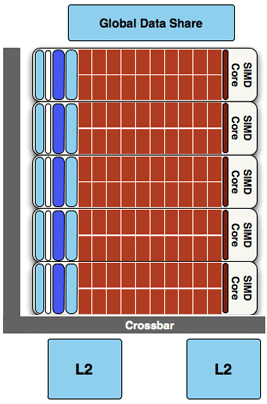
AMD has done 3 things to differentiate the 5570 from the 5670. The first of which is to significantly castrate the 5670’s memory bandwidth. While the 5670 had 1GHz (4GHz effective) GDD5, the 5570 drops that for simple 900MHz (1.8GHz effective) DDR3, giving the card only 45% of the memory bandwidth of the 5670. The second change is more customary, and that is lowering the core clock from 775MHz to 650MHz, leaving the card with roughly 83% of the computational/rendering/texturing performance of the 5670. None of the SIMDs have been disabled however, so this is a fully functional Redwood GPU.
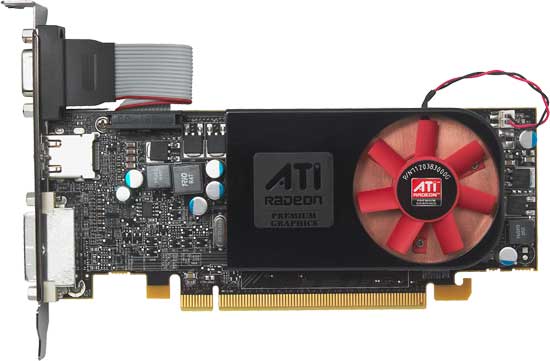
Finally, in another significant departure from the 4000 series, this is AMD’s second official low-profile video card. For the 4000 series AMD’s only official low-profile card was the 4350, although vendors were known to do low-profile versions of the 4550 (RV710) and the 4650 (RV730). Here AMD is not leaving that up to their vendors, and is doing an official retail low-profile design for their more powerful Redwood GPU. This allows AMD to fill a potential hole in their lineup by offering a low-profile GPU with better than bargain-bin performance.
This card also fills the overall price/performance hole in AMD’s 5000 series lineup, giving them something between the $9 9 5670 and the $50-$60 5450. AMD’s MSRP on this card will be $85, a bit more than half way between the other two cards. Unlike the 5670 and 5450, we’ll only be seeing a single official configuration of the 5570: 1GB of 900MHz DDR3. Our sample comes with 900MHz Samsung chips. It’s also worth noting that this is the same memory configuration as the base Radeon HD 4670, which also used 1GB of 900MHz DDR3.
Between the drop in the core clock and the movement to DDR3, AMD has lopped off nearly 30W from the 5670’s load power usage, bringing the 5570 in at 42.7W. Idle power also drops by nearly 33%, for 9.7W. This low power usage is a big part of why AMD can get away with the 5570 being a low-profile card, as they only need a small single-slot blower to cool the card. The reference cooler (not that we expect many – if any – vendors to use it) is a blower design built upon a copper heatsink, with a small fan blowing air towards the front of the card.
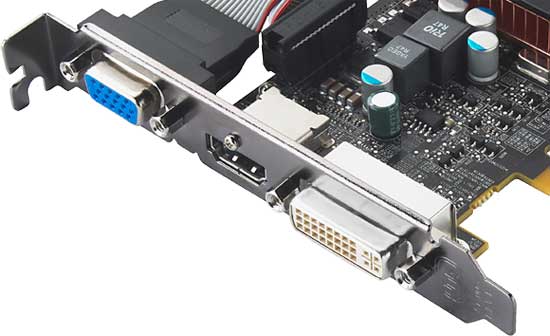
The port configuration is the same as the 5450: 1 VGA, 1 DVI, and 1 smaller digital port. Our sample came with a HDMI port, with vendors free to use an HDMI port or a DisplayPort depending on whether they want Eyefinity support as enabled by using a DisplayPort. As has been the case with all of AMD’s sub-$100 5000 series cards, Eyefinity is still cost-prohibitive at this time due to a lack of cheap active DisplayPort adaptors and monitors offering DisplayPort inputs.
AMD considers NVIDIA’s GT 220 the chief competition for this card. The GT 220 isn’t an official low-profile card, but there are a few models out there in that form factor. In terms of overall pricing, a number of GDDR5 GT 240s can be found at or right below $85, making the GT 240 the closest competitor for this card.


 Facebook
 Twitter
 RSS
RSS


36 Comments
View All Comments
YogiBeer - Tuesday, March 16, 2010 - link
Hey i'm a bit of an end user so dont troll on me for asking this but ive got an Hp s5216f system the graphics card i got with it is shovel ware and i need one that can play games like modern warfare 2 and the like...will this do the trick and if not what will.......... thanx for the help............ Cheers matesmAJORD - Friday, April 2, 2010 - link
I got one of these to play Battlefield Bad company 2 on a little ITX system.I OCd it to 720 core 1080 mem leaving the fan at AUTO.
at 1920x1080 Med detail settings, DX10, no AA 2xAF it's quite "playable" 25-mid 30 FPS and looks OK to be honest for such such a low power card. which is exactly what I was hoping.
Saying that I really wish they were equiped with downclocked DDR5! and the same 42w TDP. that would have been incredible bang / watt and size! disapointing AMD :(
avi1956 - Sunday, February 28, 2010 - link
I purchased HIS 5570 HD 1GB video card from Newegg on Feb 15. When playing games after 5 to 15 mins of play I get crackling sound and frame rate degradation. The problem gets worse till the frame rate drop becomes progressively worse and noise continues. Also the OS slows down (mouse slow down). The only way to recover is to reboot. I have gateway SX2802-01 quad core Q8300 with 4 meg ram and windows 7 64 bit and latest catalyst driver dated 2/17/10 from ati.com. I have sent a belarc trouble report to ati and HIS and awaiting their feedback. Not sure if this is a hardware or software problem.PhantomKnight - Tuesday, February 23, 2010 - link
Thank you for a very informative article. It clears a lot up. I'm interested because I'm sick of using old hot noisy hardware.I don't normally like typo posts, but when it confuses, it's a problem.
"As with Sapphire’s 5450, their 5770 comes in a surprisingly large box. Inside is the card, a low-profile bracket, drivers, an installation guide, and Arcsoft’s SimHD video conferencing plugin."
While I'd love to see a 5770 utalise a low profile, I doubt it will happen.
office boy - Wednesday, February 10, 2010 - link
With the NV GT cards supporting 8 channel LPCM is ATI's support of Bitstreaming that important? Decoding in the PC vs in the receiver.Isn't the outcome is the same? Uncompressed 7.1?
wlee15 - Wednesday, February 10, 2010 - link
The GT and older ATI cards don't support the Protected audio path which means that any soundtracks higher than 16-bit 48 khz are downsampled to 16-bit 48 khz.Also the HD 5570 should support support Vector Adaptive with newer drivers.
http://forum.beyond3d.com/showpost.php?p=1392217&a...">http://forum.beyond3d.com/showpost.php?p=1392217&a...
falacy - Wednesday, February 10, 2010 - link
My upgrade process over the last several years has led me to the following system, which I am very happy with in terms performance for the things I actually do (World of Warcraft, media encoding, productivity applications, music production). However, I have a couple "issues" that I'd like to resolve.eVGA 8600GT 256MB video
1600x900 resolution
Asus P5K-VM motherboard
Q8200 2.33GHz CPU
6GB 667MHz RAM
Seagate 7200RPM 16MB Cache HD
The thermal performance of my case, a modified AT server tower cira 1991, is great and the 8600GT runs at 50c idle 73c avg load, which compairs nicely to the 5570. Ultimately, I'd like a fanless card that can do what I do now.
In WoW I can run at full (4x AA and 8x AF in driver) settings as long as I turn Shadow Detail all the way down to Min. However, any time there is a lot fog or spell detail, I end up with a nice 5FPS picture show. Turning spell detail to half resolves that.
Do you think the 5570, when someone creates a fanless version, would solve those two issues and perform a little better than the 8600GT with its whopping 256MB of slow RAM?
MrSpadge - Tuesday, February 9, 2010 - link
I've been reading this sentence in GPU reviews since some time now:[quote]The GT 240 is the biggest winner here, beating even the 5570. However this is likely due to differences in how AMD and NVIDIA throttle their cards under FurMark.[/quote]
Doesn't it bother you to basically say "Well, half of all these measurements are probably wrong, but we'll show them as a comparison anyway"? Either rename the FurMark.exe or use a different test. 3DCenter.org have shown that Bioshock is very demanding and reaches the highest real world power usage ever recorded in a game (still lower than FurMark, of course).
Moizy - Tuesday, February 9, 2010 - link
Now that the 5450 and 5570 are out, and nVidia won't have replacements for the 210 and 220 for a while, can we have a HTPC card showdown article? I noticed that the GT 220 review didn't analyze the video quality quite like the 5450 and 5570 reviews have, so I'm wondering how they all compare.Could we have a showdown that analyzes these newer HTPC cards for audio and video capabilities, and maybe throw in the new Intel HD graphics? Would be very educational for those of us that want a good HTPC card but don't care about gaming.
Ryan Smith - Tuesday, February 9, 2010 - link
If you check the 5450 article, I actually do have a shot of the GT 220 in there. It actually does rather well at the VA test, but going NVIDIA means you have to give up some degree of post-processing control, along with bitstreaming audio.