



ATI's New High End and Mid Range: Radeon X1950 XTX & X1900 XT 256MB
by Derek Wilson on August 23, 2006 9:52 AM EST- Posted in
- GPUs
Power to the People
The major power hog of this generation is the X1900 XTX, as we have made clear in past articles. Almost disturbingly, a single X1900 XTX draws more power than a 7950 GX2, and X1900 XTX CrossFire is more power hungry than 7950 Quad SLI. While ATI already had the slightly lower clocked X1900 XT available for those who wanted something that acted slightly less as a space heater, they needed something that performed better and fit into the same (or better) power envelope to round out this generation of GPUs for them. What they latched on to has now given graphics cards sporting the R580+ a much needed drop in power: GDDR4.
As we explained in the GDDR4 section, the optimizations made to this generation of graphics memory technology have been designed with both power savings and potential speed in mind. We've already seen how the higher speed memory pulls through in our performance tests, but how does it hold up on the power front?
For this test, used our Kill-A-Watt to measure system power at the wall. Our load numbers are recorded as maximum power draw during a run of 3DMark06's fill rate and pixel shader feature tests.
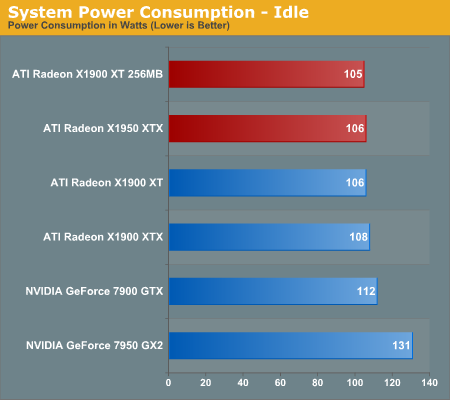
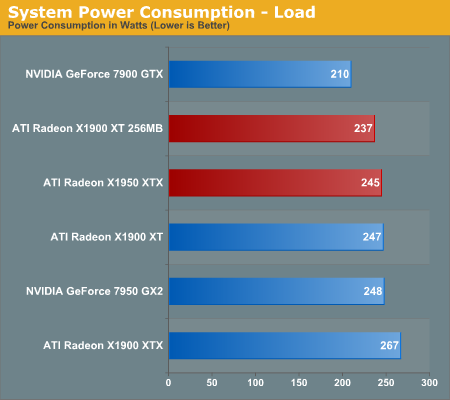
Apparently, JEDEC and ATI did their jobs well when deciding on the features of GDDR4 and making the decision to adopt it so quickly. Not only has ATI been able to improve performance with their X1950 XTX, but they've been able to do so using significantly less power. While the X1950 XTX is still no where near the envelope of the 7900 GTX, drawing the same amount of power as the X1900 XT and 7950 GX2 is a great start.
It will certainly be interesting to see what graphics makers can do with this RAM when focusing on low power implementations like silent or budget products.


 Facebook
 Twitter
 RSS
RSS


74 Comments
View All Comments
SixtyFo - Friday, September 15, 2006 - link
So do they still use a dongle between the cards? If you had 2 xfire cards then it won't be connecting to a dvi port. Is there an adaptor? I guess what I'm asking is are you REALLY sure I can run 2 crossfire ed. x1950s together? I'm about to drop a grand on video cards so that piece of info may come in handy.unclebud - Friday, September 1, 2006 - link
"And 10Mhz beyond the X1600 XT is barely enough to warrant a different pair of letters following the model number, let alone a whole new series starting with the X1650 Pro."nvidia has been doing it for years with the 4mx/5200/6200/7300/whatever and nobody here said boo!
hm.
SonicIce - Thursday, August 24, 2006 - link
How can a whole X1900XTX system use only 267 watts? So a 300w power supply could handle the system?DerekWilson - Saturday, August 26, 2006 - link
generally you need something bigger than a 300w psu, because the main problem is current supply on both 12v rails must be fairly high.Trisped - Thursday, August 24, 2006 - link
The crossfire card is not the same as the normal one. The normal card also has the extra video out options. So there is a reason to buy the one to team up with the other, but only if you need to output to a composite, s-video, or component.JarredWalton - Thursday, August 24, 2006 - link
See discussion above under the topic "well..."bob4432 - Thursday, August 24, 2006 - link
why is the x1800xt left out of just about every comparison i have read? for the price you really can't beat it....araczynski - Thursday, August 24, 2006 - link
...I haven't read the article, but i did want to just make a comment...having just scored a brand new 7900gtx for $330 shipped, it feels good to be able to see the headlines for articles like this, ignore them, and think "...whew, i won't have to read anymore of these until the second generation of DX10's comes out..."
I'm guessing nvidia will be skipping the 8000's, and 9000's, and go straight for the 10,000's, to signal the DX10 and 'uber' (in hype) improvements.
either way, its nice to get out of the rat race for a few years.
MrJim - Thursday, August 24, 2006 - link
Why no Anisotropic filtering tests? Or am i blind?DerekWilson - Saturday, August 26, 2006 - link
yes, all tests are performed with at least 8xAF. Under games that don't allow selection of a specific degree of AF, we choose the highest quality texture filtering option (as in BF2 for instance).AF comes at fairly little cost these days, and it just doesn't make sense not to turn on at least 8x. I wouldn't personally want to go any higher without angle independant AF (like the high quality af offered on ATI x1k cards).