



IDF Fall 2006 - Day 2: Opteron vs. Xeon, SSE4 & Intel's Torrenza competitor Announced
by Anand Shimpi & Virginia Lee on September 27, 2006 1:12 PM EST- Posted in
- Trade Shows
Back when Pat Gelsinger was Intel's CTO, he was on stage at these IDF Keynotes talking pure, unadulterated technology and research - much like Justin Rattner was doing yesterday. Pat is an absolutely excellent presenter, arguably Intel's best; unfortunately, these days he spends his time talking about the Enterprise market - and historically, the Enterprise keynote has always been the least interesting keynote of IDF. Against all odds, Pat managed to make the latter half of the keynote interesting with some important announcements that we'll talk about in the coming pages.
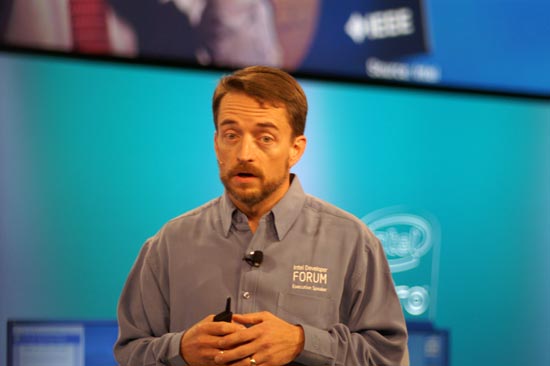
Gelsinger's keynote started with a recap of what's been released in the past six months: mainly Core 2 based processors into the server and client markets.
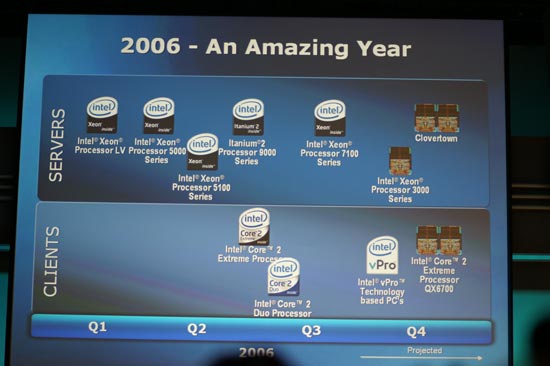
Given that this is the first IDF since the launch of Intel's Core 2 based processors, it's not surprising that the majority of the show has been touting the performance advantages of Intel's existing Core 2 products rather than new products.
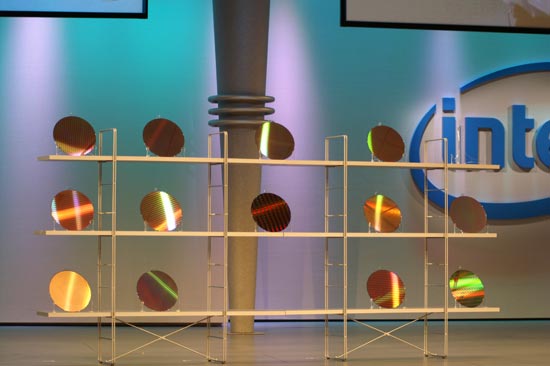
Ever since Core 2 launched, Intel has been unusually competitive in that it has done an unprecedented amount of public Intel vs. AMD benchmarking. From setting up an AMD system to compare to Conroe at last IDF to having a live Socket-F Opteron performance comparison today, Intel is proud of its performance advantages and is not shy of talking about them.
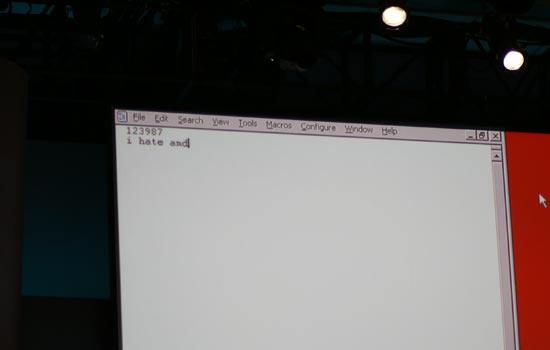
The second line is Pat Gelsinger's password captured by an Intel rep playing a hacker during a security demo at today's keynote
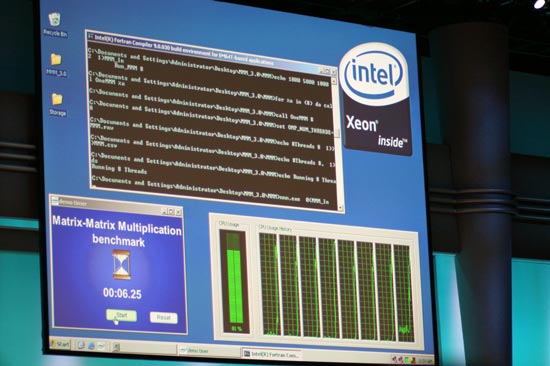
The Socket-F Opteron 2.8GHz vs. Xeon 5160 (3.0GHz) demo was a simple performance test using a Matrix-Matrix Multiplication benchmark (sounds a lot like Linpack). Obviously the Opteron system lost taking 67.49 seconds to complete the benchmark compared to 39.06 seconds for the Xeon 5160 system (both systems were dual socket). Power consumption was lower on the Xeon system at 370W vs. 444W. Without knowing the configurations of both systems (other than Intel saying that they were as close to identical as possible), we can't really say much about how comparable these results are.
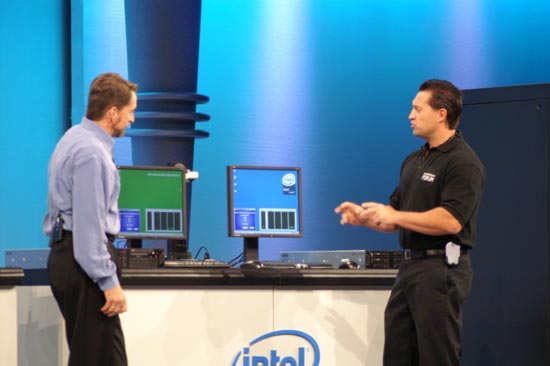
Gelsinger then "challenged" his demo assistant to upgrade the Xeon box to new Clovertown based, quad-core Xeon processors within the next 8 minutes.
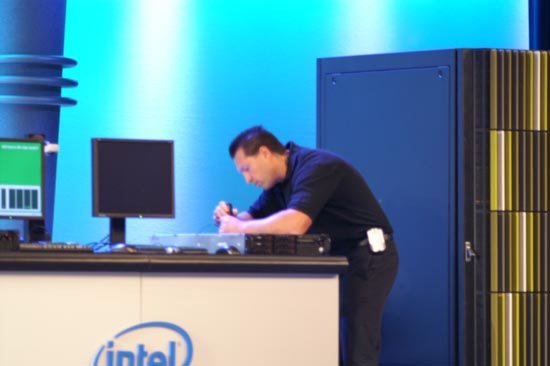
The demo assistant simply swapped out the old Xeon 5160s with new Low Voltage Clovertown based Xeons running at a clock speed almost 900MHz lower than the 5160s (around 2.1GHz). Despite the lower clock speed, having twice as many cores in the system let the new LV quad-core Xeon setup complete the benchmark in 31.01 seconds, and at marginally higher power consumption of 380W.


 Facebook
 Twitter
 RSS
RSS


18 Comments
View All Comments
archikins - Wednesday, September 27, 2006 - link
..not much information in your article about this except the "i hate amd" screen shot. Could you please add some more info on this?AnnihilatorX - Wednesday, September 27, 2006 - link
What's with the "I hate amd" password...JarredWalton - Wednesday, September 27, 2006 - link
It was a joke more than anything - that was his "secret" password, but he got "hacked".tygrus - Thursday, September 28, 2006 - link
Was he blaming AMD that he was hacked? Implying that if it was an Intel machine with ??? tech it wouldn't.A real reason to hate AMD would be if AMD could beat Intel. Why would you hate someone you had beat ? Freudian slip that Intel thinks AMD can beat Intel ?
Who's afraid of the big bad wolf :)
slashbinslashbash - Wednesday, September 27, 2006 - link
So we've got IBM at IDF saying that they're supporting Intel in this new venture to plug accelerator chips into the motherboard with cache coherency and all kinds of really big stuff, and no explicit mention of Cell?wien - Wednesday, September 27, 2006 - link
Hmm. What's going on with the ads recently? When I open this page in Firefox/Epiphany on Linux, I'm instantly redirected to Newegg, Zipzoomfly or some other advertiser. Opera at least opens a new tab for the ad, but it's still mighty annoying.slatr - Wednesday, September 27, 2006 - link
This makes me want to work for Intel. I am such a nerd.psychobriggsy - Wednesday, September 27, 2006 - link
"Socket-F Opteron 285"No such beast exists. It'd be a 2220 or something. Either the box was Socket F and they got the name wrong, or it was Socket 940 still.
Intel's bus licensing thing looks quite weak compared to AMD's Torrenza. Intel have more might however, but a potential 18 months to mere specification isn't a good start. Quite what advantages they'll have over HyperTransport 3 remains to be seen, but if it is competing just to be awkward then Intel haven't really matured as a company like many had hoped.
Hopefully the benchmarking suite will be non-biased and based around sensible usage patterns. I guess we'll see soon enough.
The new instructions will be useful if they accellerate common algorithms decently over software implementations, e.g., CRC32 was on the list. However are these sensible instructions to have? Would general purpose accellerators, e.g., TCP/IP and Encryption, be better?
finalfan - Wednesday, September 27, 2006 - link
The one advantage of fsb bus licensing is it makes the 3rd party device being able to access system memory without forcing its own memory controller and its own memory since it is connected with MCH and MCH will be able to ensure memory coherence. It makes the other devices more like a CPU than a co-processor.Kiijibari - Wednesday, September 27, 2006 - link
Nobody forces a memory controller with torrenza. It is jsut optional. Some dual Opteron mainboards also just use 1 CPU's memory, the other CPU is accesing the RAM through the coherent Hypertransport bus.Thus the AMD solution is more flexible.
cheers
Kiijibari
P.S: @anandtech, good article :)