



Fall IDF 2005 - Day 2: More Details on VIIV and Next-Gen Architecture
by Anand Lal Shimpi on August 24, 2005 7:21 PM EST- Posted in
- Trade Shows
We've got two items to update you all on, let's first start with some more information about Intel's next-generation microprocessor architecture.
Memory Disambiguation
There's a lot more than meets the eye when it comes to Intel's next-generation micro-architectures, but Intel is saving quite a bit of that for the Spring 2006 IDF. One feature that they did quietly introduce was something they call Memory Disambiguation, which we referred to in our previous article on the topic as speculative data loads.
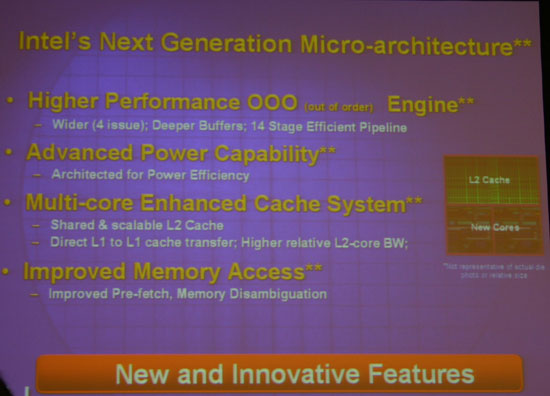
We got a slightly better grasp on the feature, and it basically works like this:
Normally when an Out of Order microprocessor re-orders instructions, it cannot reschedule loads ahead of stores because it does not know if there are any dependencies it would be violating.
Intel's memory disambiguation technology is essentially speculative loading, where based on some algorithms the processor evaluates whether or not a load can be executed ahead of a store, if it can then the load instructions can be rescheduled to further optimize for the highest possible instruction level parallelism. If the speculative load ends up being valid, then business is as usual, otherwise the result must be thrown away and the load executed after the store is complete.
Intel couldn't provide us with more information on the speculative loading, in particular the accuracy of its speculative algorithms, but we would assume that they would be highly accurate if this technology will be used in mobile processors. Anything speculative has the potential to be a waste of power if not done with the highest accuracy.


 Facebook
 Twitter
 RSS
RSS


26 Comments
View All Comments
ceefka - Saturday, August 27, 2005 - link
This sounds like something that needs a lot of MHz:bhtooefr - Friday, August 26, 2005 - link
Well?A laptop can definitely meet the VIIV requirements.
Pentium M Yonah? Check.
i945GM? Check.
Intel network? Last I checked, that was possible. Check.
HD Audio? Well, a single SPDIF would do the trick... Check.
Remote? Laptops had IR ports in the past, and they can have them now. Check.
bhtooefr - Friday, August 26, 2005 - link
Replying to myself...Add a 2915ABG to that, and you'll have a Centrino VIIV.
sprockkets - Thursday, August 25, 2005 - link
If all that is happening is the lights and video out turn off, then that isn't instant on and off, that's just like turning off the screen and light on a PDA.joex444 - Friday, August 26, 2005 - link
exactly what instant on/off means from inteljohnsonx - Thursday, August 25, 2005 - link
June 2005: Intel inks a deal with Apple to provide CPUs for next-gen Macs, claims "we're not Microsoft's bitch any more!"August 2005: Intel agrees they are in fact Microsoft's bitch by requiring MCE as the centerpiece of their V//V marchitecture.
Leper Messiah - Thursday, August 25, 2005 - link
Anyone else noticing the trend of all intel crap? You MUST have intel NICs, you MUST have intel drivers, etc. Thats 1) depressing, because they might not have the best drivers out there, and basically says no to SI SATA...meh.Joepublic2 - Friday, August 26, 2005 - link
Why would you not want an intel NIC? Their networking producs are excellent. Intel's drivers are also generally excellent. I do agree that forcing vendors to use their entry level graphics, RAID and audio solutions is pretty stubborn.joex444 - Thursday, August 25, 2005 - link
If you were Intel, it makes sense. Somebody gets a Realtek NIC in their formerly VIIV PC, then it isnt a VIIV PC and if that PC needs to be fixed, Intel can refuse help on the grounds its not VIIV and therefore unsupported.PeteRoy - Thursday, August 25, 2005 - link
It's overkill to have a dual core processor for digital home theater, vive or not.I mean this thing probably sits in the living room playing movies, music and pictures.
Why do you need a dual core processor for that? Home Theater can do just as fine with a 2Ghz Celeron and 512MB of RAM.