



Computex 2005 Day 1 - ATI R520 Sighting, NVIDIA's new Chipset
by Anand Lal Shimpi on May 31, 2005 6:41 AM EST- Posted in
- Trade Shows
Day one of Computex has already been quite eventful; we've seen yet another working R520 demo performing some impressive H.264 GPU acceleration, as well as motherboards based on NVIDIA's new C51G. All that and much more in this Computex article...
The H.264 specification is particularly important as it will be the predominant encoding/decoding standard for both blu-ray and HD-DVD. Being able to accelerate H.264 encoding, decoding and transcoding will soon be the new focus of system performance. If you've played around with either encoding H.264 content or playing back the limited amount of H.264 content currently available, you know that the overall system demands for anything dealing with H.264 are quite high.
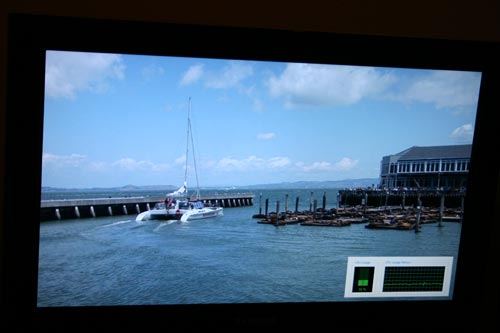
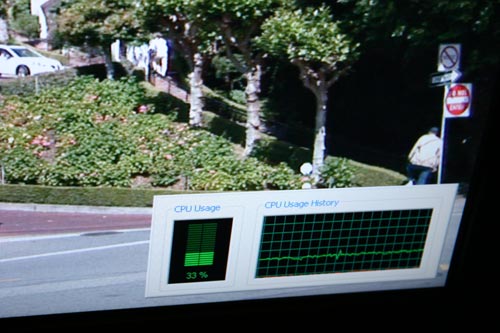
ATI is addressing one part of the problem by offering GPU-accelerated H.264 decoding with the R520. The demo was conducted on 25Mbps HD footage recorded using a HD video camera and played back on a Pentium 4 3.6GHz system (Hyper Threading enabled) with a R520 graphics card.
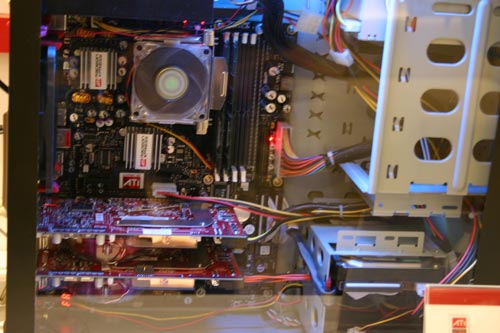
Obviously, the story of the day happens to be ATI's CrossFire multi-GPU solution, and ATI had some CrossFire demos running in their suite as well.
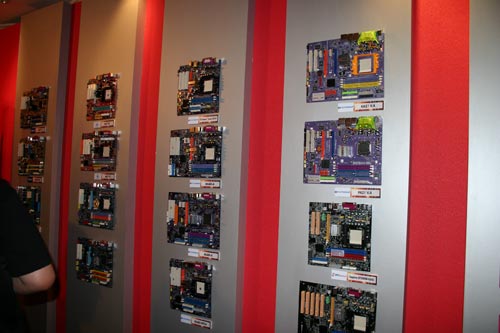
Just like all of the other chipset makers, ATI had a wall of motherboards based on ATI chipsets at their suite:
ATI Demos R520, Accelerates H.264 Decoding
ATI's R520 has made its second appearance in the past couple of weeks, this time behind not-so-closed doors at ATI's suite in the Hyatt hotel.
The H.264 specification is particularly important as it will be the predominant encoding/decoding standard for both blu-ray and HD-DVD. Being able to accelerate H.264 encoding, decoding and transcoding will soon be the new focus of system performance. If you've played around with either encoding H.264 content or playing back the limited amount of H.264 content currently available, you know that the overall system demands for anything dealing with H.264 are quite high.
ATI is addressing one part of the problem by offering GPU-accelerated H.264 decoding with the R520. The demo was conducted on 25Mbps HD footage recorded using a HD video camera and played back on a Pentium 4 3.6GHz system (Hyper Threading enabled) with a R520 graphics card.
Obviously, the story of the day happens to be ATI's CrossFire multi-GPU solution, and ATI had some CrossFire demos running in their suite as well.
Just like all of the other chipset makers, ATI had a wall of motherboards based on ATI chipsets at their suite:


 Facebook
 Twitter
 RSS
RSS


37 Comments
View All Comments
Reflex - Wednesday, June 1, 2005 - link
#35 - You are quoting marketing information. I am telling you how sound engineers actually work with this stuff. Believe what you want, obviously you have no desire to know how these things actually work.xsilver - Wednesday, June 1, 2005 - link
#35if you crack open an expensive reciever, you may be surprised to see that the dac and other audio chips are exact to that of some pc soundcards.... pro audio companies dont make the chips themselves, they buy them from chip manufacturers just like everybody else
ArneBjarne - Wednesday, June 1, 2005 - link
#33 + 34Repeating it over and over will not make it more true. Bring some documentation to the table that contradicts Dolbys own.
Reflex - Wednesday, June 1, 2005 - link
BTW, your statement about video cards is proof of exactly what I am speaking of. Video cards as they currently exist are 'fire and forget' systems, much like on the fly DD encoding. The result is that while most of the time your display is perfect, occasionaly you have serious glitches, for instance clipping and texture anomolies. This is because the video card has no quality control system, no way to report back to the rendering engine that something is in the wrong place. It simply renders whatever its told as best it knows how and moves on.Realtime encoding works the same way. Most of the time its just fine, but anomolies can definatly be detected by anyone who is paying attention.
Reflex - Wednesday, June 1, 2005 - link
Your dedicated AMP will not make sound better than the PC is outputting it. When its being encoded on the fly with no quality control(fire and forget) it is not as nice as a quality analog output. Digital is not inherantly better than analog, it all depends on how it is being done. And yes, that $40 Santa Cruz will put your SoundStorm to shame. If you doubt that, you should peruse some audio forums, there is not even any debate on that topic.Furthermore, the Santa Cruz also has hardware accelleration, its CPU overhead is roughly 7%(compared to 5% for the SS), neither total would significantly impact performance of a game, it takes greater than 10% to be noticable to a user. Regardless, someone bragging about their $1700 AMP can surely spend a couple hundred on a decent CPU.
As for the part about Dolby Digital that you do not understand, I am not going to try to explain the entire technology to you in the space of a commentary section. You can either do the research yourself or you can take the word of someone who has worked with this stuff for a living. Or you can continue being ignorant of how it all works and continue the "SOUNDSTORM IS TEH L337 R0X0RS!!! LOL OMG!!!11!!!" mentality.
Just because people like me do not bemoan its loss does not mean it was terrible technology. But it was not some great leap because you could utilize one digital cable rather than three analog ones. It was integrated audio, with all the same pluses and minuses as other integrated audio solutions. Almost anything off the shelf is better than Soundstorm, the lowest priced card I know that puts it to shame is the Santa Cruz. The highest end card that is still in the consumer market is the M-Audio Revolution 7.1. Either of those cards make Soundstorm(and even the Audigy) sound like crap when using quality cables and a good sound system attached.
ArneBjarne - Wednesday, June 1, 2005 - link
#30 You honestly want me to believe that the DACs on a $40 card is going to compete with the ones in my $1700 amp. Yeah right. On top of that it's acceleration capabilities are nowhere near the SS. For what i need it is crap. But hey, if you only care about stereo music then I or anyone else can't possibly have different needs which the SS fits, right? You'll have to excuse me if I don't think your needs alone should determine what there is or isn't a market for.With regard to the encoding process could you please provide some documentation since you claim to know more about it than Dolby themselves.
"There is no 'source' 5.1 output for games, its simply an extrapolation based on the existing sound data from the game, a guesstimate more or less."
What is it exactly that makes a realtime generated 5.1 mix any less a '5.1 source' than a pre-recorded one? The "rendering" of the sound by the SS APU is no more a guesstimate than the graphics rendering done by the GPU is. If a soundsource is placed behind the camera in the gameworld it damn well better be put in the back channels of the mix. If you turn the camera left to face the soundsource the sound damn well better be moved right in the mix until it is in the center channel, just as the gpu damn well better render the visual representation of the soundsource if it isn't hidden behind other objects.
"Regardless, for gaming and basic Windows audio, Soundstorm is adequate and better than most integrated solutions. But for people who are more serious about their audio, its not a loss at all."
Again not only adequate and better than most integrated solutions for gaming in my setup, but better than most anything period, which certainly includes a $40 Turtle Beach Santa Cruz. But hey, if I use my dedicated amp and DVD player for playing music instead of a computer soundcard i guess i'm just not "serious" about my audio so my needs are not valid.
yacoub - Wednesday, June 1, 2005 - link
"[SoundStorm] was the best of the low end solutions, but there are $40 add-in cards that are better these days, so bemoaning its loss is a bit rediculous."1: You just said why it's not ridiculous - it was the best of the onboard solutions. That alone made it appealing to those of us who DON'T want to go out and buy an add-in card.
2: Not only was it onboard, but it had digital output.
If you're someone like me who is attracted to an SFF for my next PC, the onboard nature becomes even more appealing as opposed to having to stick two PCI cards (PCI-E GPU and a PCI soundcard) inside a little Shuttle case, thus reducing the airflow over the GPU and just really crowding the darn thing. =
If NForce4 Deluxe boards came with SoundStorm2 (which clearly would be better than SoundStorm was, though that was already acceptable enough for my usage considering the two positives listed above), it would have been IDEAL for SFF cases.
So that is why I lament its death.
Reflex - Wednesday, June 1, 2005 - link
First off, you can have a Turtle Beach Santa Cruz for around $40. It has quality DAC's and is used in even semi-pro environments. Secondly, the shielding issue is and always has been seriously overblown, and is an issue that *any* electronic reciever deals with as well. Remember, the packaging on the chips inside your PC themselves are designed to shield, go put your PC next to other devices and note the lack of interferance. Its not like it was in the Pentium Pro days anymore and hasn't been for a long long time.And finally, yes there are engineers who check the quality of encoded sound when it comes to DVD's and other pre-mastered sources. They don't simply encode and forget. Usually it will go through several stages before they consider it final, and they will tweak the encoding process as needed to make certain that the audio is perfect from human perception. This is not true of on the fly encoding for obvious reasons. There is no 'source' 5.1 output for games, its simply an extrapolation based on the existing sound data from the game, a guesstimate more or less. Now in general thats alright, although nothing that cannot be accomplished with analog cables as well. Since I do more than play games with my PC, I also expect a decent audio experience as well, Soundstorm provides merely a adequate experience easily topped with reasonably cheap off the shelf cards.
Also, as I understand it the digital output on most Soundstorm boards was actually re-sampled by the PHY interface. I read about that a while back but I do not have the details handy(tough to find info anymore). If that were true than going digital does not necessarily make the sound any purer than the cheap analog DAC's that most boards used.
Regardless, for gaming and basic Windows audio, Soundstorm is adequate and better than most integrated solutions. But for people who are more serious about their audio, its not a loss at all.
Gatak - Wednesday, June 1, 2005 - link
#25There are enormous problems to get good analogue outputs from computer hardware. One of the first reasons is the electrical noise from within the computer. It is very difficult to properly shield.
The second problem are the DACs which are often mediocre quality at best. The sound output is not balanced, optimized for the same impedance as your receiver/amp system and so on.
A digital output, even if it is compressed, may very well give a lot better quality than analogue.
Of course, Sound Blaster Live! cards (pre live 2) do not even have a proper digital output either!
ArneBjarne - Wednesday, June 1, 2005 - link
1. Clearly there is a trade off between the two types of loss. You can aruge about where the scale tips, but to say that uncompressed analogue is always going to be better than lossy-compressed digital no matter what components are used is pretty silly.2. Sure there are, but none of the cards mentioned earlier are in that category, nor do those that are serve the same market as SS, hardware accelration + realtime encoding of 5.1 game sound.
3 + 4. No monitoring of the perceptual coding used in AC3 is needed:
"Perceptual coding vs. Metadata
It is generally not necessary to monitor the Dolby Digital coding process from encode to decode to simply preview the effects of the encoding algorithm. However, it is very important to monitor the effects of [i]metadata[/i] on the source audio either through the encode/decode process or through the use of a DP570 Multichannel Audio Tool. The simple reason is that the Dolby Digital encoding process is specifically designed to be transparent, while metadata is intended to optimize the program audio for playback in a variety of home listening environments."
- Standards and Pratices for Authoring Dolby Digital and Dolby E Bitstreams, Issue 3
http://www.dolby.com/assets/pdf/tech_library/20_Do...
Finally, I don't really care about HiFi music quality in relation to SS DD encoding. Why would you want to use it for that in the first place? Even if you insist on using SS you would turn of DD encoding and use uncompressed PCM or passthrough just like Gatak said.
"I'm not a Soundstorm or a DD hater. But I don't pretend they are something which they are not. SS was a low end sound solution, it was the best of the low end solutions, but there are $40 add-in cards that are better these days, so bemoaning its loss is a bit rediculous."
That is pure BS. If you used the crappy DACs the SS was often paired with by motherboard makers then sure, but if you used the DD out with a home theater setup then no damn $40 add-in card is going to come even close when it comes to 5.1 gaming sound.
#24 Sure, dts would have been nice and if you were to make a new solution today dts lossless would be even sweeter, but I can understand why the went with AC3 instead. If you implement only one of them then the install base of AC3 decoders is larger than that of dts. In fact, I think most amps that can decode dts can also decode AC3, while the oposite is not true.