



Sun’s T2000 “Coolthreads” Server: First Impressions and Experiences
by Johan De Gelas on March 24, 2006 12:05 AM EST- Posted in
- IT Computing
Introduction
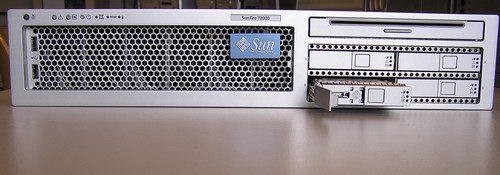
The Sun T2000 server, based on the UltraSparc T1 CPU, sparks our curiosity. For years, x86 servers have been gobbling up the server market share fast, forcing the RISC vendors – who don’t have the same economies of scale – to retreat to niche markets. First, the low end market was completely overrun, and right now, Xeons and Opterons are on their way to dominate the mid-range market too.
It is, however, clear from reading the T2000 server documentation that Sun hopes that the T1 CPU and the T2000 server can turn the x86 tide. The documentation files contain many references to the x86 competition, which indicate how the T1 outshines the x86 competition.
No, this is not a server and Sparc CPU that must keep Sun’s current position among the RISC vendors safe. This is an ambitious effort to take back some of the lost server market.
“The Sun Fire T2000 Server marks the dawn of a new era in network computing, by allowing customers to break through limitations of capacity, space and cooling.”
If Sun’s own benchmarks are accurate, it is no exaggeration to call the T2000 a server with a revolutionary CPU. Sun claims that this 72 W eight core, 32-thread CPU can outperform the power hungry (200-400W) quad IBM Power 5, Intel Xeon and the AMD Opteron machines in many server applications.
However, there is no substitute for independent benchmarks. So, we proudly present you our first experiences with Sun’s T2000. Note the phrase, “first experiences”, as there is still a lot of benchmarking going on in our labs. We are only scratching the surface in the first part, but rest assured that we’ll show you much more soon.
In this first part of our T2000 review, we look at the T2000 as a heavy Solaris, Apache, MySQL and PHP web server or SAMP web server. We also take a look at the performance of a single T1 Sparc core, to get an idea of how powerful each individual core is.
We are working on a JSP web server benchmark and there are several database benchmarks also in progress.
The Sun T2000 server, based on the UltraSparc T1 CPU, sparks our curiosity. For years, x86 servers have been gobbling up the server market share fast, forcing the RISC vendors – who don’t have the same economies of scale – to retreat to niche markets. First, the low end market was completely overrun, and right now, Xeons and Opterons are on their way to dominate the mid-range market too.
It is, however, clear from reading the T2000 server documentation that Sun hopes that the T1 CPU and the T2000 server can turn the x86 tide. The documentation files contain many references to the x86 competition, which indicate how the T1 outshines the x86 competition.
No, this is not a server and Sparc CPU that must keep Sun’s current position among the RISC vendors safe. This is an ambitious effort to take back some of the lost server market.
“The Sun Fire T2000 Server marks the dawn of a new era in network computing, by allowing customers to break through limitations of capacity, space and cooling.”
If Sun’s own benchmarks are accurate, it is no exaggeration to call the T2000 a server with a revolutionary CPU. Sun claims that this 72 W eight core, 32-thread CPU can outperform the power hungry (200-400W) quad IBM Power 5, Intel Xeon and the AMD Opteron machines in many server applications.
However, there is no substitute for independent benchmarks. So, we proudly present you our first experiences with Sun’s T2000. Note the phrase, “first experiences”, as there is still a lot of benchmarking going on in our labs. We are only scratching the surface in the first part, but rest assured that we’ll show you much more soon.
In this first part of our T2000 review, we look at the T2000 as a heavy Solaris, Apache, MySQL and PHP web server or SAMP web server. We also take a look at the performance of a single T1 Sparc core, to get an idea of how powerful each individual core is.
We are working on a JSP web server benchmark and there are several database benchmarks also in progress.


 Facebook
 Twitter
 RSS
RSS


26 Comments
View All Comments
phantasm - Wednesday, April 5, 2006 - link
While I appreciate the review, especially the performance benchmarks between Solaris and Linux on like hardware, I can't help but feel this article falls short in terms of an enterprise class server review which, undoubtedly, a lot of enterprise class folks will be looking for.* Given the enterprise characteristics of the T2000 I would have liked to see a comparison against an HP DL385 and IBM x366.
* The performance testing should have been done with the standard Opteron processors (versus the HE). The HP DL385 using non HE processors have nearly the same power and thermal characteristics as the T2000. DL385 is a 4A 1615 BTU system whereas the T2000 is a 4A 1365 BTU system.
* The T2000 is difficient in serveral design areas. It has a tool-less case lid that is easily removable. However, our experience has been that it opens too easily and given the 'embedded kill switch' it immediately shuts off without warning. Closing the case requires slamming the lid shut several times.
* The T2000 only supports *half height* PCI-E/X cards. This is an issue with using 3rd party cards.
* Solaris installation has a nifty power savings feature enabled by default. However, rather than throtteling CPU speed or fans it simply shuts down to the OK prompt after 30 minutes of a 'threshold' not being met. Luckily this 'feature' can be disabled through the OS.
* Power button -- I ask any T2000 owner to show me one that doesn't have a blue or black mark from a ball point pen on their power button. Sun really needs to make a more usable power button on these systems.
* Disk drives -- The disk drives are not labeled with FRU numbers or any indication to size and speed.
* Installing and configuring Solaris on a T2000 versus Linux on an x86 system will take a factor of 10x longer. Most commonly, this is initially done through a hyperterm access through the remote console. (Painful) Luckily subsequent builds can be done through a jumpstart server.
* HW RAID Configuration -- This can only be done through the Solaris OS commands.
I hope Anandtech takes up the former call to begin enterprise class server reviews.
JohanAnandtech - Thursday, April 6, 2006 - link
DL385 will be in our next test.All other issues you adressed will definitely be checked and tested.
That it falls short of a full review is clearly indicated by "first impressions" and it has been made clear several times in the article. Just give us a bit more time to get the issues out of our benchmarks. We had to move all our typical linux x86 benchmarks to Solaris and The T1 and keep it fair to Sun. This meant that we had to invest massive amounts of time in migrating databases and applications and tuning them.
davem330 - Friday, March 24, 2006 - link
You aren't seeing the same kind of performance that Sun is claimingregarding Spec Web2005 because Sun specifically choose workloads
that make heavy use of SSL.
Niagara has on-chip SSL acceleration, using a per-core modular
arithmetic unit.
BTW, would be nice to get a Linux review on the T2000 :-)
blackbrrd - Saturday, March 25, 2006 - link
Good point about the ssl.I can see both ssl and gzip beeing used quite often, so please include ssl into the benchmarks.
As mentioned in the article 1-2% of FP operations affect the server quite badly, so I would say that getting one FPU per core would make the cpu a lot better, looking forward to seeing results from the next generation.
.. but then again, both Intel and AMD will probably have launched quad cores by then...
Anyway, its interesting seeing a third contender :)
yonzie - Friday, March 24, 2006 - link
Nice review, a few comments though:I think that should have been , although you might mean dual channel ECC memory, but if that's the case it's a strange way to write it IMHO.
No mention of the Pentium M on page 4, but it shows up in benchmarks on page 5 but not further on... Would have been interesting :-(
And the second scenario is what exactly? ;-) (yeah, I know it's written a few paragraphs later, but...)
Oh, and more pretty pictures pls ^_^
sitheris - Friday, March 24, 2006 - link
Why not benchmark it on a more intensive application like Oracle 10gJohanAnandtech - Friday, March 24, 2006 - link
We are still tuning and making sure our results are 100% accurate. Sounds easy, but it is incredible complex.But they are coming
Anyway, no Oracle, we have no support from them so far.
JCheng - Friday, March 24, 2006 - link
By using a cache file you are all but taking MySQL and PHP out of the equation. The vast majority of requests will be filled by simply including the cached content. Can we get another set of results with the caching turned off?ormandj - Friday, March 24, 2006 - link
I would agree. Not only that, but I sure would like to know what the disk configuration was. Especially reading from a static file, this makes a big difference. Turn off caching and see how it does, that should be interesting!Disk configurations please! :)
kamper - Friday, March 31, 2006 - link
No kidding. I thought that php script was pretty dumb. Once a minute you'll get a complete anomaly as a whole load of concurrent requests all detect an out of date file, recalculate it and then try to dump their results at the same time.How much time was spent testing each request rate and did you try to make sure each run came across the anomaly in the same way, the same number of times?